Pocketwatch Retrofit Takes Input From Accelerometer

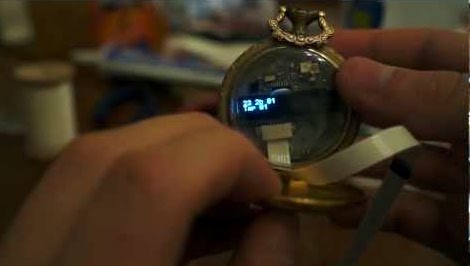
A friend of [CNLohr’s] used the mechanism from an old pocket watch in an art piece, but left him with the enclosure. It’s an interesting looking object that feels great in your hand so he decided to fill it with his own electronics, thereby giving it a new life. He’s showing off an early version of the hardware in the video, but plans to send off another version of the board soon to add a few features.

You can see that the round PCB is small enough to fit in the space vacated by the original hardware. The ribbon cable is used to connect to the programmer and we think it’s also the power source for this demonstration. There’s a small Densitron display that’s reading out hex values from the accelerometer. Many of these mems chip (you can learn how they work from this post) include a hardware tap detector. This meant you can tap your finger on the device and the chip will signal an input to whatever chip is attached to it. That’s a great option for user input, and it’s what [CNLohr] chose as the select button here. He tilts the watch to one side, then taps to turn on the LED. That’s all for now, but we like the promise it shows and can’t wait for updates!

Continue reading “Pocketwatch Retrofit Takes Input From Accelerometer”

The Engineer Guy Explains How MEMS Accelerometer Chips Work

There’s a good chance that you use a MEMS accelerometer every single day. It’s the small chip that let your smart phone automatically adjust its screen orientation. They’re great chips, and since they’re mass-produced you can add them to your projects for a song (if you can abide the tiny packaging). But we have no idea of how they are made and only a inkling of how they work. [Bill Hammack] has filled that knowledge gap with this explanation of how MEMS accelerometers are made and how they function.

Our base knowledge comes from the acronym: Micro Electro-Mechanical Systems. There’s something in the chip that moves (so much for solid state electronics; and it makes us wonder if these wear out). [Bill] includes a diagram in his video after the break which shows the silicon-based system that moves as it is affected by gravity. This changes the capacitive properties of the structure, which can be measured and reported to a microcontroller for further use. The structure is built using an intricate etching process which we never want to try out at home.

Looking for a project in which to use one of these devices? We’ve always been fond of this POV device.

Continue reading “The Engineer Guy Explains How MEMS Accelerometer Chips Work”