

Hackaday Links Column Banner

Hackaday Links: August 9, 2026

Bad news for anyone who was hoping for some relief from the memory shortage — Digitimes is reporting that the production capacity of major players such as Samsung, Micron, and SK Hynix has already been booked for 2027 due to record demand. Their industry sources indicate that what we’re experiencing currently is just a prelude to when things get really ugly, which is why customers are paying a premium to lock in their orders so far out.

Although there’s been no official word from either side of the transaction, the Digitimes article further points out that these sort of agreements are usually 3 to 5 year contracts. If that’s the case, and nothing changes in supply and demand equation, we could be in for a very rough ride. There’s a potential opportunity here for other manufacturers to step in and start producing DRAM, possibly even focusing on lower-performance offerings intended for the consumer market, but setting up those production lines isn’t going to happen overnight. It’s always possible the AI bubble could pop in the next couple of years, but we’re not sure we’d put money on it.

There’s a developing story this weekend about the breach of customer data over at Framework. The maker of modular and repairable computers has recently sent an email out to all customers that their names, email addresses, phone numbers, and physical addresses were leaked due to an upstream zero-day attack against database provider Metabase.

Metabase disclosed the breach on August 3rd, but we were mildly surprised to see that Framework doesn’t seem to have made any public acknowledgement of the event so far. As far as we can tell, the only reason there are copies of the email from them circulating online is because several customers posted it to social media. In their statements to sources such as TechCrunch, Framework reps were also hesitant to give hard details such as how many customers were impacted. While we’re fans of what Framework is trying to do in terms of hardware customization and repairability, we have to admit that being cagey about this sort of thing isn’t a good look.
Continue reading “Hackaday Links: August 9, 2026”

The Simplest Social Engineering Hack Of Them All

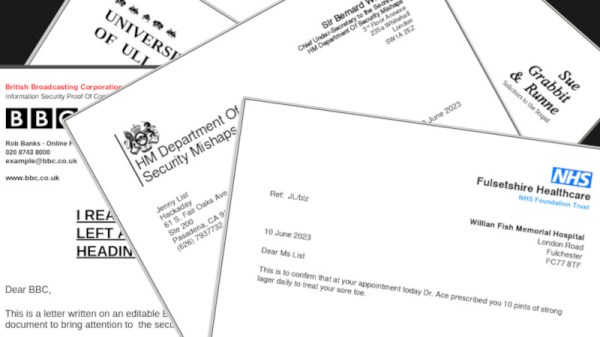
Here at Hackaday we cover news and interesting features for the hacker community, with an emphasis more on the hardware side. Nevertheless we also cover stories from time to time from the broader world of security. These usually involve vulnerabilities discovered through the patient work of software or hardware researchers, and are certainly what we’d call hacking. But what about those information security breaches that aren’t hacks like that at all? What happens when the person being breached simply gives you the information?

I’ve got one, and while it’s Not A Hack, it’s definitely something that we and those outside our community need to talk about. I’m talking about the depressingly common occurrence of organisations who should know better, gifting their letterhead to all and sundry in the form of freely editable Word documents. Continue reading “The Simplest Social Engineering Hack Of Them All”

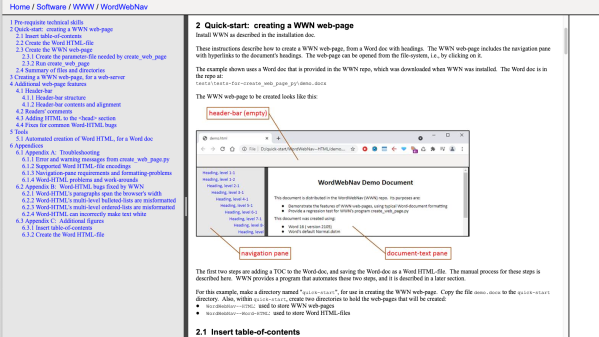
Screen capture of the WWN project, from the project's website, showing the instructions for WWN which are themselves presented as a WWN site.

Making Web Pages With Word?

If you’ve ever examined the messy HTML that results from doing a Save As HTML from Microsoft Word, you can appreciate [Jim Yuill]’s motivation for his WordWebNav (WWN) project. [Jim] uses Word to document his technical projects, and wanted an easy way to generate web pages. Not only is Word-generated HTML nearly unreadable, [Jim] notes there are known bugs, as well. His project attempts to solve these shortcomings, and adds new features like a navigation pane and headers, among others. Here is a link to a dummy project which shows off these features.

There are, of course, other ways of generating web pages from your technical documentation — there is the Markdown / Pandoc combination, various Wiki solutions, or GitHub Pages, for example. If you’re Python-focused, there’s always the Jupyter Notebooks / JupyterLab approach which we wrote about in 2019. But these presume the source documents are in a certain format. If you have years of existing documentation in Word, or you prefer (or are required) to use Word, [Jim]’s WWN tool might be of interest.

The open source, Python-based program can be found in the project’s GitHub repository. [Jim] has a lot of experience writing software, and the clean and well-organized source code reflects this. Do you convert project documentation to HTML for browsing, be it local or online? If so, share your techniques in the comments below.









