DIY Optical Sensor Breakout Board Makes DIY Optical Mouse

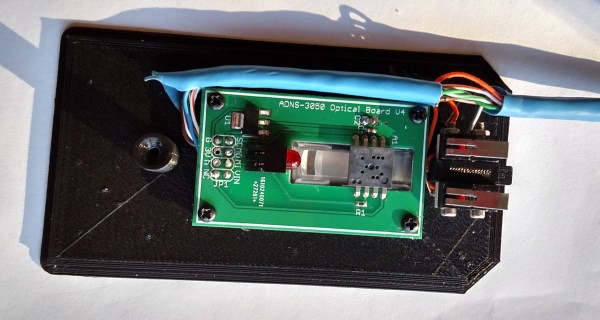
Wanting to experiment with using optical mouse sensors but a bit frustrated with the lack of options, [Tom Wiggins] rolled his own breakout board for the ADNS 3050 optical mouse sensor and in the process of developing it used it to make his own 3D-printed optical mouse. Optical mouse sensors are essentially self-contained cameras that track movement and make it available to a host. To work properly, the sensor needs a lens assembly and appropriate illumination, both of which mate to a specialized bracket along with the sensor. [Tom] found a replacement for the original ADNS LED but still couldn’t find the sensor bracket anywhere, so he designed his own.

Continue reading “DIY Optical Sensor Breakout Board Makes DIY Optical Mouse”
Turntable Turns Waveform Generator

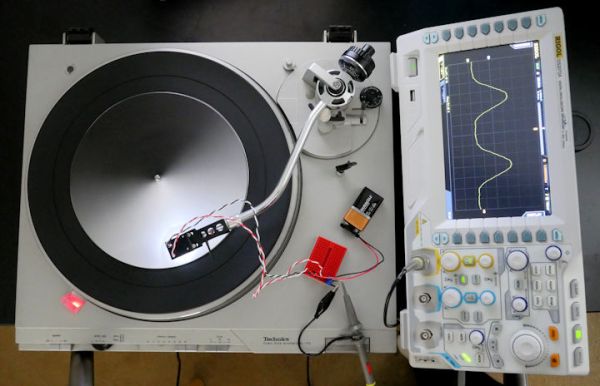
In need of a waveform generator for another project, [David Cook] crammed out the old turntable to modify it for a handy hack: By adding a simple reflectance sensor to the pickup he turned it into a waveform generator that optically plays back arbitrary waveforms from printed paper discs.

Continue reading “Turntable Turns Waveform Generator”

One lightbulb ON one OFF

Single Molecule Detects Light

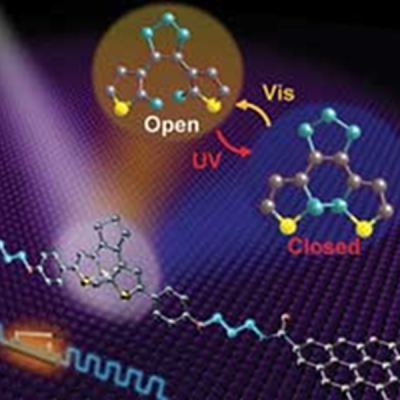
Everything is getting smaller all the time. Computers used to take rooms, then desks, and now they fit in your pocket or on your wrist. Researchers that investigate light sensors have known that individual diarylethene molecules can exist in two states: one where it conducts electricity and one where it doesn’t. A visible photon causes the molecule to be electrically open and ultraviolet causes it to close. But there’s a problem.

light600Placing electrodes on the molecule interferes with the process. Depending on the kind of electrode, the switch will get stuck in the on or off position. Researchers at Peking University in Beijing determined that placing some buffering material between the molecule and the electrodes would reduce the interference enough to maintain correct operation. What’s more the switches remain operable for a year, which is unusually long for this kind of construct.

Using chemical vapor deposition and electron beam lithography, the team produced over 40 working single molecule switches. These devices could be useful in optical computing and other applications. Future work will include developing multilevel switches comprised of multiple molecules.

If you want something more macroscopic, you might try using an LED to sense light. A switch is fine, but sometimes you want to generate a signal.