Silica Gel Makes For Better 3D Prints

It’s possible to improve your 3D prints in all kinds of ways. You can tune your printer’s motion, buy better filament, or tinker endlessly with any number of slicer settings. Or, as [Dirt-E-Bikes] explains, you could grab yourself some silica gel.

If you’re unfamiliar with silica gel, it’s that stuff that comes in the “DO NOT EAT” packet when you buy a new pair of shoes. It’s key feature is that it’s hygroscopic—which means it likes to suck up moisture from the atmosphere. When it comes to 3D printing, this is a highly useful property—specifically because it can help keep filament dry. Over time, plastic filament tends to pick up some moisture on its own from the atmosphere, and this tends to interfere with print quality. This can be avoided by storing filament in a sealed or semi-seaeled environment with silica gel. The gel will tend to suck up most of the moisture from the air in the sealed container, helping to keep the filament drier.

[Dirt-E-Bikes] does a great job of explaining how best to integrate silica gel with your filament spools and automatic material changer (if you have one). He also explains the value of color changing silica gel which indicates when the material is saturated with water, as well as how to dry it out for reuse. You can even combine some of the color changing beads with the more common plain white beads recycled from your shoe boxes, since you only need a few colored beads to get an idea of the water content.

We’ve explored other filament drying solutions before, too. Video after the break.

Continue reading “Silica Gel Makes For Better 3D Prints”

Figuring Out The Most Efficient Way To Reuse Bags Of Desiccant

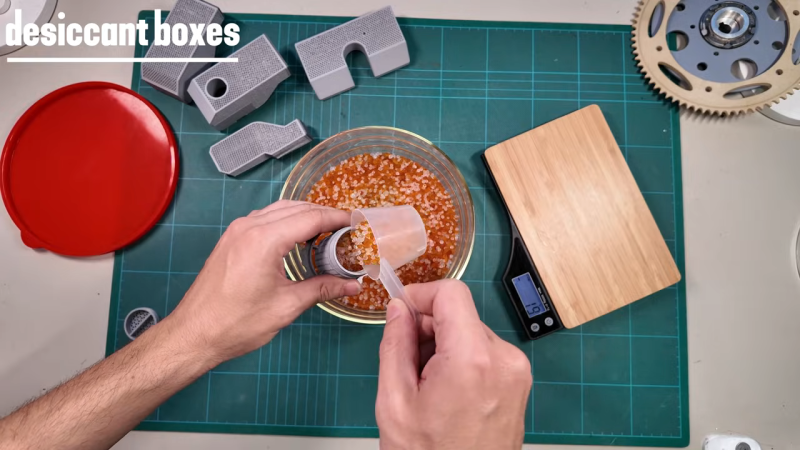
Everyone knows those small bags of forbidden “Do not eat” candy that come with fresh rolls of FDM filament as well as a wide range of other products. Containing usually silica gel but sometimes also bentonite clay, these desiccant bags are often either thrown away or tossed into bags of FDM filament with a ‘adding one can’t hurt’ attitude. As [Stefan] over at CNC Kitchen recently figured out, adding an already saturated bag of desiccant into e.g. an airtight container with a freshly dried spool of filament can actually make the humidity in the container spike as the desiccant will start releasing moisture. So it’s best to dry those little bags if you intend to reuse them, but what is the best way?

Among the ‘safe’ contenders are an oven, a filament dryer and the ‘filament drying’ option of [Stefan]’s Bambu Lab FDM printer. These managed to remove most of the moisture from the desiccant in a few hours. The more exciting option is that of a microwave, which does the same in a matter of minutes, requiring one or more ~5 minute sessions at low power, which effectively also used less power than the other options. Among the disadvantages are potentially melting bags, silica beads cracking, the bentonite clay desiccant heating up rather dangerously and the indicator dye in silica beads may be damaged by the rapid heating.

After all of this testing, it would seem that there are many good options to reuse those desiccant bags with a bit of care, although for those who happen to have a vacuum chamber nearby, that might be an even faster option.

Continue reading “Figuring Out The Most Efficient Way To Reuse Bags Of Desiccant”

Desiccants, Tested Side By Side

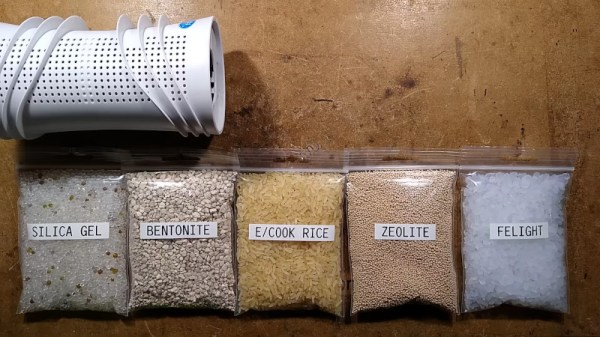
We’re so used to seeing a little sachet of desiccant drop out of a package when we open it, that we seldom consider these essential substances. But anyone who spends a while around 3D printing soon finds the need for drying their filament, and knowing a bit about the subject becomes of interest. It’s refreshing then to see [Big Clive] do a side-by-side test of a range of commonly available desiccants. Of silica gel, bentonite, easy-cook rice, zeolite, or felight, which is the best? He subjects them to exactly the same conditions over a couple of months, and weighs them to measure their efficiency in absorbing water.

The results are hardly surprising, in that silica gel wins by a country mile. Perhaps the interesting part comes in exploding the rice myth; while the rice does have some desiccant properties, it’s in fact not the best of the bunch despite being the folk remedy for an immersed mobile phone.

Meanwhile, this isn’t the first time we’ve looked at desiccants, in the past we’ve featured activated alumina.

Continue reading “Desiccants, Tested Side By Side”