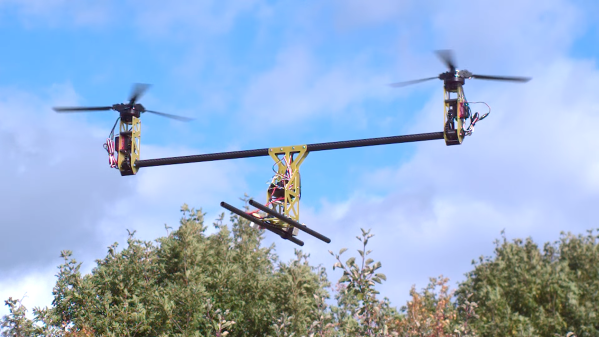
A helicopter blade uses a swash plate and a set of linkages to change the angle of the blades. Not only does it vary the collective pitch to increase or decrease thrust, but it varies each blade’s pitch throughout each rotation, letting it produce more lift on one side of the rotor. This presented a problem to [worked in theory] — he’s building an RC helicopter from scratch, and this mechanism added both complexity and weight. Instead, he started looking for a way to get around the problem.
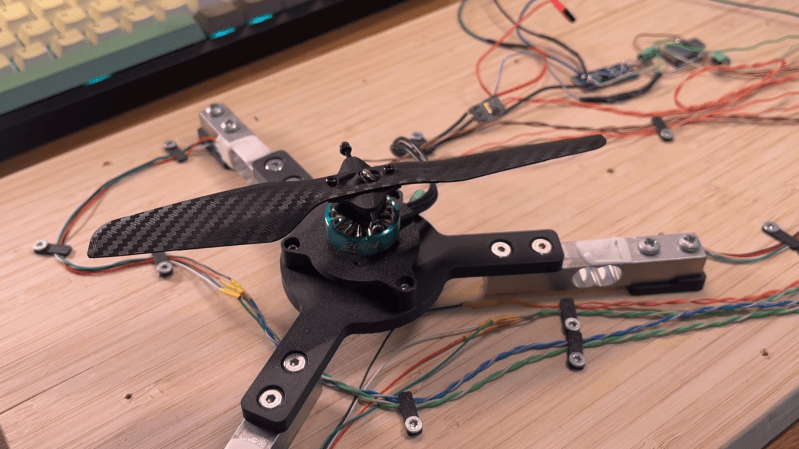
There were two options to eliminate the linkages: a linkage-less swashplate design used in Black Hornet drones, and an under-actuated design using angled hinges to control the blade angle. [worked in theory] started with the Black Hornet design, which has the end of each blade run along the swashplate on wheels, while a central spring presses them down. Friction in the hinge and wheels proved too high, and it stopped responding at higher speeds. A second, lower-friction design seemed promising, but it still required actuators, and thus weight, to control the swashplate. [worked in theory] therefore moved on to the under-actuated approach. In this design, the blades are mounted on angled hinges — by varying the motor’s speed throughout each rotation, inertia causes the blades to swing backwards or forwards, changing their pitch.
[worked in theory] tested two such rotor designs: one with one hinge per rotor, and one with one hinge for both rotors. The design using a single hinge seemed less sensitive to friction, was more responsive in testing, and had a more linear control response, so he used that. To actually make the blades, [worked in theory] 3D printed them as flat blanks, then thermoformed them using printed molds. During testing, the blades needed weights added to pull them back toward the standard angle under constant rotation; fortunately, though, this had the side effect of damping out unwanted vibrations.
There’s still a long way to go before the helicopter’s finished, but this is quite an impressive start. This is the second under-actuated propeller we’ve seen recently, both inspired by [Tom Stanton]’s original design.
Continue reading “Building A Swashplate-less Helicoper Rotor”