
Writing An Optimizing Tensor Compiler From Scratch

Not everyone will write their own optimizing compiler from scratch, but those who do sometimes roll into it during the course of ever-growing project scope creep. People like [Michael Moroz], who wrote up a long and detailed article on the why and how. Specifically, a ‘small library’ involving a few matrix operations for a Unity-based project turned into a static optimizing tensor compiler, called TensorFrost, with a Python front-end and a shader-like syntax, all of which is available on GitHub.

The Python-based front-end implements low-level NumPy-like operations, with development still ongoing. As for why Yet Another Tensor Library had be developed, the reasons were that most of existing libraries are heavily focused on machine learning tasks and scale poorly otherwise, dynamic control flow is hard to implement, and the requirement of writing custom kernels in e.g. CUDA.

Above all [Michael] wanted to use a high-level language instead of pure shader code, and have something that can output graphical data in real-time. Taking the gamble, and leaning on LLVM for some parts, there is now a functional implementation, albeit with still a lot of work ahead.

No Tension For Tensors?

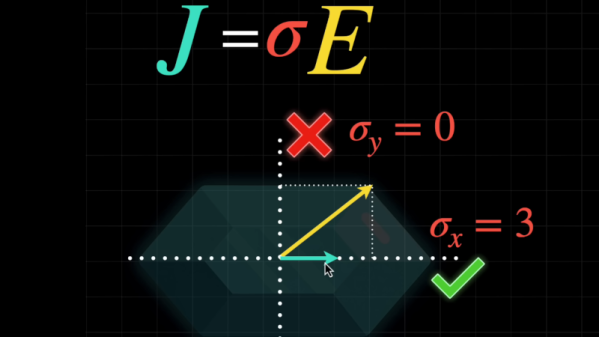
We always enjoy [FloatHeadPhysics] explaining any math or physics topic. We don’t know if he’s acting or not, but he seems genuinely excited about every topic he covers, and it is infectious. He also has entertaining imaginary conversations with people like Feynman and Einstein. His recent video on tensors begins by showing the vector form of Ohm’s law, making it even more interesting. Check out the video below.

If you ever thought you could use fewer numbers for many tensor calculations, [FloatHeadPhysics] had the same idea. Luckily, imaginary Feynman explains why this isn’t right, and the answer shows the basic nature of why people use tensors.

Continue reading “No Tension For Tensors?”

How Smart Are AI Chips, Really?

The best part about the term “Artificial Intelligence” is that nobody can really tell you what it exactly means. The main reason for this stems from the term “intelligence”, with definitions ranging from the ability to practice logical reasoning to the ability to perform cognitive tasks or dream up symphonies. When it comes to human intelligence, properties such as self-awareness, complex cognitive feats, and the ability to plan and motivate oneself are generally considered to be defining features. But frankly, what is and isn’t “intelligence” is open to debate.

What isn’t open to debate is that AI is a marketing goldmine. The vagueness has allowed for marketing departments around the world to go all AI-happy, declaring that their product is AI-enabled and insisting that their speech assistant responds ‘intelligently’ to one’s queries. One might begin to believe that we’re on the cusp of a fantastic future inhabited by androids and strong AIs attending to our every whim.

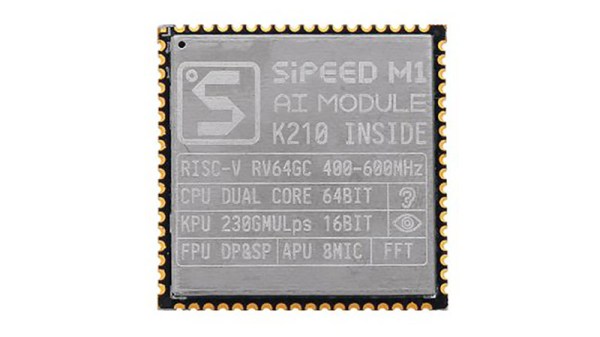
In this article we’ll be looking at the reality behind these claims and ponder humanity’s progress towards becoming a Type I civilization. But this is Hackaday, so we’re also going to dig into the guts of some AI chips, including the Kendryte K210 and see how the hardware of today fits into our Glorious Future. Continue reading “How Smart Are AI Chips, Really?”








