
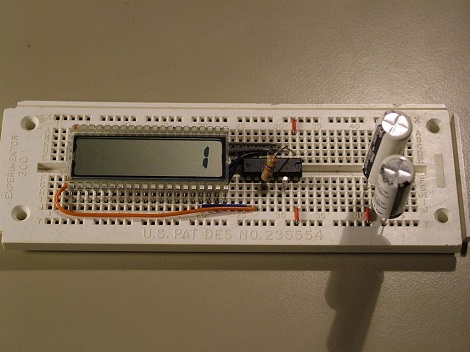
We’ve all known the MSP430s under the Launchpad are designed to be low power, but who wants to bet how long the chip can last on only 20F worth of capacitors? A couple of hours? A day at max? [Kenneth Finnegan] setup a MSP430 with supercaps to find out. To make sure the chip is actually running, [Kenneth] programmed it to count from 0 to 9 over a period of 10 seconds, and then reset. To get it ultra low power, the chip is in sleep mode most of the time, and a raw low current LCD is used to display the output. While [Kenneth] simply checks the chip every few hours to see if it’s still counting, a setup much like the Flash Destroyer, tracking a clock and then storing the current value would get a more exact time of death. Either way, it’s been over 3 weeks…and still counting. Video after the rift.
[youtube http://www.youtube.com/watch?v=xbjpQmjwMyU&feature=player_embedded%5D









I think we will see more of these circuits soon – runs for weeks, and can be “reloaded” in seconds.
I guess measuring the current usage vs power capacity of capacitors was too easy so he decided to do it the hard way.
20 Farads?
That’s a crapload of capacitance. At work they used 5F supercaps instead of coin cells for backup power. No wonder this thing is still going.
looking for 3000F so it can run 12 years ?
here it is
http://www.maxwell.com/ultracapacitors/products/large-cell/bcap0650.asp
No it won’t all capacitors have a leakage current
1 Farad is 1 amp-second. That isn’t a whole lot of power really the average AA battery is around 1000 mAh. 3,600,000 times more than a 1 Farad capacitor.
Rail guns often use ni-cads and various other battery chemistry variants in place of capacitors.
When you need a bunch of current right NOW, big caps just don’t have the right discharge curves.
Nothing compares with flash-over in a big steel cage after something goes wrong – KaPOW!
Your math is wrong. If one farad is one amp-second, a 1000mah battery is 60*60=3600 times that capacity (at the same voltage).
Hah, “Only 20F…”
That’s a lot of capacitance there buddy!
50 years ago, my high school science teacher was told that a 1F capacitor would have to be the size of a football field!
Of course, that’s surface area, which you can clearly still cram into something small. But its a funny quote considering how common these super and ultracapacitors have become!
Still, 20F is a lot by pretty much anyone’s standards.
-Taylor
Maybe I should rig some coin caps to my 01 ibza, batteries are so expensive
farads aren’t amp-seconds, that’s coulombs. Farads are coulombs per volt. Q = It and C = Q/V. super caps have a very high capacitance but a low maximum voltage, so they don’t store ex much energy as it would initially appear, especially since energy stores is proportional to the square of the voltage across the cap
I wonder if he is using the power down mode and a wake up timer, or if he is just using a delay routine.
@Ken
It says so right up there:
“To get it ultra low power, the chip is in sleep mode most of the time…”
specifically, 20F at 2.7V will store 20 x 2.7^2 = 145.8 coulombs. a 1000 mAh battery will store 1000 x10^-3 x 3600 = 3600 coulombs, or 25 times as much.
@cgmark: I lack any kind of measuring device to measure current accurately down to fractions of microamps, and there are more variables than that: the current consumption is very spiky (the controller runs in 32Hz bursts, so what are you actually measuring on an amp meter?), and theres the self-discharge of the caps, and how low the controller can *really* run below the rated 1.8V, etc etc.
So I decided that just running it would give a more meaningful result than a single current measurement.
Others have already made the point that supercaps are ridiculously huge capacitors, but still orders of magnitude smaller than chemical batteries…
20F is a whole lot. Pretty much anything MOS should run forever on that.
Also add to the comments that Microchips product line boasts the lowest sleep current industry wide. Well that was the case when I last researched it. (about a month ago)
maybe its just me , but lately the quantity of posts is high, but its stuff like jamming a hub in a mouse.
Personally I wouldnt call that a hack . But the idea had potential no less to become a hack .
To be a hack I would say you need to add functionality to a device , not add more devices.
This is one of my favorite sites to page threw, Just some constructive criticism.
How long does it take for the super-cap to self discharge?
the problem with just running it without measuring current and voltage during the process is all that it tells you is what that exact code and circuit will do. It doesn’t tell you how that will apply to other circuits powered by the same capacitors. Unless you know what it is consuming at the various times there is nothing to use for comparison.
For measuring something that powers on and off you take a period of time for the measurement and multiply it. Measure what it uses for 1,5,10 seconds and use that to figure out the usage for longer periods.
If you don’t have meters that can measure down to microamps then you can use an opamp to make a current to voltage converter. They can measure into the picoamps range before it gets difficult. Just an opamp and a few resistors.
@RCX
They do store a lot of energy when it comes to caps; a 5v 10F cap stores 125joules.
I thought this was pretty cool and can be turned into something useful quite easily. There sure are a lot of grumpy people reading this website. If you don’t like it then don’t comment.
driving e-ink its about 4 years in smd at 160mha
sorry mah not mha
@johannesburgel
“…and can be “reloaded” in seconds.”
actually (fully) charging these caps would take a really really long time…
He should have compared different microcontrollers. That would have been fun!
i put rechargeable AAs in a wireless mouse to replace the dead disposables in it. Can i has artical?
These guys have pretty big caps.
http://www.goldmine-elec.com/
@Jaspel
E-ink / e-paper was my first thought too. Funny that my copy of esquire died already, thats the problem with professionals “this is how it’s done”
@ knox
At 10.9kJ those are indeed big capacitors!
Also, all you people are forgetting super caps are very leaky; typically around 5mA. You need to factor that in your time estimates.
Still think its comical so much testing and todoo over this when its not even the best out there. I would be curious to see one of our math wizards do a comparison between the TI chips here and a Microchip XLP. Obviously Im referring to doing the math for both not waiting 3 weeks for the answers.
I suppose the point of this is to benchmark the incredibly well priced launchpad. But still if people are awed by the results it is worth noting that low power is one of Microchips (many) strong points.
So any math wizards wanna break it down?
ok so it wont let me post the link directly to microchips comparison chart comparing PIC24 and MSP430.
Goto microchip dot com , under applications and markets click on XLP .
I dont think there really is much comparison. But by all means check the graph out your self ;)
I’d love to see the same thing done with an ATMega328 and compare!
Q = C * V
Q = I * T
Where
C = 20F
V = 5V
Q = 100C
With discharge current say 1uA:
T = 100C / 1uA = 100,000,000 seconds
T(seconds) / 60 / 60 / 24 / 7 = 165 weeks to discharge to 68% of max capacity.
At current draw 100uA the value is 11 weeks.
Actually, I think that specsmanship on power consumption of thing has gotten so complex that running the exact target application on real hardware, for a capacitor charged to a known point, is about the only way to really tell how things are going to work out. C values of far less than 20F are likely to be more useful, though!
The microchip graph claiming to compare “instruction set efficiency” by counting the percentage of instructions that execute “in a single cycle” was particularly laughable. Especially since it included PIC16 and PIC18 families that don’t actually have ANY “single cycle” instructions (unless you’re willing to allow that a cycle is 4 clocks…) I like PICs, but the MSP430 instruction set blows the 8bit PICs out of the water…
TI have just announced a new MSP430 which will run all the way down to 0.9V. I bet that would have more of an effect on the result here than sleep mode current.
At 0.9V VCC, you are going to be badly effected by EMI. I think if someone sneezes close to your product it will fall over.
If a Vref could be found it would have been fun to use the ADC to show the current supply voltage.
@smoker_dave
Thanks for making my Pepsi squirt through my nose. lol
Also, IIRC, there’s a way to modify the clock cycle to reduce the effect of EMI. Forgot where I saw it though.
This is pretty amazing, but a rock doesn’t use much power either. I would think a real test would be to actually have it doing something a little more complex than incrementing a register, like running a multifaceted benchmark program, and monitor a heartbeat pulse. Then you start getting an idea of instructions per watt. Use something like the old “self-winding watch” mechanisms to generate current, and you’ve a great portable device.
Rallen, I would not trust this kind of technology with a critical function like heartbeat monitoring. However for something like a home automation sensor / actuator which simply turns an IO pin on or off once every so often I feel this is a good simulation.
@smoker_dave – I didn’t mean “use it to monitor human heart activity”. :) I meant, “have the device send out a regular pulse that resets a watchdog timer, as a function of its normal operation”. That’s a heartbeat pulse. Informal slang. It can be fun. Try it, sometime. Confuse the hell out of your co-workers. :)
Microchip blows the rest of the industry away as far as low-power micros are concerned. They are the best.
That and a clock divided by 4 lol.
And a lot os spit glue logic all over the pic.
I do a lot of MSP430 work at uni, and the correct way to measure current in a setup like this is to take the integral of the current. In his case it should be an easy step function, so effectively:
(i_sleep * %_sleeping) + (current_wake * %_awake) = i_total. Unfortunately the current draw is a function of Vcc in CMOS tech, so it varies a bit with the current level of the caps and stuff, but it should be close enough for a first order approximation. The MSP430s are fairly power efficient if you use the low power modes as Ken did, and with 20F backing it, I wouldn’t be surprised it runs for a very very long time.
Hell, I bet the caps are self-discharging more current than the MSP430+LCD is drawing.
PIC are not the lowest on power consumption…
deep sleep mode is useless, it wont save ram, registers etc. pic can be woken up just by external interrupt – in fact it is reset and start from scratch. In TI’s micros you can go down in sleep mode but you can woke it up by software side (counter), the same (by functionality) mode in PIC’s is taking more power. The Microchip youtube demo video is a scam, it shows conditions newer existing in real life!!.
Ωsmoker_dave: Don’t see why the rail voltage should have any bearing on susceptibility to interference. Care to clarify that?
Alright, first I’m no math wizard really…
(couldn’t get through calculus…)
I just looked at datasheets.
I don’t know the MSP430, but his datasheet say
With internal oscillator @1Mhz = from .2ma – .3ma
(change with / voltage) so let’s guess .25ma
Yeah, there the lcd module that would be easy
To measure since consumption is steady.
Let’s say it take 100 clock to get a task done
(assuming a more complexe task is done)
= ~100us @ 1Mhz, which give 100us/1s = 0.01% duty cycle
= 0.01 * .25mA = 2,5uA average
or ((2.7+1.8)/2)V * 2,5uA= 5.6uWatts
Capacitor leakage :
We dont what it is, it seem to change wildly from
One 10F from another :
Nichicon = .5 * C at 2.7volt = .5 * 10 = 5mA…
They say it’s after half an hour.
Maxwell = 0,03ma after 72 hours
So duuhh it must be reduced when voltage drop…
Here you also have to take into account ESR
(Equivalent Serial Resistor) so it’s like a resistor .
Nichicon = .3 ohm
Maxwell = .075 ohm
We take that in account in the capacitor
Discharge formula ( as R)
Q = C* V * (1-e^(-t/(RC) ) )
Where Q= is the charge Amp/s?
C = 10F
V = 2.7 at start, 0 or with our mcu 1.7V
e = natural number = ~ 2.71828…
t = time in second
R= in this case, ESR + mcu load (V=RI)
Then you need to consider the leakage of both cap.
So it’s not impossible, it took like 10min to get these info,
Take 20 more and you might have some approximation
I did my part.
@Torque i am working on a way to reuse these panels for active camouflage.. only problem is the number required.
also another useful trick i came up with is reducing the external clock below 32 kHz, it seems that all that is required is a simple “equivalent crystal” composed of resistors inductors and capacitors with a resonant frequency in the low audio range (say 1kHz) as the current draw scales linearly with reducing frequency.
right now ti is more efficient than micro but epson’s soon to be released chip will have some serious benefits such as rfid, io, and charge consumption.