
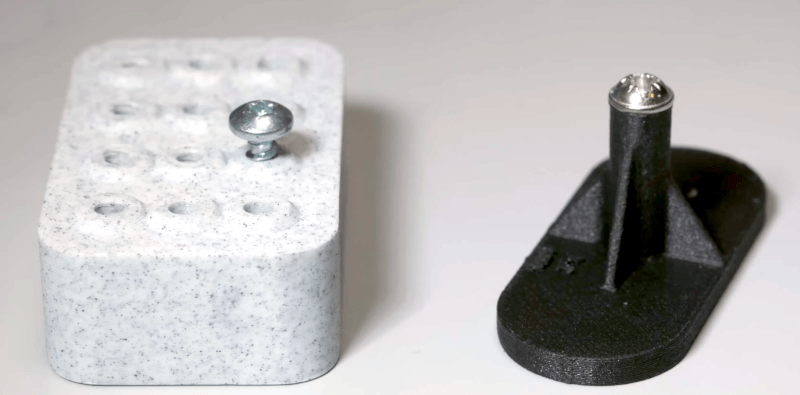
Machine screws aren’t made for wood or sheet metal, they make specific screws for those applications. You probably also know there are special screws for plastic. But did you know there are at least two distinct types? In a recent video, [Lost in Tech] show us different types of plastic screws, including thermal camera shots of screws driving into 3D printed parts, along with tests using a torque driver.
We have often used “any old” screw in printed parts, which usually works OK. We’ve also used threaded inserts or captive nuts, classic choices. One of the issues with screws or inserts is that you have to get accurately sized holes in your 3D prints.
In addition to learning about the types of screws and how best to accommodate them, he also developed a free web-based tool that does all the math for you.
Of course, there are cases when you do need a threaded insert. In particular, the plastic screws will tend to wear the plastic each time you insert them. If you expect the screw to go in and out many times, this might not be the right technique for you. On the other hand, if you think you might remove and replace the screws a few dozen times over the life of the part, this might be attractive.
We’ve covered self-tapping screws in plastic before, but, as the video shows, not all of them are created equal. And, of course, there are always heat-set inserts.











Dyson vacuum cleaners are held together like this. Screw directly into plastic. If it’s good enough for $800 crappy cleaner, then it’s good enough for my 3d prints.
lol
Well of course you can screw screws into plastic. If you have a cable tv terminal on your house go pop it open, did it for years at the cable company. You just need proper size thickness on your standoffs, proper size hole, and the proper thread for what you are trying to do. Now, if I’m doing a project, if it’s holding a case together I’m going to use brass heat installed inserts and machine screws, but if it’s just holding a board in a project casing I would do it like this. I also worked in manufacturing, making plastic housings, assembling plastic housings, the biggest thing if you are running any kind of manufacturing, your biggest thing is going to be using “torx” or other torque-controlled fastener head, and having a proper and calibrated torque-controlled driver to do it
This is excellent information and very helpful. Will be trying these out for sure. Thanks to Al and Lost in Tech.
Ditto on the consumer vacuum cleaners. Oric and just about every plastic toy I have taken apart in my lifetime also uses them and they hold up nicely over many years. I would like to add that when you take them out, be sure to run the in reverse by hand to get the screw to find the old threads before screwing it back in. It keeps the threads from being remade which makes it last a lot longer. Saw that on here or YouTube at some point in the past.
@ Chris
I came here to sy the same as the second part of your statement. Always run the screw in reverse until you fell the click and then drive it home in the old thread cuts. I learned this after stripping the cover of a Fluke DMM. Also if it’s good enough for Fluke it’s good enough for me.
Agreeing to amplify: this practice preserves screw function in plastic.
Yeah but then there’s the double-start plastic specific screws, the ones with one-big-one-little thread, that are near impossible to find the right starting point with the turn it backwards trick. I hate those.
And speaking of fasteners, something I have been pondering lately: Why isn’t EVERY Philips bit a Pozidriv instead? They fit even regular Philips screws better than a standard bit ever will. And yet, PZ bits are rare as hen’s teeth in tool/bit sets and expensive as hell when you have to buy them separate.
(Similarly, every socket head hex fastener really should have been a Torx. I can’t recall ever rounding out a Torx (the bits will break first)).
I can answer that one for you. It’s all about copywrite and licencing. Pozidrive is a patented and licenced specification, while Philips is public domain. Every time a company sells a “pozidrive” screwdriver or screw, they have to send a cheque to Mr Pozidrive. Pozidrive IS the better spec, but Phillips is free. Same as the old Betamax vs VHS, HDMI Vs Display-Port, etc….
Also in flat screen TV screens, TV remotes, power strips etc
When my Panasonic TV died two year ago because of wrong design decision in using eMMC it gave 50-60 M3 screws….
BTW: I hope everyone that use plastic screws knows that you have to turn it one turn counter clockwise before you screw it in, so the screw fall in the old path and did not cut a new one.
Many, many things are done this way. My $300 air filter, the toolboxes in my truck, hell half my truck interior is done like this. If you get the right screws and the right fit, it’s legitimately strong. I’ve been doing this for prints for a while now.
I do like seeing someone doing the actual science so this doesn’t have to be a guessing game (like I’ve mostly done).
Isn’t this what sheet metal self tapping screws are all about? No taper shallow thread hopefully smooth machining not some of the dreadful rough stuff I see nowadays. That roughness will sand the threads looser than without, especially in plastic. Repeat and it loosens in a hurry.
There is not any significant difference between the “thread cutting” or “thread rolling” variant for repeated use. The only important factor is that you turn the screw a bit backwards until the “clunk” and then follow the already existing thead.