More Kinect Holograms From [programming4fun]

[programing4fun] has been playing around with his Kinect-based 3D display and building a holographic WALL-E controllable with a Windows phone. It’s a ‘kid safe’ version of his Terminator personal assistant that has voice control and support for 3d anaglyph and shutter glasses.

When we saw [programming4fun]’s Kinect hologram setup last summer we were blown away. By tracking a user’s head with a Kinect, [programming] was able to display a 3D image using only a projector. This build was adapted into a 3D multitouch table and real life portals, so we’re glad to see [programming4fun] refining his code and coming up with some really neat builds.

In addition to robotic avatars catering to your every wish, [programming4fun] also put together a rudimentary helicopter flight simulator controlled by tilting cell phone. It’s the same DirectX 9 heli from [programming]’s original build. with the addition of Desert Strike-esque top-down graphics. This might be the future of gaming here, so we’ll keep our eyes out for similar head-tracking 3D builds.

As always, videos after the break.

Continue reading “More Kinect Holograms From [programming4fun]”
3D Printing With Nylon For A More Useful Objects

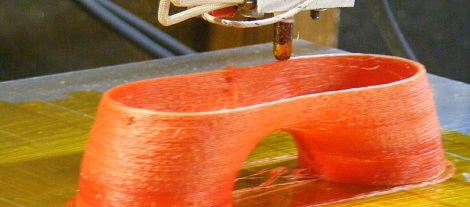
[taulman] over on Instructables has been working on his own version of a 3D printer. Unlike the usual PLA or ABS filament all the RepRaps and Makerbots use, this printer uses nylon to make parts with very interesting properties.

Most extrusion printers are designed to print with ABS (a very hard plastic that melts around 220-230° C) or PLA (a somewhat softer plastic that melts at about 180° C). [taulman] is using Nylon 6, a very slippery and bendable plastic that melts around 320° C (about 600 degrees Fahrenheit). He’s doing this with a hot end of his own design and a ‘spiky’ extruder bolt that allows high-temperature thermoplastics to be extruded into any shape imaginable.

For the longest time, the 3D printer community has been using low-temperature thermoplastics such as PLA and ABS. There are obvious benefits to these materials: it’s pretty easy to source a spool of filament, and the low melting point of these plastics makes building a printer easier and safer. Now that [taulman] has the high-temperature plastic nut cracked, he’s moving on to easily-machiniable Delrin and transparent Polycarbonate. Very cool, and hopefully in a year’s time we’ll have a choice of what material to run in our printers.

After the break, there are a few videos [taulman] put up showing his printer at work and the properties of his 3D printed objects. It looks like [taulman] can print objects that are impossible on any other 3D printer we’ve seen; the flexible iPhone case probably couldn’t be made on any other DIY machine.

Continue reading “3D Printing With Nylon For A More Useful Objects”

Volt Teardown Shows More Than Just What’s Under The Hood

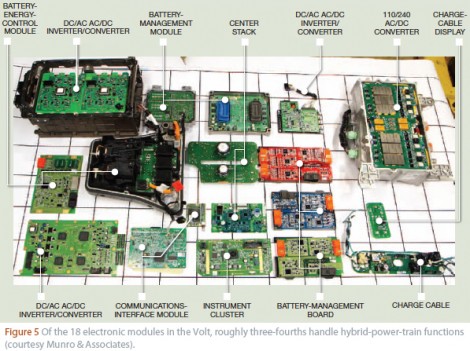
The Chevrolet Volt is one of the top contenders in mass-market electric vehicles. Now you can get a look at the components that make up the electrical system with this Chevy Volt teardown article.

The adventure starts with a look at the 288 cell battery. It forms a T shape and takes up the space that forms the hump down the center of the interior of a vehicle. Theses have a liquid cooling system build into the enclosure to make sure things don’t get too hot during use or charging. The sights are then set on the control and monitoring hardware, and there’s a lot of it. In fact, the image above is an overview of the eighteen modules that pull the new plug-in EV technology together. If you’re brave enough to void the warranty on one of these, this should be a helpful road map to get you started.

Has anyone seen a teardown of the home charging station for one of these?

Man, Stranded In The Desert, Makes A Motorcycle From His Broken Car

The original story is in French, and the Google translate is very rough. Please forgive us if we don’t get this completely accurate.

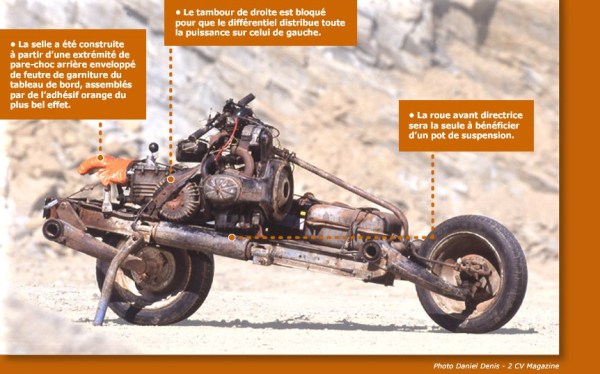
While traveling through the desert somewhere in north west Africa in his Citroen 2CV , [Emile] is stopped, and told not to go any further due to some military conflicts in the area. Not wanting to actually listen to this advice, he decides to loop around, through the desert, to circumvent this roadblock.

After a while of treading off the beaten path, [Emile] manages to snap a swing arm on his vehicle, leaving him stranded. He decided that the best course of action was to disassemble his vehicle and construct a motorcycle from the parts. This feat would be impressive on its own, but remember, he’s still in the desert and un-prepared. If we’re reading this correctly, he managed to drill holes by bending metal and sawing at it, then un-bending it to be flat again.

It takes him twelve days to construct this thing. There are more pictures on the site, you simply have to go look at it. Feel free to translate the labels and post them in the comments.

Update: From [Semicolo] in the comments

You got the translation right, but there’s not just a swing arm that’s broken, there’s a frame beam broken too (not sure about the exact term, one of the 2 girder of the chassis).
He’s not far away but he has a lot of tools and other hardware that could be stolen if he leaves them unattended.

[via Reddit]

Heliowatcher Positions Solar Panels For Highest Efficiency

[Jason Wright] and [Jeremy Blum] are showing off the project they developed for their Designing with Microcontrollers course at Cornell University. They call it the Heliowatcher, and if you know your Greek mythology we’d be you figured out this watches the movement of the sun and adjust a solar panel to follow it.

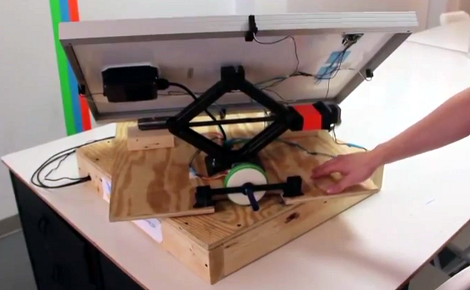
Their design is simple and effective. The base is mounted like a Lazy Susan, able to pivot on the horizontal plane. The bottom edge of the solar panel is mounted with two door hinges, with a motorized screw jack used to raise and lower it. The system uses a GPS to provide geographical position, day, and time feedback. This is used in conjunction with an array of four LEDs to determine the best position of the panel. Those LEDs are acting as light sensors; when the top and the bottom detect similar levels, the panel is at its most efficient orientation. The left and right LED sensors work the same way.

Now if we can just work out a self-cleaning system to keep the panels free of the dirty film that builds up over time we’d be set!

Continue reading “Heliowatcher Positions Solar Panels For Highest Efficiency”

FTA Dish Used To Receive L-band Amateur Radio

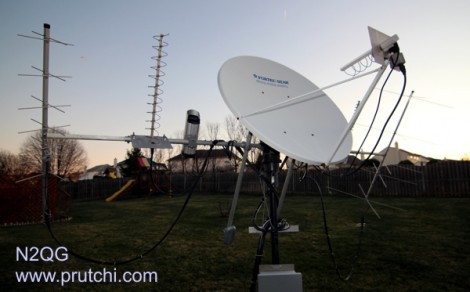
[David Prutchi] has an FTA (free-to-air) satellite dish. This means he can tune and watch freely available satellite television feeds. But this sounds much better than it actually is. There isn’t much that’s broadcasted unecrypted from satellites with the exception of a collection of religious channels. But he still uses the dish by using the FTA satellites to calibrate the alignment, then repositioning it to receive L-Band radio transmissions with his own add-on hardware. In the image above it’s the spiral of wire attached to the dish’s collector.

The satellite transmissions are picked up on the KU-band by an aftermarket horn that [David] purchased for this purpose. To add his own helix receiver he cut a square mounting plate that fits around the horn. This plate serves as a reflector and ground plane, and also hosts the helix connector which picks up the L-band transmissions. He had to be creative with routing the first few inches of the helix but it looks like he manages to get some pretty good performance out of the hardware.

[via Hacked Gadgets]

Hackerspace Intro: STGO Makerspace In Santiago, Chile

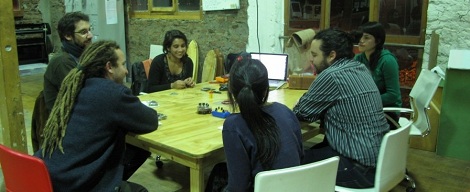
[Roy MacDonald] sent in a few links to all the cool stuff his home base – the StgoMakerSpace (Google translation) in Santiago, Chile – is putting together. They’re a new hackerspace that’s only been open for two months or so, but already they’re put together a great assemblage of tools, hosted a few awesome workshops, and even gotten a good bit of local media exposure.

The StgoMakerSpace found its first bit of fame with a very in-depth article in Qué Pasa, a Chilean magazine (Google Translate). There’s a lot of very, very talented people at StgoMakerSpace that includes [macapola], an industrial designer who spent a year in China learning all about modern, global  manufacturing processes.

StgoMakerSpace has a few workshops coming up, including a Kinect hacking workshop, and Arduino workshop, and a welding workshop. If you’re around Santiago, it’s worth checking out. In addition to very, very smart people and a whole bunch of tools, StgoMakerSpace also has a retro video game museum and FREE BEER brewed in-house.

As a small aside, [Roy] tells us the word ‘hacker’ has a negative connotation in Spanish, and it immediately associated with cybercrime; that’s the reason it’s the Santiago Makerspace. In our experience, the same connotation sometimes applies in English, something that hasn’t stopped all the Hackerspaces around the US.