
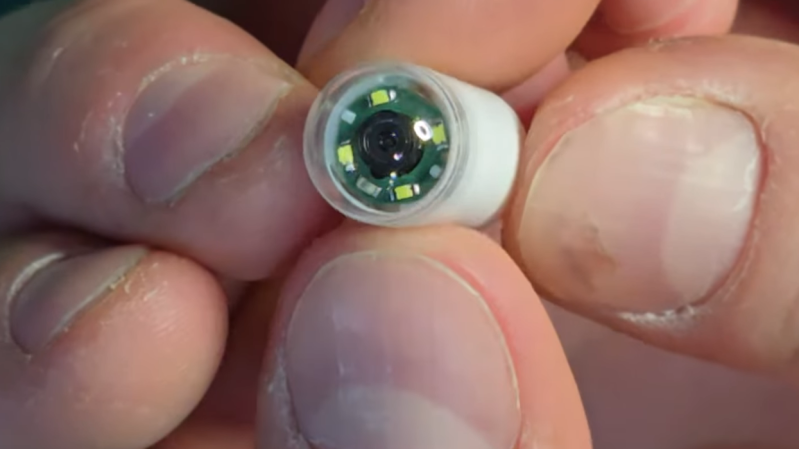
A gastroscopy is a procedure that, in simple terms, involves sticking a long, flexible tube down a patient’s throat to inspect the oesophagus and adjacent structures with a camera fitted to the tip. However, modern technology has developed an alternative, in the form of a camera fitted inside a pill. [Aaron Christophel] recently came across one of these devices, and decided to investigate its functionality.
[Aaron’s] first video involves a simple teardown of the camera. The small plastic pill is a marvel of miniaturization. Through the hemispherical transparent lens, we can see a tiny camera and LEDs to provide light in the depths of the human body. Slicing the camera open reveals the hardware inside, however, like the miniature battery, the microcontroller, and the radio hardware that transmits signals outside the body. Unsurprisingly, it’s difficult to get into, since it’s heavily sealed to ensure the human body doesn’t accidentally digest the electronics inside.
Unwilling to stop there, [Aaron] pushed onward—with his second video focusing on reverse engineering. With a little glitching, he was able to dump the firmware from the TI CC1310 microcontroller. From there, he was able to get to the point where he could pull a shaky video feed transmitted from the camera itself. Artists are already making music videos on Ring doorbells; perhaps this is just the the next step.
Smart pills were once the realm of science fiction, but they’re an increasingly common tool in modern medicine. Video after the break.












30 years ago, disposable camera used film, needed to be developed in chemical bath, and it wasn’t something you can swallow. Today’s disposable camera is flushed down after it’s passed through.
Don’t worry, once the EU gets wind of this, they’ll demand replaceable batteries and a USB-C connector. Then you’ll be able to reuse them! Though that may be a tough pill to swallow!
Have you even read the article, this isn’t about phones?!?!
Regarding phones, being able to replace the battery is a more than reasonable request.
USB-C is a perfectly fine connector for charging your phone, but perhaps you’d prefer the wonky DC-plugs or silly non standard cable contraptions of the late 90’s?
Eh, Dan just seems to be weirdly opposed to the basic user rights the EU push for.
I’m just glad there’s an organisation with some power fighting for the user rather than letting corporations operate like it’s the Wild West.
We do need some regulation, rampant capitalism is a fast fight to the bottom. The world would be filled with John Deere style DRM in the physical world otherwise.
There may be an element of sarcasm in Dan’s rely.
As @E. Rodemmoc pointed out, there were once a plethora of power connectors and DC barrel jack sizes. It is not out-of-line to liken that to a “wild west” of connectors.
Luckily “rampant capitalism” weeded out this insane system and left us with only 2 major types of connector; each of them with their own objective strengths. Only years after this problem had already been solved did the governments of Europe decide to destroy any possibility of further innovation and competition.
You need capitalism to drive innovation, and you need government to intervene as little as possible, and only when basic human rights are indeed being curtailed.
@Jace
It wasn’t capitalism that weeded different connctors in phones that was also EU regulation that forced companies to addopt earlier standard microUSB compatibility. Most of producers obeyed, Apple decided to play dumb games and provided cable apple connector to microUSB and said see you can connect Apple via microUSB its useless addon cable but if you really wand you can. Then EU decided update rules and now closed stupid games Apple plays.
Did you even read his comment? He said nothing about phones.
… and the Internet Explorer was removed from the default web browser.
I would not bet on that… Disposable douche flutes still are sold everywhere, so…
Haha, with an all-weather twist lock USB-C cable, so the camera can be retrieved the long way.
You sure seem to be missing the days when each device had a different charging connector and voltage, so you had to carry around one for each of them.
Anyway, your comment is deeply based on ignorance.
The environmental impact of this device is extremely low in the quantities it will be used. Besides that, hospitals settings, where this device would be used, don’t want reusable devices, they simply don’t have the time to deal with recovering the device, recharging it, and having it sterilized, all this while maintaining traceability of the whole process. It is simply to risky, especially compared to the cost of a new device.
Would you ingest a camera pill that has already gone through multiple people?
It seems most people did not appreciate the joke. I found it amusing.
There must be good reasons to use pillcams, but I’m not sure why.
The article talks about upper-Gi tract inspection – esophagus, stomach, duodenum, intestine – but there’s also the colon.
Pillcam or ‘scope, you still have to do the prep. For an endoscope, it’s no solids on the day, and nil by mouth for 4 hours prior. Same for a colonoscopy but more – no solids for 24 hours prior, plus laxatives, plus the wonderful liquid that ensures you are all clean inside – achieved by reverse osmosis (close enough) in your colon, flushing and flushing it all out so the ‘scope gets a clear view.
You have to do the same prep for a pillcam, it takes hours to transit, and some poor tech has to watch the footage to observe any problems – which might end up needing a ‘scope anyway if they spot a polyp or worse. Whereas a ‘scope takes 20 – 30 minutes and you have a diagnosis pretty much straight away. And they can remove small polyps during the procedure.
Under what situations are pillcams preferred? Allergic to anaesthetics, perhaps?
The GI tract is long. Maybe there are parts that are hard to reach with a wired camera.
Yup. The middle bit.
I imagine the issue of cost is one of those reasons you’re looking for. The number of doctors and nurses required to manage the colonoscopy is pretty costly. The room and tools are all pretty expensive as well. A pill camera, however, is a pretty inexpensive option when compared to the colonoscopy procedure, under anesthesia and such.
My wife had to get a colonoscopy done, and it involved at least 5 people, including at least 2 high level medical professionals. If this only needs a nurse and a technician to be present for the procedure that’s a huge cost saving, and that’s without even considering the risks involved in general anaesthetic and the much more invasive colonoscopy procedure.
Cheaper and less chance of death or permanent disability sounds great.
Latter good for us, the former makes cheap insurance (which more of us will be getting, don’t ask why) very happy. Plus it’s easier to stream to the internet.
Colonoscopy usually requires general anaesthetic and is far more invasive than the pillcam. That always adds risk to a procedure.
If pillcams can halve the number of colonoscopies required, that’s a lot of complications avoided.
It’s not a general anaesthetic, it’s sedation (valium) and twilight medication (fentanyl or a derivative. I’ve had alfentanyl). You wake up about 40 minutes after the sedation is injected. And it doesn’t take hours to recover, although you’re banned from driving for 24 hours to make sure. I was able to walk back to my overnight accommodation within 2 hours of waking up.
I suppose so, it’s just that if the cam sees something wrong or even suspicious, then you’ll need a ‘scope or surgery anyway, so you’ll have to do the prep again. Urgh. it’s not fun and i’d hate to do it twice within a couple of weeks.
There are some suggestions in the replies already, but not the whole picture. We do endoscopies every day, so I’ll gladly explain: with a normal gastroscope, you reach the first part of the small intestine (duodenum) and may push a little further into the jejunum. With a colonoscopy, you can examine the whole colon and reach a little bit into the small intestine (ileum). There’s much more to the small intestine in between. To reach the middle part, there are several devices available, e.g. a technique with two inflatable balloons with which you can work your way through the bowels. This isn’t fun, neither for the patient nor for us. The patient needs to be sedated for significantly longer and the risk for injury is higher. Moreover, the most painless lesions are found in the easier to reach parts, thankfully. So, to rule out some additional problem in the middle part, the pill camera is a fantastic device.
I bet i couldn’t sell these to fetishist at 500% markup
All I want to know is how they remotely aim it. Otherwise all you get is random pictures that probably miss the actual target
It’s steered magnetically from outside the body.
It just flows with the liquid in the bowels, it does not need steering. The view angle is enough to compensate for some pitch and jaw.
You mention swallowing magnets could be dangerous. The issue would be if TWO or more magnets (or a magnet and ferromagnetic object) were swallowed: the magnets could cling to each other across two loops of the intestines, pinching the delicate tissues and causing necrosis.
Magnets are also contradicted if there are nearby ferromagnetic objects, such as an implant, that could pinch the intestines.
As for danger the batteries are marked as HgO which could be dangerous if the plastic capsule is compromised.
It’s Hg0%, not ‘Murcury Oxside’ :)