
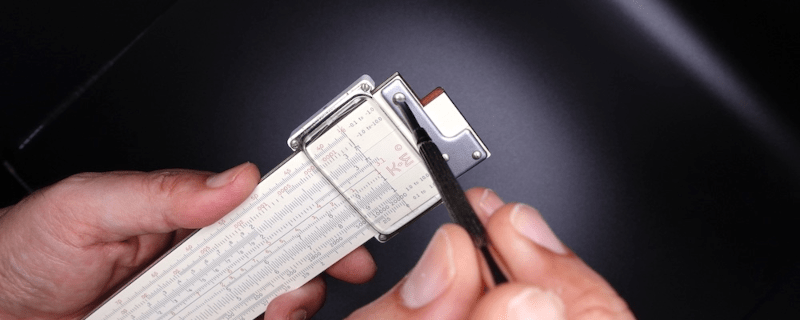
You have that slide rule in the back of the closet. Maybe it was from your college days. Maybe it was your Dad’s. Honestly. Do you know how to use it? Really? All the scales? That’s what we thought. [Amen Zwa, Esq.] not only tells you how slide rules came about, but also how to use many of the common scales. You can also see his collection and notes on being a casual slide rule collector and even a few maintenance tips.
The idea behind these computing devices is devilishly simple. It is well known that you can reduce a multiplication operation to addition if you have a table of logarithms. You simply take the log of both operands and add them. Then you do a reverse lookup in the table to get the answer.
For a simple example, you know the (base 10) log of 10 is 1 and the log of 1000 is 3. Adding those gives you 4, and, what do you know, 104 is 10,000, the correct answer. That’s easy when you are working with numbers like 10 and 1000 with base 10 logarithms, but it works with any base and with any wacky numbers you want to multiply.
The slide rule is essentially a log table on a stick. That’s how the most common scales work, at least. Many rules have other scales, so you can quickly, say, square or cube numbers (or find roots). Some specialized rules have scales for things like computing power.
We collect slide rules, too. Even oddball ones. We’ve often said that the barrier of learning to use a slide rule weeded out many bad engineers early.












I have a nice collection of slide rules. I was the guy with the leather scabbard and flopping Pickett slide rule in Junior High School. Today, at 77,many of the estimating and trueing tools I learned from using a sliderule make me a much better Math thinker than most of the younger ‘Engineers”. Thanks for the link.
I grow up after the slide rule was replaced by pocket calculators, and despite my digital career around today’s computers, I have a small 10 cm/4 inch slide rule in my backpack, besides a small collection of usual slide rules.
I am waiting for the day when I’ll be able to afford a Curta calculator and a cilindrical slide rule.
But the issue is that I do not have a reason to use it. Not many calculations are needed, and the ones that I need are requiring all digits of the result to be known. Yet I enjoy playing with it and exploring things that a pocket calculator cannot see, for instance pi squared is very close to 10.
Unfortunately the slide rule main enemy – time – is about to strike for a second, well, time. First they were replaced, but now they are become useless as the body and the slide have different rates of size change (the wood is not having the same drying speed, and the plastics decaying can be faster in smaller section pieces). Many that I’ved collected have this problem. As many other great things that came and gone (starting with fire made with two sticks and ending temporarely with the space shuttle – for now) the slide rule will be almost forgotten, rarely remembered and used.
But this is evolution, with a whiff of nostalgia that changes but not fades with every generation of humans that are going out.
Cylindrical slide rules such as the Fuller calculator can be beautiful artefacts in their own right. I own a non-trivial proportion of the entire 94 year production run. How many do you want to buy ;)
They frequently come up for auction, but beware if you are in the USA or Canada (and maybe elsewhere). I sold one on fleabay to a person, but fleabay promptly cancelled the sale.
I couldn’t get fleabay to tell me why, but in the description I noted it was made of metal and mahogany. The latter probably invoked immune responses w.r.t. importing wood. In retrospect it was good that the sale was aborted: a worse outcome would have been it being stopped at customs and destroyed (and me losing the money).
Nowadays I won’t sell anything to the US since there are too many reports of piles of items being destroyed because someone didn’t like the paper work. But that’s a different tale, of course.
I am on the propper side of the Atlantic pond (ie Europe). Kind stranger can you point me to your Fuller calculator distribution booth/site?
Guitar manufactures have found that donating to both major political parties can greatly reduce their problems importing exotic woods.
Clintons made an example of one, now money is flowing nicely.
If that’s not an option, you’re right, don’t do it.
I wouldn’t send them into the EU ether, more political parties to bribe, er donate to and more or less same rules about cert of origin for tropical hardwood.
You can’t even export reloading dies for 50 cal BMG ammo from the USA to the EU without a ton of paperwork.
My ‘gun nut’ German cousin found that out.
You can download the dimensions, some Germans are passable machinists.
Not really a problem.
When I want to use it I ask ChatGPT to remind me how, engrave me a few clay tablets, and send them at light-speed with a candle powered signal lamp. Then all I have to do is to transcribe into a Quipu manual, job done !
Some things are simply nice to look at, to handle, to use, and to own. And that is sufficient reason to cherish them.
Would I use a slide rule for everyday calculations? No, of course not. (Except to provoke a reaction, of course :) )
Would I like to own ancient clay tablets and a Quipu “manuscript”? Yes. Will I? Probably not.
Using ChatGPT indicates a lot about you.
I have them all, even a little fragment of Quipu. And also the bakelite Morse actuator from my grandfather, Hollerith cards from a ukrainian hospital, few rolls of punched tape, a unplayable rib record aka “bone music”, a damn fine metal wire pocket cassette recorder, a couple of wax cylinder records (…)
no signal lamp, though. Too bulky.
And yes I find ChatGPT damn useful. It seriously enhanced my efficiency for:
– quickly finding the right info and put me on track
– elaborate stubs and quick working code examples, and under guidance and scrutiny, tackle more complex problems
– introduce me to a field of knowledge i know little about and allow me to quickly make steps that would have take me a lot of nerves and time to get in.
I can relate efficiently using a search engine to efficiently using an LLM:
googling efficiently requires a careful formulation, using include/exclude terms, narrow to a time frame and so on.
What about you ?
My experiences of LLMs are similar to these:
https://www.theregister.com/2025/11/14/ai_and_the_software_engineer/
https://www.science.org/content/blog-post/evaluation-deep-research-performance
https://spectrum.ieee.org/ai-failures
Many people are finding that LLM output looks good provided you don’t know the subject. People who do know the subject quickly spot the hallucinations and other nonsense. As Derek Lowe (who knows he needs any and every tool that can help) put it…
“As with all LLM output, all of these things are presented in the same fluid, confident-sounding style: you have to know the material already to realize when your foot has gone through what was earlier solid flooring. That, to me, is one of their most pernicious features. I know that these things were not designed per se to glide over or hide their weak points and their mistakes, but they do a terrific job of it, and that’s not really what you want.”
exactly. And because one can spot the nonsense one can put it back on track or try another approach. Similarly in a web search one can spot garbage like aggregator, nonsensical, too-good-to-be-true pages, or off-topic pages.
Applying the same discernment and doubt to LLM results is critical. And a good dose of it allows to sidestep their flaws, for demonstrable results. At least that´s my experience and I´m getting better at it everyday.
And there is also a fact: those LLM get better everyday. So the experiences you linked will progressively fade into irrelevance.
I found LLM particularly apt at writing shell scripts for example. Sure you have to clean after them, because they tend to be very verboset, and things can often be simplified. I don´t particularly like writing sed or grep rules, for example. And the result can be immediately verified.
What i REALLY dislike is their fake politeness. Starting sentences with “Great, that is a very brilliant bla bla bla” can be really unnerving. I always start with a “gimme crude, rude, concise answers, even negative ones, stop your boot-licking and go straight to the point”. Despite that they always get back to their BS after a while. Sign it´s time to sum up, and start a fresh, new conversation with a more precise approach using the harvested valid nuggets. That´s barely a loss of time since it allows to clear up and reframe things. What one would do in a long drifting conversation with a meat bag too.
Prompt engineering: you want a good answer, one has to ask a good question.
Last class in college chemistry to use a slide rule. In December 1972, I bought myself a Sears (Bowmar) 4-banger calculator for about $100. I still needed the slide rule for logs and trig functions, so both of them came with me to exams. In graduate school, I bought an HP-25 and that made life a lot simpler.
I often wonder how much easier college would have been, if I’d had a word processor and a spreadsheet…
I took a Model 100 and a portable dot matrix printer to my finals in Journalism school. The whole class laughed when the printer started. The prof gracefully allowed it.
Kinda condescending. Yes, those of us who(se parents) bought our sliderule new know how to use all the scales because we read the instruction booklet.
Yes indeed.
I helped to not have the internet and ready access to information. No distractions => boredom => when you got a little you learned how to glean every morsel from it.
Nowadays the opposite skill is important: how to quickly decide what to ignore.
I wish I still had my dad’s slide rule. I never once saw him use it, but he did teach all of his kids how.
Last time HaD wrote about slide rules it prompted me to dig mine out and learn how to do trig functions on it. I’d have to look again but it basically has cosine only and to do sine and tan you had to know how they are all related- plus I discovered a till-then unnoticed hairline on the back of the slide rule that would allow you to do inverse functions. If not practical at least a rather neat demonstration of how it’s all related. With not too much practice you can quickly chain mixed log and twig function calculations with squares and cubes and roots and stuff which of course you have to remember how all those work too.
I own a few slide rules and enjoy my Versalog the most because the bamboo slide and glass reticle are so smooth to operate. I have a few “How to use…” books from the 1940s and 1950s that offer very good problem sets that work up through difficulty at the end of each teaching section. I also have an engineering problems book for the Versalog that has taught me a lot of engineering math. It is relaxing to work the problems. I create a spreadsheet with the problems and my answers that displays the error margin from a computer calculated value to what I come up with. My average error rate is around 0.03% unless I perform the operation incorrectly. The biggest issue is I need lots of light and strong reading glasses to see the tiny scales.
Here’s a little something that always tickled my fancy.
Most slide rules have a tick-marks for …..I don’t care… let’s say 2, 3, pi, or any other number you choose.
And, let’s say you need to multiply that number by some other number, say 2.8…. or what ever, who cares…
So, you slip the sticks to multiply the two numbers….and … whoo-hoo … you got your answer!
But look at the rule. You just multiplied that number by all the numbers on the number line ! ! ! !
All the answers, of X * Y= for all the numbers in the universe for Y !
Just think, a computer that that says: X * Y for every number in {Y} with a simple slide of the stick!
Just my $0.02
“So, you slip the sticks to multiply the two numbers….and … whoo-hoo … you got your answer!
But look at the rule. You just multiplied that number by all the numbers on the number line ! ! ! !”
That’s sounds wrong. What are you on about?
Go look at a slide rule. You’ll see.
Use your words.
The original Single Instruction, Multiple Data (SIMD) processor!
Despite having a university degree in mathematics, I keep forgetting how to apply the concept of logarithmics and most trigonometric functions. I can do multiplication on the one slide rule I have, but the 8 other scales are magic to me.
When the alternative was using Godfrey and Siddons’ book of four figure tables, you rapidly learned how to use the scales.
Back in the mid ’70s, my high school chem teacher wouldn’t let anyone use a calculator until he taught us how to use a slide rule (he had a giant 6 ft one hanging over the chalk board). The next day I brought in mine and used it during class. The day after, I brought in my TI calculator. He was rather pissed.
1972 the same didn’t have a calculator yet and EET courses got into higher functions. I had a slipstick from an older sibling and had to watch a filmstrip – audio lesson to learn it. Unfortunately then I learned that all the powers of ten math had to stay in my head and that’s when a TI calculator came along and saved me.
The earlier that you learn the more ingrained you think, in grade school we were taught that shifting the decimal point was cheating we had to show it the hard way. Gets messy when it’s mega and micro stats all at the same time.
The sliderule didn’t do all the math.
I was at the Skunk Works back when it was in Burbank CA. About to sign into a building, a Guard said “show me your calculator, and PROVE to me you can clear its memoey”.
I took out my slide rule and moved the slide and slid the window. He doubled over laughing.
So Lockheed was hiring DEI idiots back then? “Show me your calculator and fool me” is what he was saying.
Sounds like a made-up story that never happened.
Went through undergraduate mechanical engineering with a slide rule. Fluid mechanics and heat transfer separated the mechanical engineers from the future business majors.