
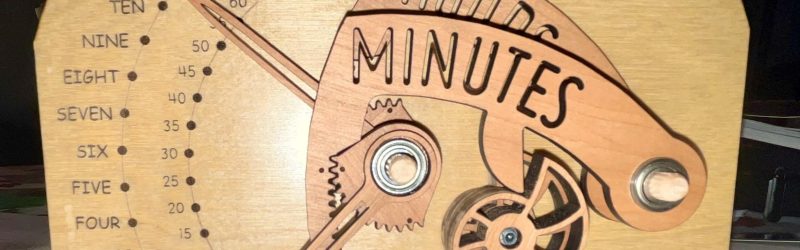
It’s clock time again on Hackaday, this time with a lovely laser-cut biretrograde clock by [PaulH175] over on Instructables. If you’ve never heard of a ‘biretrograde clock,’ well, we hadn’t either. This is clearly a form of retrograde clock, which unlike the name implies doesn’t spin backwards but oscillates in its motion– the hands ‘go retrograde’ the same way the planets do.
The oscillating movement is achieved via a pair of cams mounted on the hour and minute shafts of a common clock mechanism. As the shafts (and thus cams) turn, the minute and hour arms are raised and drop. While that could itself be enough to tell the time, [Paul] goes one further and has the actual hands on pivots driven by a gear mechanism on the cam-controlled arms. You might think that that extra reversal is what makes this a ‘biretrograde clock’ but in the clockmaker’s world that’s just saying it’s a retrograde clock with two indicators: in this case, minute and hour.
It’s a fairly rare way to make a clock, but we’ve seen one before. That older project was 3D printed, which might be more your speed; if you prefer laser-cutting, though, [Paul]’s Instructable includes SVG files. Alternatively, you could take a different approach and use voltmeters to get the same effect.












The linked instructibles explains biretrograde much more clearly:
≥ A retrograde clock has a hand that moves along an arc before rapidly snapping back to its starting point, unlike a conventional hand that moves in a full circle. Biretrograde means that there is more than 1 hand that does the retrograde movement.
“in this case, minute and second”
hour and minute
Fixed, thank you.
So, what time is it if the hour hand is at “ONE” and the minute hand is at 59 or 60?
Is it 1 o’clock? Or is it 2 o’clock?
Given that both hands are cam driven off a normal clock motor, the hour hand will approach one as the minute hand sweeps up toward 60. So pointing near “ONE” at 59 will be 12:59, just like a standard analog clock. At 60 it should drop back down to 0, I suspect the 60 is just there for appearance sake since otherwise the hand after 59 would be moving toward nothing.
I quite like the laser-cut implementation, and I think it may improve upon the linked, 3d-printed version. Maybe this iteration’s mechanics could be adopted by the extruder crowd? I’d like to see a super-tight, as ‘retro'(grade) version in dazzling plastic.
Lasers and 3d-printers look such fun, don’t they?
This is a nice project! I particularly like that it uses a standard clock escapement (well, okay, a high-torque escapement) to drive the clock instead of stepper motors and an Arduino. Not that I’m against programming (I do it for a living), but I bet there are quite a few half-completed “unusual clock” projects because learning curve required to wire up electronics and programming an Arduino was just slightly “too steep” for the maker. Or maybe they simply didn’t have the time or patience to build their first custom, electronic escapement even though they had all the mechanicals finished.