
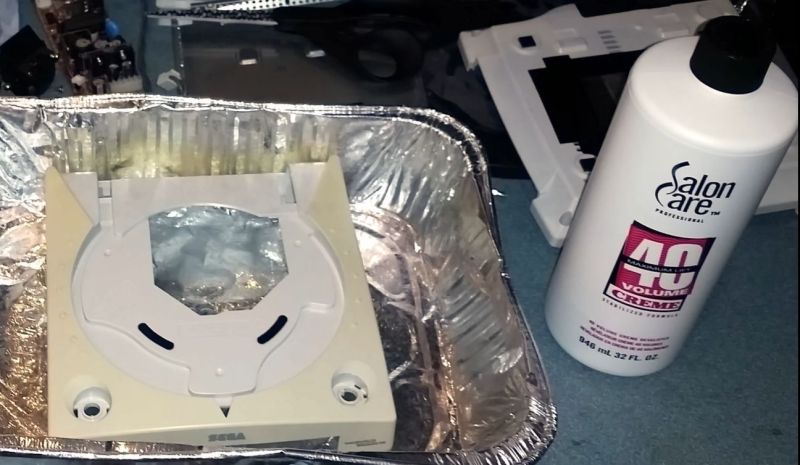
Within the retro computing community there exists a lot of controversy about so-called ‘retrobrighting’, which involves methods that seeks to reverse the yellowing that many plastics suffer over time. While some are all in on this practice that restores yellow plastics to their previous white luster, others actively warn against it after bad experiences, such as [Tech Tangents] in a recent video.
After a decade of trying out various retrobrighting methods, he found for example that a Sega Dreamcast shell which he treated with hydrogen peroxide ten years ago actually yellowed faster than the untreated plastic right beside it. Similarly, the use of ozone as another way to achieve the oxidation of the brominated flame retardants that are said to underlie the yellowing was also attempted, with highly dubious results.
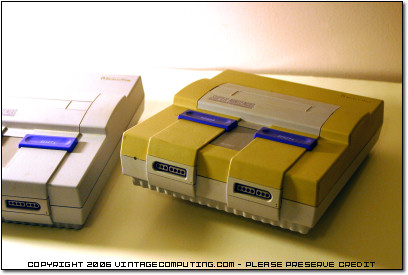
While streaking after retrobrighting with hydrogen peroxide can be attributed to an uneven application of the compound, there are many reports of the treatment damaging the plastics and making it brittle. Considering the uneven yellowing of e.g. Super Nintendo consoles, the cause of the yellowing is also not just photo-oxidation caused by UV exposure, but seems to be related to heat exposure and the exact amount of flame retardants mixed in with the plastic, as well as potentially general degradation of the plastic’s polymers.
Pending more research on the topic, the use of retrobrighting should perhaps not be banished completely. But considering the damage that we may be doing to potentially historical artifacts, it would behoove us to at least take a step or two back and consider the urgency of retrobrighting today instead of in the future with a better understanding of the implications.












At the heart of the issue lies the misconception that all plastics are alike, and what damages one damages all. This is not so: there are plastics that go brittle on their on, while others don’t; there are plastics that are negatively affected by retr0bright while others ain’t. Treating the problem as if the plastics of a Dreamcast behave in the same way as the plastics on a SNES is not the way to look at these problems.
This. It’s not a one-size-fits-all.
Agreed.
To be fair though, I thought the same way until I got into 3D printing and had to learn about different plastics and how they react differently to heat, cold, chemicals and oils. Hell, when then the plastics can be changed dramatically depending on any addatives.
Part that blows my mind is the measurable-at-home structural differences (largely layer bonding, but brittleness/toughness as well) due to different pigments used in the otherwise-same polymers from the same manufacturer.
Even the same sort of plastic – even as part of the same device – could be blended differently or come from a different supplier with different modifiers in. Saying one piece of a certain type of plastic is the same as another is like saying all pies are made of pie.
There are not much polymers that can resist a very strong oxidant like H2O2 or O3 anyway…
retrobright creates retrodust
I would consider a multi part treatment. Strong oxidants can remove discoloration but they probably create many acidic sites which can later easily yellow. So you probably need to esterify them or something similar. Perhaps cost them in an antioxidant after. Not sure but in most cases oxidants are used to age materials not the opposite!
I have an SNES as yellow as the one in the post, and it is already extremely brittle. I also have an SNES Jr that was not that yellow, which I retr0brited a couple of years ago, which is still just as solid as ever. I think the brittleness is just due to age and specific chemical makeup of the original plastic. I would definitely assume that a Sega console from just before they shut down their hardware development would have more corners cut than a Nintendo product.
I forgot to mention: I use standard drugstore 3% H2O2, not the stronger hair bleach type, but I have a fairly powerful UV source, originally designed to cure sealants for automotive applications, which I use in short bursts. The only bad thing that happened was when I accidentally forgot about my SNES mouse shell, which is now bleached almost white. It is still not brittle, however.
This everyone i have seen that has bad results (either immediately or eventually) uses weapons grade creme, applies it unevenly as possible, then scrunches the mess in plastic wrap.
Uneven application using the strongest stuff you can get leads to uneven results.
A few quarts of drug store liquid a scoop of oxygen clean top off with water is really all it takes (and some uv i used to do it in the spring time and just used the mild sun)
The early SNES models (2 chip PPU) will break soon anyway, because the ICs rust away,
so no need to worry what retrobrighting might do in 10 years.
Also, it’s just about chassises. On the bright side, there are replacement cases for popular consoles and home computers, so not everything is lost.
It’s not entirely a surprise that this is a problem, you’re not stopping or reversing the ageing process, you’re just masking the symptoms.
Like a fine coating of rust on steel is often left untreated because it prevents further, more significant corrosion forming, I suspect retrobrighting exposes fresh surface to damage.
Personally, I prefer ‘patina’ and just don’t bother doing anything other than cleaning the accumulated crud off of old stuff with warm water and dish soap, if it’s really unpleasant I might run it through a low temperature dishwasher cycle (works great for getting rid of accumulated crud on circuit boards and also cleans off the rosin flux that was applied to old HiFi and radio gear)
It’s not uncommon to prefer ‘patina’. I don’t get it though. I get wanting to experience new stuff, modern up to date consoles, computers and other gadgets. I also get wanting to re-experience the stuff of one’s youth for nostalgia, or the stuff from before one’s youth for curiosity regarding where it all came from.
But patina?
My computer and NES that I had back in 1989 were not yellow. Anyone reconstructing MY computer room from then would not be doing a more accurate job by keeping them yellowed. I wouldn’t have sat down in front of a bunch of yellowed stuff back then and thought “this is the style today”. I would have thought.. how much does this person smoke?!? I’m out of here! Likewise, your grandfather or great grandfather might have driven a model T but it wasn’t a rusty dilapidated one. Taking a good portion of one’s salary to buy it grandpa probably kept it in as close to new condition for as long as possible. Accuracy is in restoration, not patina.
Well, that’s just my ¢2 and probably overpriced at that. Have a nice day!
People who tolerate patina are not seeking to experience something pristine. They are seeking to experience something that has authentically survived and shows the effects of time.
You can buy a ancient bronze Roman coin for a few dollars. In that case I want it to show the effects of time. I want to hold it and think about the ancient people who held it before me. If it were shiny new, I would just be thinking about the person who recently restored it.
And as the article shows, removing patina often damages the object in the long run. So it’s unwise if you actually wanted to preserve the object for the future.
THIS. I have an old, early 1960’s vintage rifle that has what a firearms dealer called “a patina of value” on it; I’ll use protective oils on it to keep the corrosion down to as little as possible, but re-bluing the metal on it, or trying to remove the rust? not gonna happen.
circling back to yellowed plastics, my first thought was also “was this in a home with a smoker, and how many [packs | cartons] a day did they consume?”. If I was in the mindset of a full “make it look like it was just taken out of the box” restoration, I would go a different route and attempt to re-make the plastics using 3d printing and other techniques, and go about preserving the original plastics on it.
Surprised 3D printing isn’t more common. It has come far and people can now scan it in more easily.
Precisely, my old computers aren’t dirty with the accumulation of half a century’s worth of finger jam, snot and other assorted spooge, they look old because they are old.
I get quite a bit of pleasure out of using them and keeping them running with (when necessary and as far as possible) original parts.
I’m glad people still enjoy them but they were consumer products built down to a price and they aren’t even particularly rare now, ~50 years after they first hit the market so keeping them ‘museum grade’ or ‘rat rod’ is purely personal preference
(though it would amuse me to see how high the bidding might get on the never unboxed NOS Commodore Plus 4 and Atari ST machines I’ve been moving around various storage units for 30-40 years or so)
Here in Europe, we have buildings that are centuries old.
However, they’re not magically looking “old” because of their age.
Except for their style being outdated, of course.
The majority of them rather look clean and timeless.
Actually, most of EU’s architecture is potemkin stuff, built after WW2 because post war everything was destroyed by british and american freedombombing.
If they loved us so much as to turn our heritage into rubble, why didn’t they drop a nuke on NYC instead?
Interesting idea. Personally, I would feel the completely opposite here.
I had a NES in good condition when I was very young. It was fresh, like me.
If I now see a yellowed NES it would make me feel extremely depressed.
Because, it would remind me of mortality. Of what an old farth I’ve become.
How much time has passed, how many people passed away since I was young.
To me, a yellowed NES is not nostalgia. It’s an existential crisis.
A normal NES doesn’t trigger this, it rather feels being timeless. Like an anchor in life. Something to hold on to.
“I want to hold it and think about the ancient people who held it before me.”
Ok. I guess that explanation makes sense. Maybe there is room for both strategies. Personally I’m reaching a point where playing around with old stuff from my college days for a day sounds fun. (for a day please, not ready to have a basement horde of outdated PCs). If you can’t relate… just wait :-)
Having all the white turned yellow would just break the illusion and remind me those days are over and I am old now. But I see what you are saying too.
“And as the article shows, removing patina often damages the object in the long run.”
Yah. I bet over the next decade we will see larger format 3d printers become more commonplace and lots of stls for the shells of once-common kit shared online.
Well, I collect old electronics that I don’t retrobright and my dad owns a slightly dilapidated model T. I’m young enough that retro computers have always been old, so a yellowed Mac SE or brown C64 don’t really look out of place to me. Similarly, for my dad a model T has never looked new. Neither of us strive to “protect the patina” as it were, but it doesn’t really bother us. Old things are old; that’s just life.
On the other hand, my dad has a VW Beetle that has been restored and looks like new, and he has experienced what a new one is like, so maybe you just have to be there.
The thing about yellowing is that it frequently happened within months of purchase. Especially anything with fingerprint oils on it.
Retrobriting is all well and good but just like yellowed headlights, unless the plastic is s sealed afterwards the surface layer will oxidise even faster than originally
As for plastics going brittle, that could change from week to week of production depending on production variants. UV exposure factors heavily into this issue along with local industrial air pollution
???
I lived through the 80s and 90s. I think I remember one keyboard that was yellow before it’s 10th birthday. Unless it lived in a small apartment with a chain smoker… then all bets were off as to what color a device would be in it’s second year.
I get the principle, but I’m not putting pee colored stuff in my living room.
It’s bad enough that us computer fans sort of have a bad reputation of being hoarders.
It’s not necessary that they also think we’re anti-socials that don’t care about hygiene or something.
Thus, I’d rather replace the yellowed original case by, say, a transparent third-pary chassis and put the original in a box.
Or I would paint it carefully. If the paint is non-aggressive, it might even prevent further air contact and oxydation.
After the hydrogen peroxide treatment, what’s done to stop that process, and what’s done to prevent oxidation going forward? Nothing?
He speaks about that in the video and floats ideas like a UV blocking coat to hedge against future degredation.
Some folks use a UV-resistant clear-coat spray paint after retrobrighting, which should theoretically provide protection against further oxidation (and UV degradation of course).
It’d be interesting to know whether that changes the outcome vs. what we see in this video.
For that matter, I wonder how effectively we could’ve prevented yellowing if manufacturers just applied UV clear-coat to the plastic right after manufacturing.
The “UV clear coat” idea was already debunked years ago, because that’s not what causes the new yellowing.
The problem is that retrobriting is purely a surface process, but the yellowing is a volume process. The free bromine that’s causing the yellowing is mostly created at the surface but it diffuses deeper into the plastic over time, with it happening faster at higher temperatures. You then take that plastic with it’s deeply buried bromine and quickly treat the bit at the top to make it white again.
What do you think happens in the following few years? Any free bromine that’s still below the surface will slowly diffuse back out, regardless of whether it’s kept in the dark or not! If you were particularly uneven or vigorous with your retrobriting, then you might have variations in the amount of bromine that is stripped from the surface which looks fine initially, but becomes more obvious as the bromine starts to diffuse back out at different rates.
The real trick with retrobriting is that less is more (regardless of the method, peroxide or more UV exposure). You want an even, light treatment that doesn’t necessarily bring it all the way back but also doesn’t damage the plastic much, and then you need to repeat the process every few years as more bromine works it’s way out.
Or you can get a proper colour matched paint and simultaneously return the unit to it’s original colour and protect the underlying plastic from more UV exposure.
I think they thought it looked worse than raw new and as it wears off or chips under a fingernail test less so. If there is now a bonding non yellowing product use it. Hand oils degrade many finishes.
Then they figured out how to time-life a coating that “looks soft and sexy” and turns into goo! Will that stuff one day need “retro-soft” to bring back that feel rather than dripping sticky messes?
I usually use glycerine and a sponge to apply and then rinsed. Is that the method he used?
I haven’t watched the video. Is there an example of one console, half of which was treated, half not that ended up with the treated half in worse condition than the untreated half? That would be fairly strong evidence. Otherwise, I don’t really know how I’d be convinced one way or another.
I’ve never “retrobrighted” anything. My retroconsoles are happy to stay black and fake woodgrain. Tear down, scrub as needed in warm soapy water, reassemble, play. Then assume any crumbling, brittleness, or other age-related degradation was going to happen anyway.
I mean, it’s happening to me so why should my stuff escape the same fate. :-)
That is exactly what the video shows: multiple kinds of damage on places that were treated, and both reduced re-yellowing as well as no other cosmetic damage on places that were protected from the bleach a decade ago.
Specifically, the best example is on the bottom. He taped over the bottom label, but the tape was large and covered some of the plastic too. Today, the plastic that was protected by the tape from retrobrighting is less yellow than the retrobrighted plastic right next to it. On the same plastic, on the same surface, in spots 1cm from each other.
Dying seems like a much better option than retrobrighting since it is more permanent than paint and less aggressive than peroxide. I don’t understand the reluctance to dying. Dye companies can match colors exceptionally well these days although it won’t be perfect.
If you have a solid piece of plastic with no dye-sub, then I can jive with that, although application can be tricky.
If you do have dye-sub, say a white Sega Saturn or Dreamcast, the masking process can be super tedious and the dye will bleed under the masks to some degree. You have to sort of dial it in. Retrobrighting doesn’t usually encounter this problem, which is why I’d love for it to be a better solution.
To be honest, at that point just paint it.
It’s just an old toy, it’s not worth your life.
“retrobrighting” – what a weird term. How about just calling it “cleaning” ?
Because that’s not what’s being done here…
Meh. Just 3D print replacement cases. Some people take nostalgia a bit too far. :-)
Isn’t that kind of plastic even worse? 3D printed stuff feels so cheap!
I agree with the other comments about the “patina” being depressing and otherwise undesirable, but I’m more of the opinion that the characteristics of the plastics available to be used in a design should be understood and selected appropriately. We have become a disposable society where everything is meant to be used for a while and then thrown away, and it does a disservice to those of us who want to preserve what we have and find new uses for it. A true patina is kind of an elevated form of the art because it starts as something of beauty and it retains that beauty even as it transforms into something new. I would not call yellowing plastic anything of beauty – the opposite in fact, and the idea of replacing it with something transparent as Joshua suggests would seem preferable to any solution that turns ugly again over time.
I still find it unbelievable that even today many items one would reasonably expect to be used outdoors unexpectedly break in a couple years or less because UV exposure has turned the plastic brittle. In my opinion this is unacceptable, and I blame both the designers for lack of foresight and the consumer for tolerating and even encouraging this kind of design by demanding what is cheap over what is good.
Plastics are not terribly new, so ignorance isn’t an excuse. A whole generation passed between when plastics took off and when personal computers started to become a thing.
From all of the content I’ve seen on this subject ranging from 40 year old plastic as un-yellowed as the day it was made to younger plastic kept in a box in a closet as yellow as the SNES above, I think there are too many unknown variables, one extremely important one being the exact composition of the plastic used in a given manufacturing run, to draw any universal conclusions.
I am a little perplexed by preventing or reversing the oxidation of a surface with the application of an oxidizer. An oxidizer that has even previously been used in rockets.
…”the notion of preventing…”
Damn you HAD, for not having an edit button. It’s 2025. My WWIV BBS software in 1992 had an edit button. Don’t you realize that some of us are still receiving our morning injections of coffee?
It’s probably the UV that’s making it brittle, not the peroxide. The treatment involves leaving in bright sun or using UV lamps to activate the peroxide