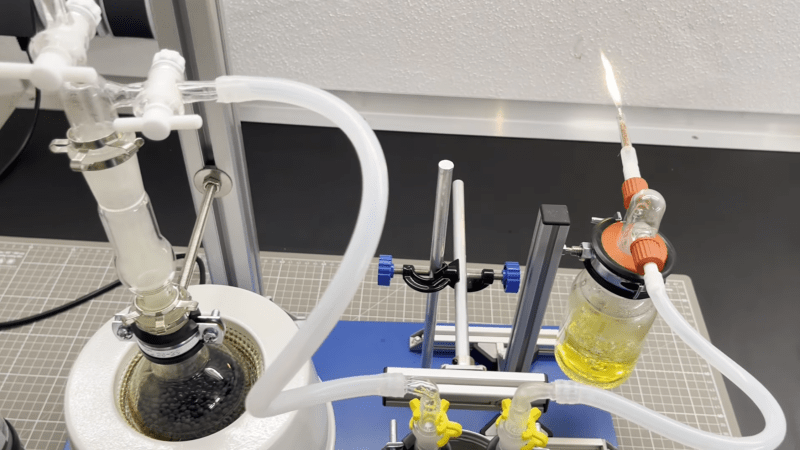
A boiling flask is mounted in a heating manted, with a tube leading from it to a U-shaped tube. From here, the tube continues to a bottle of yellow fluid, from which another tube emerges. A flame is emitted from this last tube.

Building A Desktop Catalytic Cracker

Although crude oil contains a vast diversity of hydrocarbons, a comparatively small number of these make up the bulk of demand for oil. Cracking solves this mismatch: most of the demand is for light, short-carbon-chain molecules, so a cracker breaks down long-chain hydrocarbons into lighter, more commercially-valuable chemicals. This is usually done in massive industrial plants, but as [Markus Bindhammer] showed, it’s possible even in a tabletop apparatus.

There are several methods of cracking, but [Markus] used catalytic fluid cracking: a feedstock high in alkanes (hydrocarbons containing fully saturated carbon-carbon bonds) is heated in the presence of a catalyst, whereupon its long alkane chains split to form alkenes (hydrocarbons with a carbon-carbon double bond) with the loss of a hydrogen molecule. In [Markus]’s setup, a heating mantle heated a boiling flask containing paraffin oil and an amorphous silica-alumina catalyst. Vapors from this flask passed through a condenser tube and a bottle of bromine water, then escaped through a flashback arrestor. Bromine reacts far more readily with alkenes than with alkanes, so the disappearance of its characteristic yellow color would visually indicate the production of alkenes.

To avoid unwanted oxidation, [Markus] purged the cracker with argon before using it. While running the cracker, a flammable mixture of light hydrocarbons and hydrogen escaped from the flask of bromine water. The yellow color of bromine disappeared, and two phases formed: one aqueous, and a lighter phase of hydrocarbons and brominated hydrocarbons. The hot side of the reactor did not survive well; the catalyst turned black with coke, and the heating mantel’s cover fused to the boiling flask. However, the reaction undoubtedly succeeded: while a pool of normal paraffin oil wouldn’t ignite, the cracked oil lit easily.

To go the other way, from small molecules to larger hydrocarbon chains, [Markus] has also used the Fischer-Tropsch process.
Continue reading “Building A Desktop Catalytic Cracker”

Warnings About Retrobright Damaging Plastics After 10 Year Test

Within the retro computing community there exists a lot of controversy about so-called ‘retrobrighting’, which involves methods that seeks to reverse the yellowing that many plastics suffer over time. While some are all in on this practice that restores yellow plastics to their previous white luster, others actively warn against it after bad experiences, such as [Tech Tangents] in a recent video.

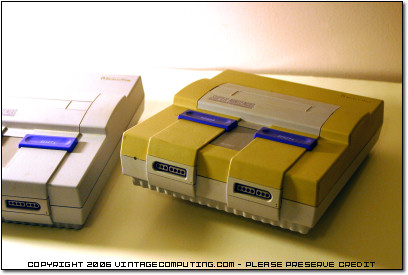
Uneven yellowing on North American SNES console. (Credit: Vintage Computing)

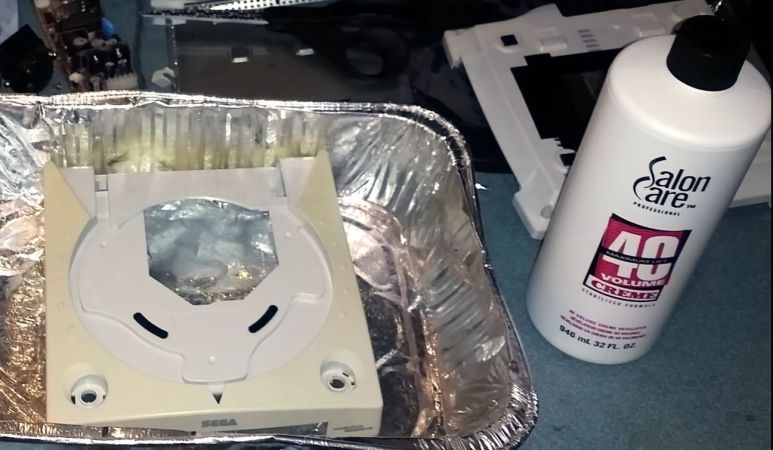
After a decade of trying out various retrobrighting methods, he found for example that a Sega Dreamcast shell which he treated with hydrogen peroxide ten years ago actually yellowed faster than the untreated plastic right beside it. Similarly, the use of ozone as another way to achieve the oxidation of the brominated flame retardants that are said to underlie the yellowing was also attempted, with highly dubious results.

While streaking after retrobrighting with hydrogen peroxide can be attributed to an uneven application of the compound, there are many reports of the treatment damaging the plastics and making it brittle. Considering the uneven yellowing of e.g. Super Nintendo consoles, the cause of the yellowing is also not just photo-oxidation caused by UV exposure, but seems to be related to heat exposure and the exact amount of flame retardants mixed in with the plastic, as well as potentially general degradation of the plastic’s polymers.

Pending more research on the topic, the use of retrobrighting should perhaps not be banished completely. But considering the damage that we may be doing to potentially historical artifacts, it would behoove us to at least take a step or two back and consider the urgency of retrobrighting today instead of in the future with a better understanding of the implications.

Continue reading “Warnings About Retrobright Damaging Plastics After 10 Year Test”

Mining And Refining: The Halogens

I was looking at the periodic table of the elements the other day, as one does, when my eye fell upon the right-hand side of the chart. Right next to the noble gases at the extreme edge of the table is a column of elements with similar and interesting properties: the halogens. Almost all of these reactive elements are pretty familiar, especially chlorine, which most of us eat by the gram every day in the form of table salt. As the neighborhoods of the periodic table go, Group 17 is pretty familiar territory.

But for some reason, one member of this group caught my attention: iodine. I realized I had no idea where we get iodine, which led to the realization that apart from chlorine, I really didn’t know where any of the halogens came from. And as usual, that meant I needed to dig in and learn a little bit about the mining and refining of the halogens. At least most of them; as interesting as they may be, we’ll be skipping the naturally occurring but rare and highly radioactive halogen astatine, as well as the synthetic halogen tennessine, which lives just below it in the group.

Continue reading “Mining And Refining: The Halogens”