
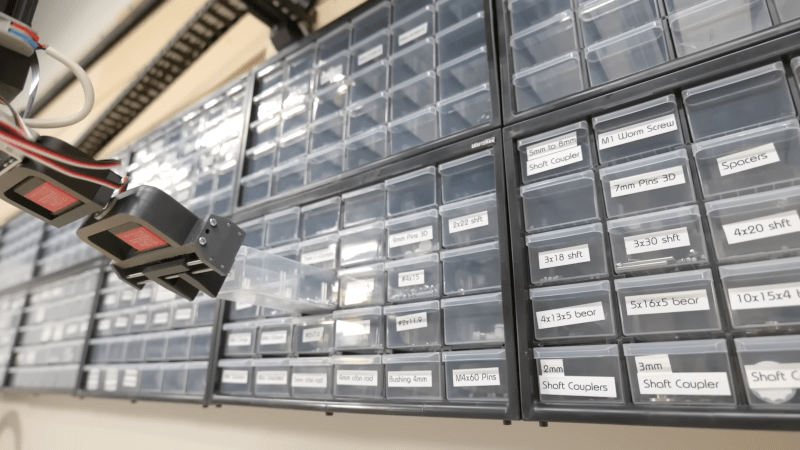
[Engineezy] might have been watching a 3D printer move when inspiration struck: Why not build a robot arm to clean up his workbench? Why not, indeed? Well, all you need is a 17-foot-long X-axis and a gripper mechanism that can pick up any strange thing that happens to be on the bench.
Like any good project, he did it step by step. Mounting a 17-foot linear rail on an accurately machined backplate required professional CNC assistance. He was shooting for a 1mm accuracy, but decided to settle for 10mm.
With the long axis done, the rest seemed anticlimactic, at least for moving it around. The system can actually support his bodyweight while moving. The next step was to control the arm manually and use a gripper to open a parts bin.
The arm works, but is somewhat slow and needs some automation. A great start to a project that might not be practical, but is still a fun build and might inspire you to do something equally large.
We have large workbenches, but we tend to use tiny ones more often in our office. We also enjoy ones that are portable.












Needs a label printer in the manipulator, so it can label a bin when something new is stored.
Maybe a laser to etch the bin?
Haha, an etching laser mounted to a robot arm, very safe, very osha XD
Each bin needs an e-ink display for the label. I wonder if they make any of those electronic price tags that small?
Excellent! Yes, a uniform surface to laser mark on will certainly help.
:trollface:
Since the robot can’t read; what’s the point? You search for a part on the computer, and the robot feches the right drawer for you. No need to label anything. Just put the drawer reference in the stock system. Screw_Countersunk_Hex_M3_20mm – drawer 47
Robot should be doing all that indexing itself.
Next step is voice control – I shouldn’t have to fuss around on the computer, just a wake word and a part description without looking up from whatever it is I’m working on.
Jackass for geeks :). I half expected them to play the intro to “Corona” at some point.
I’m not getting baited for that click, sorry.
So edgy
He does mention in the video that all the tools were in pre-determined spots during the cleanup routine so I can
The whole design is pretty good, but the hard work has yet to begin.
so I can (turn off rant). Apparently the editor doesn’t like tags.
A better solution to the saggy drawers problem might be some kind of support plate. It would have to be movable to prevent it getting in the way of the gripper and anything it was carrying.
I wear a belt.
No point in telling you to belt up then :)
ok cool, can you build something for screw and component cleanup.
This was my thought. It needs a camera on the manipulator to be able to identify screws and nuts and things and put them in the correct drawers.
Automating this is probably possible in the near term, though picking individual objects out of a pile is an unsolved problem. Once you can grab individual items, identifying what they are and dropping them in the right bin is more doable.
For rough heaps of half-assembled stuff though? Who even knows what it’s supposed to do with that.
Only partially (or not at all) related, whilst moonshining as a cable tech (running cat5s through office ceilings), up and down the ladder all day long, occasionally you leave this and that up a ceiling you just closed up. You also find occasional rusted screwdriver or a drill bit along other random things, but I digress. We just finished a weekend-long project no less than 5 hours away from the headquarters, started on our way home around 7pm, and good 2 hours away from the office we just wired, I remembered that I left my favorite flashlight there. It was one of those newly fangled LED flashlights that actually last long with the three AAs it had inside, and back then it was not cheap, good solid aluminum, a spare LED inside, etc.
When I was lamenting that the list that originally included two screwdrivers and good high voltage pliers got new addition, one of buddies quipped “you SHOULD wear a tool belt”. I asked why, since we already haul around the rat nests of tools, the toolbags, and it is common sense that tools return to their respective rat nest seats. “No,” the buddy said “you don’t get it, with tool belt, as you descend the ladder, you notice something amiss just from the weight of the belt”. “No,” the third buddy, our driver, said “what we need are the tool belts, and those funky yellow plastic chains attached to each tool in the belt. As you descend the ladder, whatever you left up there comes down with you.” Good man, he also wanted company to buy a remote-controlled four wheeled Radio Shack thingie, that could drag the end of a cable across entire office ceiling, so we won’t have to pop tiles every cable pole distance away, and now that everything is wireless, his dream is kind of fulfilled – both solutions are no longer dearly needed.
They used ferrets to run a pull cord that could go through some small spaces as well as long runs.
I have a gorgeous long and thin duckbill pliers that someone left on the roof beam of a high bay open factory back in the 70’s. They don’t make ’em like that anymore.
We had them, fish poles and fish tapes. I still own my last fish pole, btw, it was to be thrown away when the company went belly up. For most of the places that we were wiring we’d run a nylon string along the cable we just pulled – and found quite a few of those already present in the offices we were wiring, just not always running to the target end point.
But the point remains, as you work 10+ hours-a-day projects in faraway places, you just get tired and forget things. Yellow plastic chain or not, a shoe lace attached to each tool would probably suffice, you literally clear your last workspace as you go down a ladder : – ]
Likewise, once I found a set of, if I remember right, Milwaukee cast iron pliers, looked late 1960s, though, too crooked to be of good use; I put it back where I found it, next to an elevator shaft, floor 5 ceiling, (now former) Rollins building on Concord Pike, Delaware. Whoever finds it, admire, and deposit it back for the next generation to discover : -]