
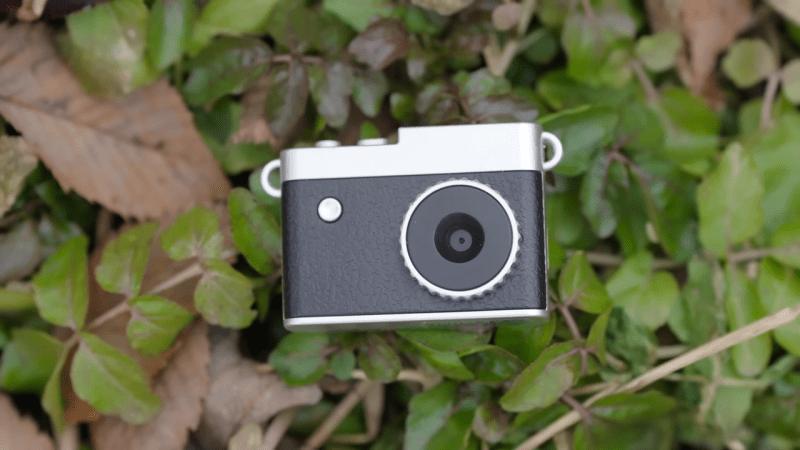
Keychain cameras are rarely good. However, in the case of Walmart’s current offering, it might be worse than it’s supposed to be. [FoxTailWhipz] bought the Vivitar-branded device and set about investigating its claim that it could deliver high-resolution photos.
The Vivatar Retro Keychain Camera costs $12.88, and wears “FULL HD” and “14MP” branding on the packaging. It’s actually built by Sakar International, a company that manufactures products for other brands to license. Outside of the branding, though, [FoxTailWhipz] figured the resolution claims were likely misleading. Taking photos quickly showed this was the case, as whatever setting was used, the photos would always come out at 640 x 480, or roughly 0.3 megapixels. He thus decided a teardown would be the best way to determine what was going on inside. You can see it all in the video below.
Pulling the device apart was easy, revealing that the screen and battery are simply attached to the PCB with double-sided tape. With the board removed from the case, the sensor and lens module are visible, with the model number printed on the flex cable. The sensor datasheet tells you what you need to know. It’s a 2-megapixel sensor, capable of resolutions up to 1632 x 1212. The camera firmware itself seems to not even use the full resolution, since it only outputs images at 640 x 480.
It’s not that surprising that an ultra-cheap keychain camera doesn’t meet the outrageous specs on the box. At the same time, it’s sad to see major retailers selling products that can’t do what they say on the tin. We see this problem a lot, in everything from network cables to oscilloscopes.












90% of tech products on Amazon
Reminds me of those 808 keychain cameras from 15 years ago. Times sure haven’t changed.
Wow what a blast from the past. Haven’t thought about those since 2011…
I fail to be outraged. You get a nice case and a useful sensor. It could have been up to the Youtuber to actually make an effort and hack it. Sure the specs are not reached with the firmware, but do we want their firmware and not our own? Videos like these always leave me confused. Hack it already, chum!
Box says it’s a 12megapixel camera but outputs 40x less at 0.3. capable of 2 megapixels.
That’s pretty outrageous.
Id like to see what can be achieved but it’s still outrageously missold.
So if I hand you a 1 gallon milk crate and a 1 inch straw, I ripped you off for 1 gallon?
This is no less illegal for ISPs to sell you up-to***** 1000 Mbit/s
*****only available in 1% of cities.
Really? 12 MP advertised, 2 MP actually possible and that is reduced to 0.3 by firmware or other hardware limitations. That’s fine by you?
So it’s more like you sell a gallon of milk in a stainless steel milk bottle, that actually has a cup of space inside and only a thimple of actual milk inside. Fair?
Not to mention in many places you do indeed get a refund if service doesn’t meet its minimum guaranteed speed.
Wait a minute. It´s not because you understand “MP” as “megapixel” that it makes it true. “MP” is not a unit of anything.
@Iman
[Wait a minute. It´s not because you understand “MP” as “megapixel” that it makes it true. “MP” is not a unit of anything.]
The walmart webpage of the prodcut specifies in the description:
So yeah, it says that it captures 14-megapixel images.
It doesn’t even talk about what the sensor can do, but that the camera captures that resolution.
@Iman
[Wait a minute. It´s not because you understand “MP” as “megapixel” that it makes it true. “MP” is not a unit of anything.]
The walmart webpage of the prodcut specifies in the description:
{High-Resolution Capture: Capture crisp 14-megapixel images and record Full HD 1080p videos with vivid detail, perfect for content creators and everyday photography.}
So yeah, it says that it captures 14-megapixel images.
It doesn’t even talk about what the sensor can do, but that the camera captures that resolution.
That sounds quite a bit like the ink cartridges that come with the printers
Maybe it’s a typo. It should be 1 2MP picture (One 2MP)
neigh, its more like a bag of american potato chips(“crisps”) where the bag is bigger but the contents is wayyyy… yyyyyyy smaller. marketing team is like “F* it, just put a big number on there to make it look good.”
Difference is with food that (“just put a big number on it”) is illegal. Sounds like someone just failed to read the lable. It’s legal to put 3 1/2 oz. of potato chips in a 1 gallon bag as long as it’s properly labeled. I would suspect it’s the same in your country.
A better analogy is selling a 1 gallon jug of milk but the jug is nearly empty.
But why do people ignore the sensor technically can support the full potential?
You don’t buy anything empty, you just cannot access the full features without your own custom firmware.
It’s like a beefed up car with a valet key (a key that limits horse power for non-versed drivers to not wreck the vehicle).
Better would be 1 litre bottle of milk whereby you only get 100ml out by opening the cap. The other 900ml is still there but you’ll need to disassemble the bottle to get to it.
I think the lying by Walmart is pretty bad too. It’s also right that you do get a nice cheap display, sensor and micro SD card interface…. without having to pay for freight!
I look around for cheap things like this as a nice source for components when you’re simply mucking around with ideas/projects.
Is there a HaD equivalent for legal projects? Like how to take some of these vendors to task for the blatant false advertisement they do. It harms the market when nobody trusts the products on there.
I am a former camera developer. Since inside this keychain camera is only a 2MP sensor, there is no point trying to defend the vendor’s claims of “14MP,” but there is one aspect where the math does check out. Why doesn’t this camera take 2MP pictures? It is because the vast majority of RGB color imaging sensors have what is called a Bayer color filter pattern covering the raw, monochrome pixel array. Every full-color pixel is really made up of a 2×2 cluster of raw pixels: RG on the first row, and GB on the second row (so yes, G has twice the resolution of R and B). For the OmniVision OV2659 camera sensor, 1632 / 2 = 816 (H) and 1212 / 2 = 606 (V) is the maximum color resolution using the simplest of color processing (no interpolation, like the “real camera” I worked on). This camera maker wanted to use a cheap JPEG compression chip like the OV528, which only handles 640×480, so they configured the sensor to output VGA @ 60 FPS. Still, pretty neat that they can include an LCD array. This makes it a viable pre-cell-phone-toting kid’s toy.
Many of us are familiar with the visual effect where “the camera” orbits around a “freeze frame.” This trick is done by lining up a whole bunch of still cameras and taking the “same picture” from different angles, all at exactly the same time. True, this this a pretty minimal camera, but at $12 each, someone might want to buy a whole bunch of these, cleverly wire all the shutter switches together, and shoot their own freeze frame videos. If you do, please post your results on Hackaday!
I don’t know,even if you did the freeze frame thing, i wouldn’t waaste my money, it’s the end of 2025. Many cameras today are no better than 30 years ago. Shops are full of these lying, useless, play things. They might as well do nothing and just tell the kids to imagine it takes pictures. Why would anyone ever need a low compression JPEG artifacted 640×480 pictures? Why would anyone bother to manufacture this trash today?
And i am not talking about all cameras being 8K 120 FPS, but you know, having a usable mimimum resolution and other features. compressed 640×480 with 8 bit colors and hazy plastic lens is not that. This is a perfect example of how we are technologically way more advanced than what is made as the minimum for gen pop. We could have the 8K @120FPS as the mimimum eeeeasily, but all tech seems to be about taking the last penny out of it every step of the way.
But riddle me this: how come we still can’t get good contrast and low light pictures? I’ve been looking for an action camera for low light conditions, but even the expenssive cameras are very, very disappointing, with the contrast as well. Grainy low contrast pictures in the evening or morning, a sunny day with a tree shadow and it’s all black or sun coming through some branches in the morning and it’s all white washed. My eyes are way better, but i can’t capture that.
Because silicon wafers still cost real money, so proper big sensors are expensive to make, and the megapixel war made it so all cameras have too many needlessly small pixels that waste a lot of light on the grid in between the cells, and require too much amplification to work except in broad daylight.
A microscopically small sensor with 8K resolution (33 Mpix) will be so grainy that it’ll barely satisfy 1080p (2 Mpix) after all the noise reduction and other filtering. That’s why they’re now offering “AI super night mode” BS that first blurs the heck out of the picture and then adds detail and contrast by faking it.
If you’ve found “even the expensive cameras are very, very disappointing” then you’ve run up against the laws of nature. If you need color then 2/3 of the light is thrown away in the Bayer filter; some more is lost in the gap between pixels.
There are ways around this. One is the Foveon sensor, but I’m not aware of any tests showing superior low light performance. Another is the 3-sensor/dichroic-mirror technique, but I’ve never seen that expensive tech in a consumer camera. A B&W sensor should be better than Bayer color, but I’m only aware of the overpriced Leica product.
Given how very very cheap you can pick up second hand DSLR often with lens that are relatively worth having included or those pocket sized digital camera with the built in lens…
If this was really even close to the advertised spec I could see it being worth the cost for that sort of playing around. But given how cheap I picked up so much of my camera gear simply for being second hand and how vast the quality improvement is despite being really darn old – yes it was more than $12 per, but probably not even double that for a camera that has better image quality than this thing could ever do if it actually met the advertised spec as light capture and focus improvements along with the larger sensor size more than make up for a slight dip in resolution, and orders of magnitude better than it actually achieves…
Also so many webcams out there now that are at least as good and likely much cheaper – I’d think that would be the best way to play with multi camera visual effects, as they all connect to the same brain for control and sync by design. Though just how tight you can actually sync a heap of computer connected cameras I don’t know.
I also work in camera based product design and was about to point out how the Bayer pattern results in a fractional image resolution on color output, so thabks for that. I do think for the price it is pretty capable. The Sony Mavica (640×480 color JPEG storage on 1.44MB floppy disc) was comparable to this, and in 1997 debuted at $599. Not too bad, progress!
Thanks for the great explanation.
Reminds me of a camera I found in a junk bin at work, fully sealed, “Driverless digital camera”, “20 Megapixis [sic]”. After reading this article, you can probably guess the resolution.
But I thought the 20 Megapixis were hilarious. Oh – and my Logitech Clicksmart from 1999 takes better photos at the same resolution.
A product can’t really be said to be a failure until someone has conclusively proven that it’s impossible to run Doom on it.
This sounds like something Walmart should be embarrassed to sell in the current packaging but something that would fit right in at Walmart – maybe even at the listed price if marketed as a functional toy – if packaged in honest packaging.
Walmart should pull this product to avoid likely lawsuits and bad publicity.
‘should’ but won’t . 99% of buyers are probably kids who probably know no difference. Cheap toy for kids…. Goes right along with the shoppers who dress ‘up’ with pajamas and slippers when shopping at Walmart.
A “pinned” comment from the YouTube Video Creator:
You’re over-thinking the problem, folks.
A lot of words have been written here, when the answer boils down to one simple fact—as it usually does…
You can NOT get “…“FULL HD” and “14MP”…” with a ‘pin-hole’ camera.
This answer should be obvious simply by looking at the camera.
You actually can get a billion megapixels from a pinhole camera, if you have a billion-megapixel sensor. It’s a pointless waste; there aren’t enough photons making it through the pinhole to be worth it, but, well, it’s not actually impossible.
Your claim has the same problem their claim has, ironically…
Now, if you mean that there ain’t no such thing as a free lunch, and if someone appears to promise one, either the cost is assessed elsewhere or they’re not actually fulfilling their prompises, well yeah. But tbh, that’s not actually what you said….
This does not come as a surprise to me, based on my experiences with WalMart and Vivitar products.
Vivitar used to be a quality supplier of lenses for 35 mm cameras, much like Tamron and Sigma today.
I also recall how some analog era walkmans (ie cassette players) from the past claimed “surround sound” with two channels output. I always wondered where the surround supposed to come from, what, some players had some kind of hidden additional channels to make it quadro, and one supposed to buy headphones with four drivers, too?
Look up psychoacoustic 3D audio and the Sound Retrieval System (SRS). SRS was developed by Hughes Aircraft (yes, the company was founded by the Howard Hughes) and it created an “immersive 3D soundfield” using only two audio channels.
So then it was not the player, but the recording. I now wonder if any recordings of the 1980s really were mixed properly.
You can fake it by cross-feeding the channels with a tiny bit of delay. That projects the sound forwards. Then you filter out some frequencies selectively from left and right, which throws different instruments and people with different vocal ranges more left or right. If done right, it sounds like the band is playing in an arc in front of you.
Binaural sound is captured with 2 mics a human head’s ears distance apart. First demoed in 1881 by Clement Ader. Once captured this way it can be heard on any pair of headphones. It is virtual reality in a sonic sense.
You can rightfully call any pair of phones or even buds VR, 3D, surround, or any other description. In the 70’s quad headphones were made with 2 drivers in the (Fixler effect), nothing new. I have decades of recordings I’ve made live with a dummy head mic.
Searching shows lots of nonsense for sale now. Since the turn of this century we have many ways of simulating “VR” digitally, those mono sounds can play out in sonic space.
Did you never notice that humans (and animals) only tend to have 2 ears? And doesn’t that tell you something about the possibilities of 2 channel audio?
There are various standards developed over the years to get positional audio from 2 channels
For games when Microsoft put HRTF in DirectX the more specialized ones lost ground and went away, even if some of them were better and had better hardware-based support.
And using 2 channels with headphones is probably best since with 4+ speaker channels you need to keep your head in the center, which of course is a bit restrictive.
Wikipedia link on how that stuff works: https://en.wikipedia.org/wiki/Hrtf
I’m honestly surprised this is still the same keychain camera from 20+ years ago without any sensor upgrade
I’m honestly surprised that all of you have the time to debate this trivia endlessly. Nothin’ better to do?
Yeah, nothing better to do. You too, apparently. Welcome to the club!
It’s quite odd to me that 2 megapixel sensors aren’t the cheapest lowest resolution you can get in 2025.
There are so many 640×480 sensors, why is that? Even the lowliest sanctioned Chinese fabs that have no state support should be able to do better these days.
Must be a case of overproduction of 640×480 sensors a decade or two or three ago.
But if so, when will they finally run out of the things?