
Once upon a time, surgery was done on patients who were fully conscious and awake. As you might imagine, this was a nasty experience for all involved, and particularly the patients. Eventually, medical science developed the techniques of anaesthesia, which allowed patients to undergo surgery without feeling pain or even being conscious of it at all.
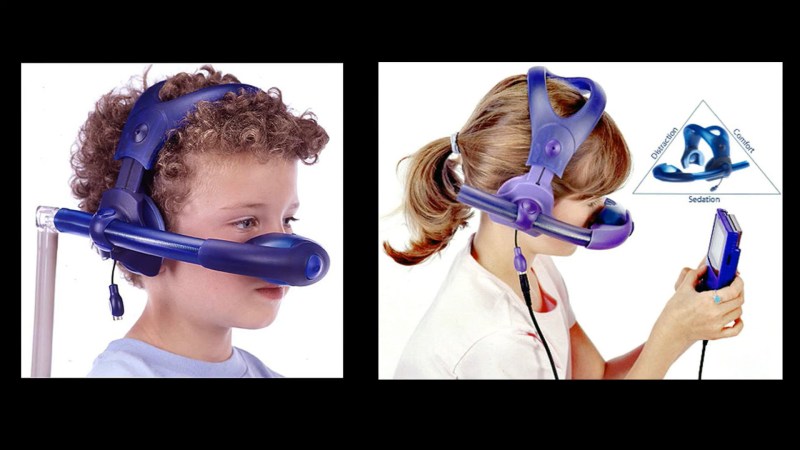
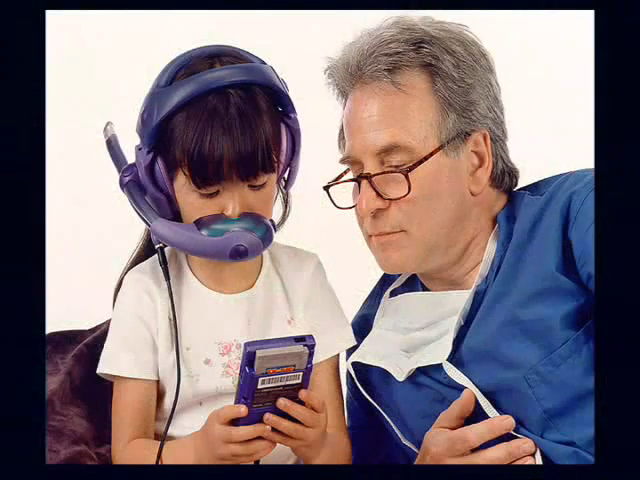
Adults are typically comfortable in the medical environment and tolerate anaesthesia well. For children, though, the experience can be altogether more daunting. Thus was invented the PediSedate—a device which was marketed almost like a Game Boy accessory intended to deliver anaesthetic treatment in order to safely and effectively prepare children for surgery.
A Happy Distraction
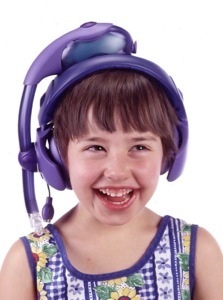
The patent filing for the PediSedate doesn’t give away much in the title—”Inhalation And Monitoring Mask With Headset.” Still, US patent 5,697,363 (PDF) recorded an innovative device, intended to solve several issues around the delivery of anaesthesia to pediatric patients. Most specifically, those developing the device had noted a great deal of anxiety and stress when using traditional anaesthesia masks with young patients. The device was created by Geoffrey A. Hart, an anaestheologist based in Boston. His hope was to create an anaesthesia delivery device that could be used with a child in a “non-threatening, non-intrusive manner.”
The resulting device looked rather a lot like a big, colorful audio headset. Indeed, it had headphones that could play audio to the wearer, while an arm that extended out over the face could deliver nitrous oxide or other gases via the nasal route. Sensors were included for pulse oximetry in order to track the patient’s heart rate and blood oxygenation, while an integrated capnometer measured vital respiratory factors, including carbon dioxide levels in the breath. Provision in the patent was also made for including a microphone, either for interactivity purposes with entertainment content for distraction’s sake, or to allow communication with medical personnel at a distance. This would be particularly useful in the case of certain imaging studies or treatments, where doctors and nurses must remain a certain distance away.
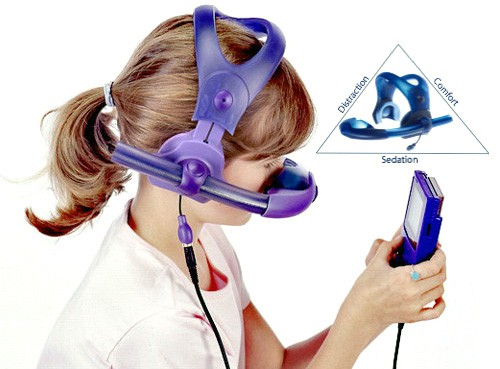
Press materials and a website were launched in 2009, as the device went through Phase II clinical trials. Most materials showed the PediSedate being used in tandem with a Nintendo Game Boy. The device featured an aesthetic that followed the late 90s trend of bright colors and translucent plastics. It was often paired in photos hooked up to a Game Boy to help distract a child during sedation, with the device often talked about as an “accessory” for the handheld console. This wasn’t really the case—it was essentially a child-friendly anaesthetic mask with headphones that could be hooked up to any relevant sound source. However, at the time, a Game Boy was a readily available way to distract and calm a sick child, and it could be had in colors that matched the PediSedate device.
Those behind the PediSedate noted the device was “very well received by parents, kids, and health-care workers.” The benefits seem to pass the common-sense check—it’s believable that the PediSedate succeeded at being a less-scary way to present children with anaesthetic treatment while also giving them something pleasant to focus on as they drifted out of consciousness. However, success was seemingly not on the cards. The PediSedate website disappeared from the internet in 2011, and precious little was heard of the device since. The creator, Geoffrey A. Hart, continued to practice medicine in the intervening years until he resigned his license in 2024, according to the Massachusetts Board of Medicine.
An explainer video demonstrated the use of the device, which was going through Phase II trials in 2009.
By and large, the medical field has gotten by without devices like the PediSedate. Children undergoing sedation with inhalational anaesthetics will typically be treated with relatively conventional masks, albeit in small sizes. They lack colorful designs or hookups for game consoles, but they seem to do the job. It might have been nice to play a little Donkey Kong before a daunting procedure, but alas, the PediSedate never quite caught on.
Featured image: still from Sharkie’s Gaming Controllers video on the PediSedate.












Kind of brilliant to pass off something scary (a drug mask) as something entertaining and familiar (headphones). On par with whoever came up with the idea of making candy-flavored liquid Tylenol and Advil for kids.
I would love to see this applied to prosthetics. I bet kids would be much more tolerant of a prosthetic arm that has a Nintendo Switch mount and USB-C charger built in.
a kid’s prosthetic arm that looks like it was made out of lego-like blocks and has little leg0-like studs to add blocks and bits to (forearm, back of hand, top of fingers)
There is a chance we are heading there:
https://openbionics.com/en/11-year-old-gets-iron-man-robotic-arm/
https://www.cbc.ca/news/trending/robert-downey-jr-delivers-real-bionic-arm-to-happy-fan-1.2993574
I had a patient who was a Korean war veteran and his green tinted mask triggered hallucinations that he was in his airplane in Korea again.
for prosthetics check out E-nable, it is exactly what you describe.
“Adults are typically comfortable in the medical environment and tolerate anaesthesia well.” Uhhh okay, speak for yourself. Don’t think I’ve every been “comfortable” in a medical environment. I did have a number of surgeries as a kid that required general anesthesia, and I vividly remember HATING it when they put the nitrous mask on. Something like this would have been awesome.
One of the main reasons I am a doctor for kids and not adults is exactly this. Other doctors for grown ups for some reasons assume that on your 18th bday, you immediately get over it. Also that you don’t need a ride home or a responsible caregiver/assistant at home and that you have easy means of securing medications and even making or eating food when recovering.
It’s frankly astounding.
My wife recently had to go for a bunch of tests to the hospital. She was scared, so I joined as “emotional support human”, made sense to me. While there, I noticed the trend, children up to about 18, with parents. Adults, alone, elderly, together or even with a friend.
So, yes, for some reason, being a scared adult isn’t allowed, but it gets being “allowed” again once you are old enough.
Interesting observation, and it makes sense that many older people just don’t care to pretend in this case either, as in many other cases where they once might be.
I don’t think that would work for me.
In general I mean, I could not be distracted from such a thing, and I’d hate to be in a VR world while others did any medical procedure on me.
Now if you had something that you did yourself but it was painful or uncomfortable and took time, then yeah maybe, but it would have to be a very specific thing that would work for that specific situation, not some general one. In other words VR would work in one situation and watching youtubes in another, reading stuff in yet another, podcasts in yet another, andsoforth.
That last one was a reply to CityZen posting:
The University of Washington did some work a while back about how VR could be used to distract burn patients from the pain of having their bandages changed. I think there was similar work done later as well, but I haven’t seen much about it lately.
Glad I read the writeup. Interesting. Just looking at the title and picture had me thinking “dang, that must be the most boring game ever, zzzzzzzzz.”
Please tell me the 2025 version of “conventional masks” for children come in pretty colors.
“Look mum, it’s the same colo(u)r as my Acorn BBC Micro!”
Just hospital green. But some come preloaded with scents like strawberry or whether.
Frankly the video games are pretty good pain relief and distraction. When #1 needed surgery all the investigations were done fine with him (figuratively!) glued to an iPhone game. The actual surgery they had to wrestle him into a mask… not a pleasant experience. Would have been much easier if I’d thought to distract him with the phone whilst they knocked him out.
They’d put an I.V. in me pre-op, wheeled me over to other place, asked how am I doing today, I said, “Fine. ‘Bye.” And that’s how that went for me.
This looks like it is for “gas and air” which is very popular in Britain for child birth and handling pain that is not excessive or before a decision is made to use morphine, etc. It is 50:50 nitrous and O2. It has never caught on in the US, which might be the reason this mask did not get much interest.
Very first impression (and I know I’m sort of giving away my age) is that it looks exactly like a clunky version of ST:TNG “The Game” episode with Will Wheaton and Ashley Judd.
The University of Washington did some work a while back about how VR could be used to distract burn patients from the pain of having their bandages changed. I think there was similar work done later as well, but I haven’t seen much about it lately.