
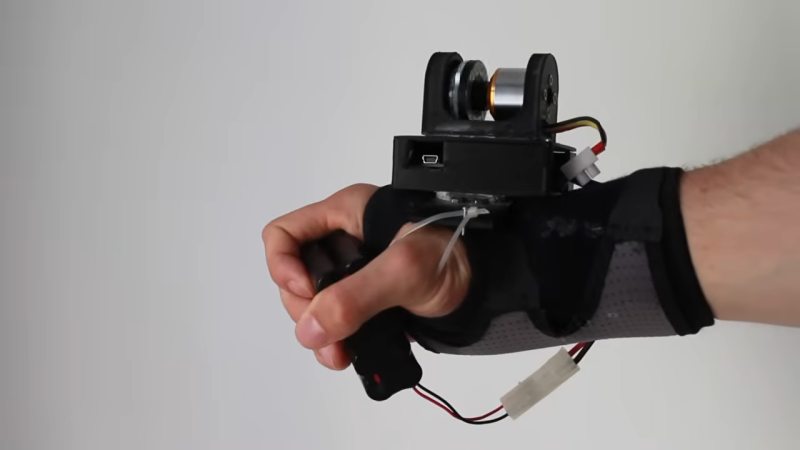
[It’s Triggy!] had a problem to solve. His grandma was having issues with hand tremors, which made the basic tasks of daily life difficult to perform. He decided to explore whether a high-tech solution could help best the tremors and make life easier.
The video covers multiple ideas on how to stabilize a hand suffering involuntary tremors. The first build involved a gyroscope, which proved unsuccessful, but led to the idea of building a reaction wheel. The concept is simple — get the reaction wheel to counteract the forces from tremors to stabilize the hand. To achieve this, an accelerometer was employed to track the movements of the arm and the hand. The magnitude of the movement was then used to control a powerful brushless motor mounted on the wrist. If the tremor was driving a hard tilt to the left, the motor would spin up to create a counter-torque, cancelling out the involuntary movement. This worked to a degree, but the resulting device was large and noisy, which made it impractical.
This thus inspired a return to earlier work involving the use of a tuned mass damper to settle tremors. The combination of some 3D printed wrist mounts along with various spring and cantilever designs… ultimately didn’t work that well. By this point, [It’s Triggy!] had noticed the tremor was mostly in the hands, while the wrist stayed steady. Thus was inspired a wrist-mounted handle for the wearer to wrap their hand around. This allowed the use of simple handheld objects like kitchen utensils, with the wearer’s own grip suppressing the tremor successfully.
As this project demonstrates, sometimes high-tech solutions are the way to go, and other times… a more passive design will actually serve you better.












My mom has essential tremor. I tried doing something like this, with pager motors set up to rotate at the vibrational frequency of her tremor, but the result was both bulky and ineffective. It would really be nice if this worked.
I’ve run across something that uses haptics only to counteract some forms of Parkinson’s shaking, the Emma wristband:
https://pmc.ncbi.nlm.nih.gov/articles/PMC11041244/
However, short term, very small sample size – mostly aimed at tasks for handwriting mainly. Action tremmor attenuation, supposedly, but not discernable aside from visual examination for performance.
(also a very high rate of mention of microsoft product usage in the study.)
Conceptually, alongside other info does make me wonder how a longer term study might re-couple top down control over such signals, such as via sensory substitution (which it’s triggy has also dabbled in). Something for half a year, or more.
A recent study into that has shown some promise for proper deep integration of such signals, although for visual data than this sort of feedback:
https://www.sciencedirect.com/science/article/pii/S105381192500655X
(Yes, this is in children, not adults which may have more issue integrating top down signals but that’s more an engineering challenge I think)
Subjectively, especially from using such sort of tech daily over the span of several years, I think there’s quite some promise down these paths, although the extent of aid will likely be varied person to person.
In terms of bulk for wristbands, I’ve been experimenting quite nicely with inlaid haptics and wiring inside a 85A TPU band – maybe helpful for anyone else looking to do similar explorations.
LRAs especially can be fun, and faster response times too so better for feedback than typical pager ERMs, and for control coupling (as the study above shows, timing is nice to have!).
cool and inspirational, thanks
Excellent work, and good story!
Maybe a purely electrical solution might be possible using something like tens.
perhaps even sensing the nerve impulses before they get to the muscles and countering them in real time rather than trying to match the phase.
Awesome!!!
Essential tremor makes soldering very frustrating. I hate to admit, but a couple of beers can really help (me anyway)
Yes, and it is even more annoying when it is magnified digital microscope!!!
“by a digital…”
Almost all tremors are a rotation around a joint. Accelerators suffer from the “gravity vector” which is impossible to filter out. Since the movement is rotational, a gyroscope provides a superior measurement. Further reading of measurement: Using Portable Transducers to Measure Tremor Severity https://pmc.ncbi.nlm.nih.gov/articles/PMC4872171/