

What filament is strongest? The real answer is “it depends”, but sometimes you have a simple question and you just want a simple answer. Like, which material makes the best 3D printed wrench? [My Tech Fun] printed a bunch of options to find out — including some expensive filaments — and got some interesting insights in the process.
His setup is simple: he printed a bunch of 13 mm open-end wrenches, and tested each one to failure by cranking on a clamped digital torque meter until the wrench failed by breaking, or skipping.
[My Tech Fun] tested a total of eighteen filaments, from regular basic PLA, PETG, ABS and ASA, and a variety of carbon fiber-infused filaments including PPA-CF. TPU is included for fun, and there’s also a wrench printed with continuous carbon fiber, which requires a special printer. More on that in a moment. First, let’s get to the results!
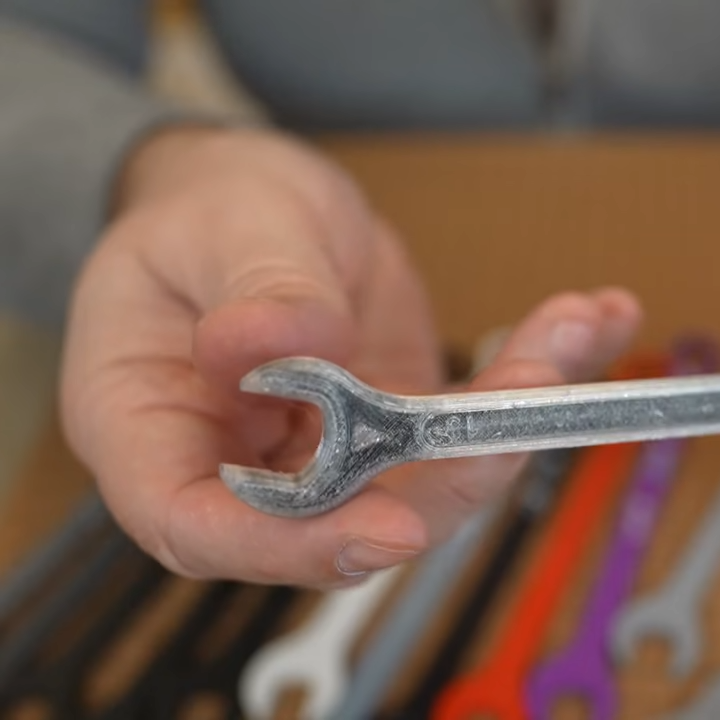
Unsurprisingly, TPU fared the worst at 0.8 nM which is roughly “unscrewing the cap of a water bottle” territory. Top performers included the wrench printed with continuous carbon fiber reinforcement (failing at 3.7 nM) and a couple printed in expensive PPA-CF (high-temperature nylon filament with carbon fiber) topped the list at 4.3 nM. Everything else landed somewhere in between, with plain PLA surprisingly outperforming some CF blends.
The continuous carbon fiber wrench was printed on a FibreSeeker printer, which reinforces a print with solid fibers embedded into the plastic instead of chopped particles, and such prints are noticeably more resistant to bending. Check out our earlier coverage for a closer look at what the FibreSeeker does.
This is a good time to mention that the wrench 3D model used is not at all optimized for best results with 3D printing. But that’s okay; this is really about the filaments, not the wrench.
The wrench model is just a way to test things in a familiar and highly visual, relatable way. You can see each one in action in the video below, and seeing [My Tech Fun] turn the wrenches gives a very good idea of just how much force is involved, with a relatable display of just how strong the different filaments are.










I think it’s N.m not nM for torque.
Especially egregious because the video actually uses the correct units.
A newton-meter, a measure of torque.
Actually it’s Nm and spelled Newton-metre. Newton is a proper noun (name) so it’s capitalised. The international standard unit of length if the Metre. A meter is a measuring device.
Meter is also the English word for the metric unit of length. The abbreviation for Newton-meter is N-m (similarly, avoirdupois units are in-oz, in-lb, ft-lb, etc.). If you send your torque wrench to a lab for calibration, that is how the paperwork will look. I know this because the company I work for runs such a lab and generates that paperwork for our customers.
Never ever have i seen N-m used anywhere. Only Nm. Even in school books.
While N-m is acceptable. N m is the correct term.
And any British person spelling metre (the correct SI unit) as meter needs to be sent to the re-education camps.
To be absolutely pedantic, N-m isn’t acceptable at all. Like you said, N m is, and a lot of places will skip the space with Nm, but ultimately the correct term is N•m, with a multiplication dot, not a hyphen, because that’s what this unit represents: A force multiplied by a distance.
Yes, it is. Well, the vector product N x m is, anyway. The scalar product N • m is a measure of energy.
But the article repeatedly says it’s measuring nanomoles.
A nM of wrenches would be interesting to see. That would make a medium-size asteroid or so.
nM is not nanomole , a number .
nM is nanomolar , a unit of concentration . how can you engineering experts be so naive of science ?
Absolutely correct. [non-engineer with a 40 year old biology degree hangs his head in shame]
Hey, holy jolly wrenchers, make finally something with your comment system. It indicates 5 comments and I see only one. But yes, I like this site.
The comments you are not seeing might be under review.
That very consistently happens when they delete comments…
The problem is the same old one: The materials you use are only readily available in your country.
Videos always end up being useful for a couple of countries worldwide.
The rest of the world doesn’t use those brands for printing.
Would be interesting to know what effect slicer settings have. For instance, make just the jaws of the wrench, where it always broke,100% infill. Or use concentric pattern on top and bottom surfaces to get the longest lines of filament. What’s the gain from additional wall loops?
Use similar materials, PET is PET regardless of who sells it. Same applies to nailon etc.
It’s not. PET or Nylon is a category.
https://www.protolabs.com/resources/blog/types-of-nylon/
Then there’s the quality of product to mind. The polymer chains can have different lengths. This is usually referred to as “molecular weight”, and it influences things like the melting point and strength or creep behavior, impact resistance, etc. Heating it up causes the chains to split, which is why e.g. PET degrades when it gets recycled and why most of it is recycled into cheap T-shirts instead of new bottles. At the end, it still ends up in the landfill because re-recycling the plastic simply turns it into a muddled mess. The same is true when the material is extruded into a filament at the factory. What you start with gets degraded by the process by some amount, so you better not be starting with already poor plastic of varying quality, and you better control your process well.
Then there’s contaminants and impurities, and fillers and modifiers including the types and amounts of dyes used. A spool of PET from one manufacturer is not the same as the other. The feed stock is different, the additives are different, and the process and machinery to make it is different even if we’re talking about the same type of plastic in principle.
Wellll, there’s “molecular weight” and there’s “molecular weight distribution”. Except in very specialized situations, polymerization processes result in a distribution of chain lengths. With an osmometer, you can determine, for a sample taken at a point in time of the process, how many polymer molecules match a given weight. Then you can calculate an average-add up the weight of molecules times the number aat that weight and divide by the total number, right? Not so fast, there, pilgrim, that only gets you “number average molecular weight”. Suppose you use size exclusion chromatography? That gives you weight average molecular weight. A viscometer gives you “viscosity average molecular weight”. Get some drift in the flow of monomer feed or temperature, and your distribution shifts. QC costs money.
Polymer degradation isn’t the only reason recycled PET goes to lower value material. When collecting for recycling, people like to chuck polyethylene, or polystyrene into the recycle bin. They like to use their empty water bottle to drown their cigarette butts. Collect half a dozen bottles in the plastic bag from the store, and put bag and all in the recycle bin. Pour other liquids in the bottle and toss that in the bin. Recycling processes are becoming more automated, but in the bins, some people continue to be idiots. Manufacturers making water bottles don’t want to be sued for contaminated water, so of course they choose new polymer over recycled. And because people often? sometimes? look only at the price tag, some managers assume that is the only metric they should use.
Even if they are available “in the country”, the next question becomes whether they’re available locally to you, at what price, and in what amounts?
If it’s just that one specialty shop in the capital city, and you’re up in the boonies, it’s just as well to mail-order it in from China. Which obviously adds the cost of shipping and the time of delivery.
I’ll save you click. This is the one frame worth looking at, the results table: https://imgur.com/a/jmGOP8V
The part that means something to me is that most filaments cluster around 2 Nm, with a hand-full at 1Nm and 4Nm each. Depending on your perspective, that’s “pretty good for a single-use plastic wrench” or “laughably weak, like it was made out of plastic.” And i can see both of those sides but the thing is, i see it the same at 1Nm as at 4Nm. I’m pretty sure 1 and 4 are the same number.
Now i know, there’s designs where you can shave dimensions based on strength, where that difference will really matter. But overall, i look at it as a “can i do this with 3d printing?” binary question and i really think 1 and 4 are basically the same number.
A plastic FDM spanner is barely useful for a few tasks (in my case, it was removing plastic paint plugs), and whether you use bargain PLA or PPA-CF, you’ll find basically that same experience.
What this test shows – and it is far from systematic – is that some of the materials are four times stronger than the others. That is important, and that is why engineers do tensile tests A LOT. A tensile test is in no way representative of any finished component, but it produces repeatable information (yield and ultimate tensile stress, tensile modulus) that allows engineers to design components that work (in a defined sense) at specified design loads.
When I design a component, the first thing I do is assess the loading. Then I choose a material and manufacturing process. Then I choose a geometry and analyse the structure. At this point I iterate to optimise the design – normally to reduce the cost -and the main levers are either change of material or geometry.
So the meaning of this testing is that I can potentially use substantially less material for my design – not that plastic copies of wrenches are particularly useful.
You certainly got to the heart of my comment, but i disagree completely with your suggestion about the value of this data.
I go through the same design process you describe, except i’m not usually optimizing…i look at just yes/no. Is it possible with this material/process? Does this prototype work? I do ask, “how thick does this have to be?” but if the project would become possible if only i could make a thinner wall, then i start looking at other materials.
And for those binaries, 1 and 4 really are almost the same number. 1 is sufficient for a project enclosure / light loads, or for heavy loads if it’s in compression and steel handles the tension. But 4 isn’t nearly strong enough to make me use the tool differently…if i could double or even quadruple the strength of all my prints overnight, i would still bend over backwards to use metal fasteners to carry all the tension.
It seems like you’re optimizing for relatively mass production, in which case you care a lot about the material characteristics…so you’d care immensely that 3d printing isn’t actually repeatable. Calibration of machine, configuration of slicer, age/storage of filament, age/storage of completed products, these all have an immense effect. And given that, i think you’ll find that FDM plastic isn’t going to be much use to you, especially not in many conditions where the difference between 1 and 4 matters.
But i mean, you’re right. If i print it and it’s twice as strong as i need, i really can probably make version 2.0 lighter / thinner. Stronger does have advantages. They’re just really minor compared to the problems i’m always running into.
The wrench isn’t the point.
Yeah when you consider the margin of error given the differences in the print process, variations in individual reels, etc these are basically all the same. Which shows that the structural flaws of FDM printing are the limiting factor much more than the material itself. Squirting barely melted plastic onto solid plastic just isn’t very effective.
The tests were very subjective, just pulling until it snapped. Objective testing with a long needle pointer on the torque meter aligning with a graduated mark on the spanner handle would show deformation before breaking. Also could have applied force with a sliding contact so as not to twist it up or down. Simple improvements like these would have made for a more quantifiable series of tests.
4 Nm is 4Nm regardless of where you grip the handle. The failure point wasnt the handle. For the average home player, this was good enough.
Should have used Protopasta Stainless Steel Filled HTPLA. That stuff is amazing.
Amazing in all ways except strength unfortunately…
I’m wondering if 13mm were chosen for a reason? Like maybe they tried 10mm but kept losing it somehow?
That’s funny right there! I didn’t care who you are!
That’s the metric half inch ;)
“with plain PLA surprisingly outperforming some CF blends”
Given the last few articles on the subject, I don’t see what’s surprising there…
sounds like lots of the CF thing is just shit and only some really work well
Just printed some plastic ring spanners for plastic seacock operation. PET-G and 100% head fill (concentric). The seacock is in Greece and I’m in England and don’t have a torque meter so couldn’t make measurements but from muscle memory of torque required (~10-20Nm?) they were plenty strong enough. Boat’s owner taking them out to test next month.
What is the yield strength of a regular cheapo wrench? Is it like 100x stronger? Like the kind you get for $2 in a set or like way less at a garage sale?
Is there a use case where a soft plastic wrench won’t mar up whatever you are working on but still be strong enough to get the job done?
.
Only thing I can think up is if you have to dodge a wrench for some reason I would it rather be a plastic one in case I’m having an off day.
Test item.
Nobody suggested actually printing wrenches and using them.
Tangential to your question, but once upon a time when I was young and impecunious, we picked up a cheap socket set (made in Taiwan), intending to replace it at some point. It wasn’t great, some of the sockets liked to slip, but it fixed the ancient riding mower a dozen times, and the car, and things around the house. I did have to replace the ratchet handle once. 25 years later, I bought a very nice US made socket set. Over the years, various open end crescent wrenches. Somehow the only set I can reliably find is that 40 year old cheap set in its battered blue steel case. No idea where the US made set got to. Probably the same place all the missing screwdrivers and tape measures go…
i had one tape measure that still would retract properly and i lost it and my wife found it in the yard and it retracts poorly now :(
What a surprise! /s Regular carbon fibre filaments are garbage. I truly hate how people would constantly gush about them and ignore all the claws because “but its carbon fibre!”