

In 1958, the American free-market economist Leonard E Read published his famous essay I, Pencil, in which he made his point about the interconnected nature of free market economics by following everything, and we mean Everything, that went into the manufacture of the humble writing instrument.
I thought about the essay last week when I wrote a piece about a new Chinese microcontroller with an integrated driver for small motors, because a commenter asked me why I was featuring a non-American part. As a Brit I remarked that it would look a bit silly were I were to only feature parts made in dear old Blighty — yes, we do still make some semiconductors! — and it made more sense to feature cool parts wherever I found them. But it left me musing about the nature of semiconductors, and whether it’s possible for any of them to truly only come from one country. So here follows a much more functional I, Chip than Read’s original, trying to work out just where your integrated circuit really comes from. It almost certainly takes great liberties with the details of the processes involved, but the countries of manufacture and extraction are accurate.
First, There’s The Silicon

An integrated circuit, or silicon chip, is as its name suggests, made of silicon. Silicon is all around us in rocks and minerals, as silicon dioxide, which we know in impure form as sand. The world’s largest producer of silicon metal is China, followed by Russia, then Brazil. So if China and Russia are off the table then somewhere in Brazil, a Korean-made continuous bucket excavator scoops up some sand from a quarry.
That sand is taken to a smelting plant and fed with some carbon, probably petroleum coke as a by-product from a Brazilian oil refinery, into a Taiwanese-made submerged-arc furnace. The smelting plant produces ingots of impure silicon, which are shipped to a wafer plant in Taiwan. There they pass through a German-made zone refining process to produce the ultra-pure silicon which is split into wafers. Taiwan is a global centre for semiconductor foundries so the wafers could be shipped locally, but our chip is going to be made in the USA. They’re packed in a carton made from Canadian wood pulp, and placed in a container on a Korean-made ship bound for an American port. There it’s unloaded by a German-made container handling crane, and placed on a truck for transport to the foundry. The truck is American, made in the great state of Washington.
Then, There’s The Package And Leads

Our integrated circuit is the chip itself, but in most cases it’s not just the bare chip. It’s supplied potted in an epoxy case, and with its contacts brought out to some kind of pins. The epoxy is a petrochemical product, while the lead frame is either stamped or chemically etched from metal sheet and plated.
So, somewhere in the Chilean Atacama desert, an American-made dragline excavator is digging out copper ore from the bottom of a huge pit. The ore is loaded into Japanese-made dump trucks, from where it’s driven to a rail head and loaded into ore carrier cars. The American-made locomotives take it to a refining plant where machinery installed by a Finnish company smelts and refines it into copper ingots. These are shipped to Sweden aboard a German-made ship, unloaded by a German-made crane, and delivered to a specialised metal refiner on a Swedish-made truck.

Meanwhile underground in Ontario, Canada, Swedish-made machinery scoops up nickel ore and loads it onto a Swedish-made mine truck. At the nickel refining plant, which is Canadian-made, the sulphur and iron impurities are removed, and the resulting nickel ingots travel by rail behind a Canadian-made (but American designed) locomotive to a port, where an American made crane loads them into an Italian-made ship bound for Sweden. Another German crane and Swedish truck deliver it to the metal refiner, where a Swedish-made plant is used to create a copper-nickel alloy.
A German-made rolling plant then turns the alloy into a thin sheet, shipped in a roll inside a container on a Japanese-made container ship bound for the USA. Eventually after another round of cranes, trains, and trucks, all American this time, it arrives at the company who makes lead frames. They use a Japanese-made machine to stamp the sheet alloy and create the frames themselves. An American-made truck delivers them to the chip foundry.
At a petrochemical plant in China, bulk epoxy resin, plasticisers, pigments, and other products are manufactured. They are supplied in drums, which are shipped on a Chinese-made container ship to an American port where American cranes and trucks do the job of delivering them to an epoxy formulation company. There they are mixed in carefully-selected proportions to produce American-made epoxy semiconductor moulding compound, which is delivered to the chip foundry on an American-made truck.
Bringing all Those Countries’ Parts Together
The foundry now has the silicon wafers, lead frames, and epoxy it needs to make an integrated circuit. There are many other chemicals used in its process, but for simplicity we’ll take those three as being the parts which make an IC. What they don’t yet have is an integrated circuit to make. For that there’s a team of high-end engineers in a smart air-conditioned office of an American semiconductor company in California. They are integrated circuit designers, but they don’t design everything. Instead they buy in much of the circuit as intellectual property, which can come from a variety of different countries. Banging the drum as a Brit I’m sure you’ll all know that ARM cores come from Cambridge here in the UK, just to name the most obvious example. So British, German, Dutch, American, and Canadian IP is combined using American software and the knowledge of American engineers, and the resulting design is sent to the foundry.
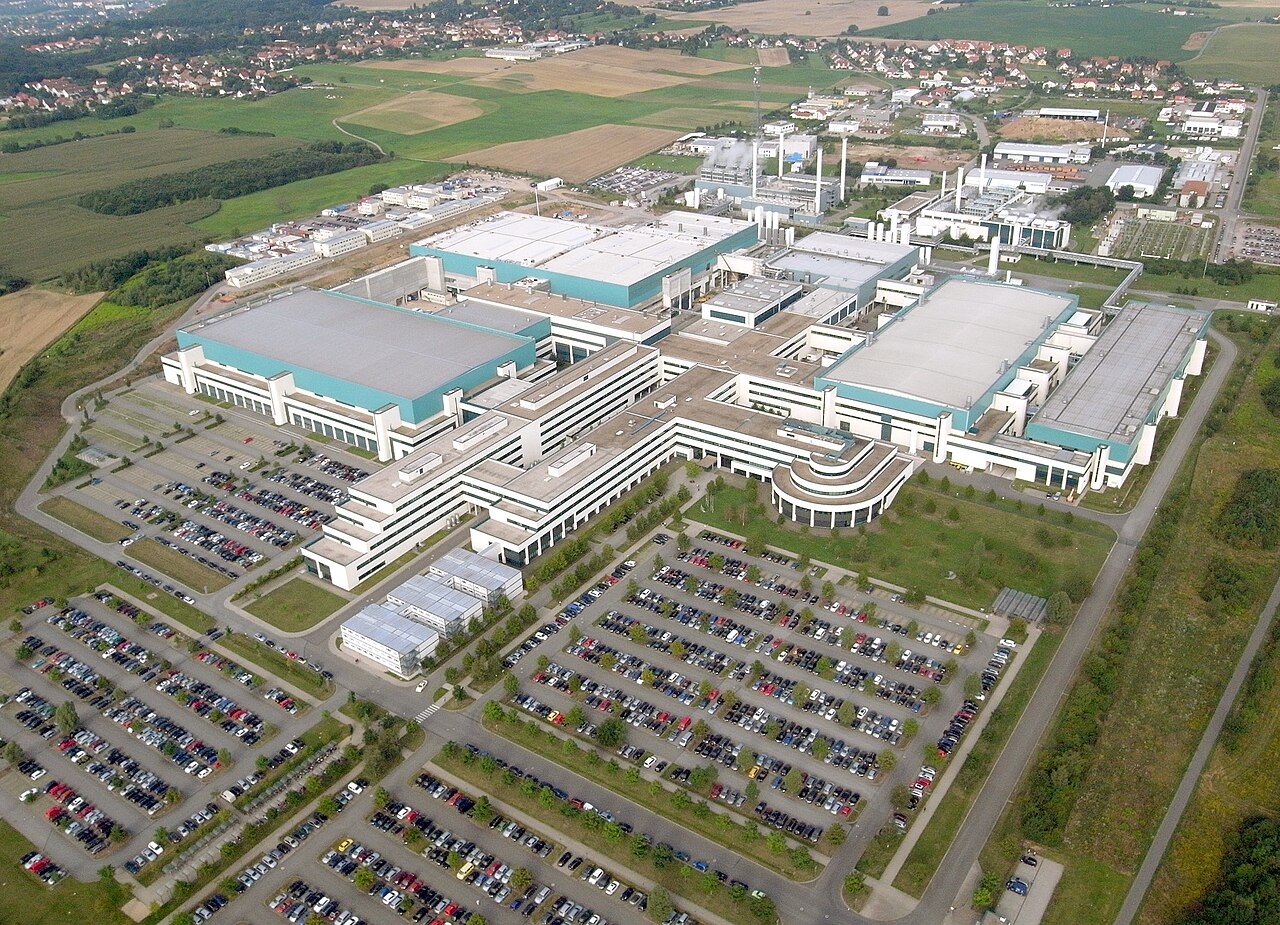
The process machinery of an integrated circuit foundry lies probably at the most bleeding edge of human technology. The machines this foundry uses are mostly from Eindhoven in the Netherlands, but they are joined by American, German, Japanese, and even British ones. Even then, those machines themselves contain high-precision parts from all those countries and more, so that Dutch machine is also in part American and German too.
Whatever magic the semiconductor foundry does is performed, and at the loading bay appear cartons made from Canadian wood pulp containing reels made from Chinese bulk polymer, that have hundreds of packaged American-made integrated circuits in them. Some of them are shipped on an American truck to an airport, from where they cross the Atlantic in the hold of a pan-European-manufactured jet aircraft to be shipped from the British airport in a German-made truck to an electronics distributor in Northamptonshire. I place an order, and the next day a Polish bloke driving an American-badged van that was made in Turkey delivers a few of them to my door.
The above path from a dusty quarry in Brazil to my front door in Oxfordshire is excessively simplified, and were you to really try to find every possible global contribution it’s likely there would be few countries left out and this document would be hundreds of pages long. I hope mining engineers, metallurgists, chemists, and semiconductor process engineers will forgive me for any omissions or errors. What I hope it does illustrate though is how connected the world of manufacturing is, and how many sources come together to produce a single product. Read’s 1958 pencil is alive and well.












Me as a German didn’t know that Germany is delivering so much cranes into the world. But at leas there is also this little light source which is used for the waver production:
https://www.youtube.com/watch?v=NHSR6AHNiDs
There is a very good video form Veritasium about the ASML maschine. It is extremely complicated and some of the last words in the video explain: 5000 companies supply 100.000 components.
https://www.youtube.com/watch?v=MiUHjLxm3V0
All of which illustrates how an efficient, predictable and well-understood global supply chain can facilitate production, and how capricious tariffs will destabilize established and mature but but doddering national economies.
Our societies only exist because of cooperation. Those who were before us learned and maximized cooperation. Many of today’s leaders and followers, while still standing on other’s shoulders, try to dismount this achievement.
well, it’s not many leaders. I don’t know exactly what the far right leaders in Europe are doing, but this is pretty much just Trump and his sycophants. Billionaires and those who work in finance are trying to capitalize on the volatility to make a quick buck for themselves, but those aren’t exactly “leaders”. Just remember when it all begins to collapse, it was Trump. I could say some things about the American political establishment who let him run and win a second term. Literally, there were many legal reasons to disqualify him, and we failed the country. We failed the world, because we were Trumped.
Except it’s not just Trump. The people around him and the Republicans that got him into office and have supported him every step of the way also want this, they just weren’t willing to stick their neck out and try it.
And of course Democrats have been willing to go along with it with the only defence being procedural things that aren’t followed by Republicans or Trump.
The ultra wealthy have demonstrated they understand how to give bribes and don’t mind lower regulation at all.
Trump is a symptom of a larger problem.
Since societal memory seems to be generational, it looks as though we are forced to try tariffs and also maybe not vaccinating against horrible diseases every 40 to 100 years, experience the horror that results, and then know, for the time being at least, why it was we vaccinated and didn’t impulsively levy tariffs.
be sure to advocate against ****ALL**** tariffs and non-tariff trade barriers then. I’m ok with that…but it seems few others have fully normalized their opinions.
Tariffs are the best way to reduce pollution.
We have a lot of ship traffic out there…and it is best that each nation reduce transport through self-sufficiency
Pretty stupid point, unless you wrongly assume all nations are equally large and endowed with same resources. Let USA be self-sufficient in bananas, as “republic”.
“Tariffs are the best way to reduce pollution.”
I thought it was recycling, long term support for products, repairability and reusability of equipment, using biodegradable materials, stop promoting seasonal fashion and cloths made of plastic etc.
“We have a lot of ship traffic out there”
We also have a lot AI generated slop that consumes tons of energy, people flying private jets overseas for shopping or mating, 600+hp sport cars consuming 30+L/Km and rich people arguing we don’t need more trees.
It’s amazing that best way to fix this world is hard work and money of those that have the least ;-)
That’s a perspective error. We have a few hundred supercars, maybe some thousands of luxury vehicles vs. 285 million regular vehicles owned by the general public.
The everyday choices of the common consumer far outweigh the excesses of the rich. They may have the least in terms of money and property, but most in terms of simply consuming stuff, which might have something to do with it.
That’s why stopping the TEMU tsunami is far more effective. Besides, if you complain about one you are really complaining about both.
If this is a common problem, solution should apply to everyone. Otherwise the narration is not credible.
Replace your supercar complaint with industrial use and you’ll be more on track. Just look at Musk’s illegal use of gas turbines that isn’t being shut down.
Musk is trying to skirt the rules by claiming they’re portable, so they don’t need clean air permits to operate.
A containership can carry 1kg across the Pacific ocean using ~10gram of fuel. My car can travel 150m toward the supermarket using that fuel.
Ships are almost never a significant amount of the CO2 in anything. In fact if you wanted a rule of thumb it would be “If you can get it here by ship from anywhere on earth – that will be the lowest CO2”
Tariffs aimed at harming places where things grow well, and encouraging “local” production where they don’t, will always be worse for CO2. Of course if tariffs were used to shut down gas and coal powered data centers in the USA, and encourage geothermal or hydro powered ones in Canada, Russia or Iceland, well that would help global CO2. As would killing USA agricultural exports like corn and soybeans, which have very high oil inputs compared to Brazil for example. Luckily the latter is indeed happening so kudos to the orange one for achieving this.
Or are subsidized well.
Facing predatory business practices in international trade has two options: either you subsidize your own stuff to the same degree so that it can compete, or you set up tariffs to make the other guy’s stuff more expensive to cancel out the subsidies they’re offering.
Both options are terrible, because the point of the game is mutual harm until your opponent yields. Not fighting back with either subsidies or tariffs means default loss: you yield your industries and business over to your opponent, who subsequently jacks the prices up and makes a beggar out of you – economically and politically.
The cost of cheaper imports is a loss of autonomy.
Tariffs are good and valuable tools to level trade imbalances, but only if judiciously crafted, negotiated and agreed upon by the parties involved.
But wielded capriciously, unilaterally and vindictively they destroy trust and dissuade investment everywhere. It makes it impossible for businesses to plan even just a year out. Factories don’t get built, capital gets squandered, jobs are lost and new ones are not created.
It’s not impossible to plan. Just skip the risk and invest in domestic suppliers. Acting randomly hurts the companies that are sitting on the fence, unable to decide whose side they’re on – the kind of business that would instantly jump back to imports when the tariffs are lifted.
Except it hurts everyone since everyone pays higher prices. Also nobody will build a new factory because of tariffs when the tariffs will be gone before the factory is finished.
Pretending this is due to fence sitting is part of the problem. These are economic tools that have seriously bad side effects when abused as they are right now.
That’s the game. Countries like China are playing loss leader and selling under cost to capture the market. If you don’t do anything, they will. They already have.
The rule of the game is, you eat the loss for as long as you can until your opponent can’t stand it anymore and capitulates. It’s an economic war of attrition, and the only way to fight back is to stop buying from countries that are trying to dominate you. The options for that are rather limited – either you ban the imports entirely, or you put tariffs on them to reduce demand.
Again, that’s because of businesses who would instantly jump back to imports the moment they can. You don’t even want that sort of business, because you want long term investments in your own economy.
The moral of the story is that the cheap imported product is not actually cheap.
What you save in the cost of purchase, you lose in increased social spending elsewhere, because you’re not paying your own people. You’re not making stuff, you’re buying it in as a service, so you’re not replacing the value you’re spending and maintaining your own means of production, which means you’re only losing money. You have no income, yet you must pay. This is society eating itself from the inside out.
A tariff on imports is a tax on the people who are the victims of this problem, but they’re also the cause of it, because the whole thing is a deliberate trap. Countries like China are deliberately maintaining imbalanced trade to drag down their economic and political opponents. Only sell, no buy, makes the customer a poor guy.
now apply this logic to 2012
China may be the largest producer of silicon metal, but not for silicon wafers. The grade of the silicon these countries produce is good enough for solar panels and some older semiconductors, not modern CPUs.
The main global source of ultra-high purity silicon is actually in the USA. Without it, the entire semiconductors industry would grind to a halt,
https://www.techspot.com/news/102377-two-mines-north-carolina-key-suppliers-world-semiconductor.html
This is the only place in the world that we’ve discovered, where you can find almost absolutely pure quartz that can make 99.9999999% pure electronic grade silicon. It is of course possible to chemically isolate silicon from other materials, but to do so at the level required for advanced semiconductors is extremely costly.
Silicon a metal?
Metalloid. It depends on who you ask.
https://en.wikipedia.org/wiki/Metalloid
I went to high school with some of those guys!
Of course the silicon mined in China or Brazil produces impure silicon from the smelting plant, that comes with the territory. I have no idea whether the ore is better in one place than the other or not. But I do know that the silicon from a Brazilian or Chinese smelter can be used as a feedstock for the refiner who produces the wafers, and that refiners produce wafers in many places that aren’t the USA.
Yeah, and the process of refining it is rather nasty. You dissolve it in hot hydrochloric acid to make trichlorosilane and then distill that over and over until you’re left with no impurities. If you’re starting with some random beach sand for quartz, distilling all the other junk out may take a while.
The silane gas is directly useful for making polycrystalline sheets by chemical vapor deposition (Siemens Process), which is why it’s used for making solar panels. However, this process only achieves purity of 99.99999% (seven nines). Getting those last two nines is yet more work, and involves a kind of freeze distillation process where you grow the silicon crystals and then dissolve them again, and then grow them again to push the remaining impurities out. Simply measuring how much other stuff you still have left is difficult at that level, so not a lot of places can do it – at a reasonable cost.
Exactly. I thought most techies found this out when the hurricane came through Pine Spruce, N. Carolina, and coincidentally Youtuber LGR had moved to the area(maybe the guardian spirits of Pure Silicon were calling to him?) in my YT feed less than a week ago popped up: “Saudi Arabia Has Oil, America Has This” from Maxinomics. Thank you for the full explanation.
If I remember the video, they pointed out that even the crucible used to melt the silicon is single-use, because it would dissolve slightly into the melt and add impurities if it were used again.
Chinese silicon chip wafer production currently sits at around 50% of domestic consumption and 15% of world consumption. They seem to be advancing at about 5% per year, probably because theirs are 2/3rds the price …
Except this isn’t the source of most high purity silicon. Instead existing other sources are purified and crystals seeded. Making those seed crystals is the entire purpose of the only commercial space lab in operation right now.
Thomas L. Friedman’s The World Is Flat (2005)
Thomas L. Friedman’s My Wife Has a Buttload of Money and My View of the Word Has Been Skewed for Decades (ongoing)
“What I hope it does illustrate though is how connected the world of manufacturing is”
I think you did a great job :-)
Simplified it enough that everyone should get the basic idea – even some of the (at least a bit more intelligent) leaders (if there are any).
This article is rubbish, you didn’t specify from where the materials to make the trucks/cranes/ships was sourced and refined, where the clothing adorning the laborers was manufactured, where the food nourishing said laborers was grown, and where the fertilizer used to grow said food was manufactured, etc…
I kid of course :) I remember reading the original I, Pencil, in a freshman-level Econ course, and the world has only become more interconnected since it was written. Well done in bringing the concepts into the nerdier realm!
So it turns out everything is Planet Earth First and America First couldn’t be more wrong.
I think we read different articles. I say America First, for Americans Canada First for Canadians, etc. basically it should be local first. Every country should be as self sustaining as possible.
This article (and Covid) just shows that a supply disruption in one part of the world can cause chaos worldwide in this worldwide supply chain. If each country is as minimally reliant on others as possible, then such disruptions have minimal effect. No country is likely to be 100% self supporting, but you can have only a few items here and there that you need from other countries and be far less open to outside influence.
There is no self-sustaining possible in a modern world unless we go pre-industrial, simple as that. Even in antique times, world trade was a key for development.
Everything’s a trade-off, in life as in engineering. The goal of minimal reliance on other countries comes at a very high cost of duplicating infrastructure across the planet and doing tasks we’re less suited to than the lowest-cost producers. This means a conscious choice to forgo wealth and standard of living to gain security against supply chain risk.
Not a lot of people struggling to make ends meet will find that sacrifice acceptable, especially when the risk is abstract and occasional.
At best there’s a good argument for on-shoring things that can be done efficiently, possibly with increased automation, though even this would have adverse consequences for overall world wealth and stability, and would not be optimum, either.
A stable geopolitical order with interdependence is just fine. The real problem is the stable geopolitical order part of that equation, not the interdependence.
Not really. If the demand stays the same, the infrastructure is split into smaller units and dispersed – not doubled.
People might argue economies of scale and why it’s better to make everything in one place, but those efficiencies turn into diminishing returns. It’s not twice as efficient to make everything in one industrial park in China, but perhaps 2-5% more efficient compared to each country making their own stuff.
The real cost advantage comes from heavy state export subsidies, disregard of environmental concerns, and abuse of low cost labor. If these factors were taken into account, the advantage would reverse because it takes more energy to ship the products all over the world than just make them where they are needed out of resources closer to home.
More importantly, it’s those small 2-5% gains that enable some few international capitalists to make profit by shuffling goods and resources across the globe. It’s McDonald’s economics: you shave a gram off the burger and you save a million across all the sales, then you pocket the million.
You as the customer won’t really see any savings. All you see is the lower quality coming out of “cost-optimized” supply chains that displaced your local industries 10-20 years ago.
Why stop at nation level? Why not slice things down to county or household level?
Why not indeed. When I was a child, many people had a little potato patch or a backyard garden for growing food and can it for winter so they wouldn’t have to buy as much. Even old apartment buildings in cities had one floor underground for cellars, where people could keep them, and the municipality had a designated garden area a short bus ride away where city folks could rent a small patch of land where you can put up a tiny shed and grow food. They still do that for whoever wants it. Our family had carrots and radishes, salad, peas, onions… a little bit of everything
Now imported potatoes cost 50 cents a kilo all year round, so very few bother. But should they? What else could you have at a local level? A simple shrubbery can turn into baskets and kitchen utensils, little household items that we now buy as plastic trinkets from overseas because they cost too little for someone to make them for sale, but in aggregate cost the economy a lot to import and result in a mountain of trash.
The article is just pointing out the facts: we live in a highly interconnected world and we have been doing for centuries. Localism is a myth, and so I guess the British author has completely failed, despite a detailed explanation, if you haven’t grasped that.
But from a US viewpoint that’d be easy, because Americans do tend to see themselves as being, or should be, self-sufficient. The rest of the world sees the interdependence for what it is and not even as a bad thing. It can breed greater resilience, in the same way that when a US state used to suffer a climate disaster, other states and FEMA would have been sent in to provide aid.
That doesn’t change the other fact that we’re also moving towards a multipolar global society.
I don’t disagree that the world sets up a large trade network at all, but many points in this feel forced….nor sure if its because of cunninghams law, poe’s law, or something in between. Either way it probably missed the point that should have been made to the twit assuming chips are all USA based, and that is that chip DESIGNING has become commonidty to the point where China can do it. It means service based economies need to find new high skill products if they want to keep their edge. At the same time, this is a warning on becoming a service only based economy. Eventually your services will become commodity, so its foolish to abandon manufacturing. Its foolish to abandon raw material production. Its foolish to completly outsource everything. That doesn’t mean you can’t buy products/raw materials from places that are better at it, just that its foolish to switch to service only.
It’s also foolish to abandon basic education for your citizens.
A society that employs a multitude of manufacturers becomes rich, because the manufacturer does not really cost you anything: they replace their wages with the value they produce.
A society that employs a multitude of servants becomes poor, because servants don’t replace their wages with new value: they merely help you consume more of it for extra cost.
It would be rather more useful that people did nothing instead of establishing a service economy in the lack of manufacturing jobs. If you really don’t need them to work in the mines or the factories, or to do whatever necessary bureaucracy, it would actually be more prudent to pay people to stay home and sit still. At least they wouldn’t waste so much resources coming up with different make-work excuses to get paid.
To understand the point, consider: when people find themselves without gainful employment, what’s the most common thing they do?
They set up a restaurant.
The restaurant will then import expensive ingredients and spices that aren’t locally available, they will load the food up with salt and sugar and fat, to make it taste better than the cheaper healthier home cooked dinner, to entice people to eat there. They will oversize the portions to sell more. They will hire entertainers, musical performances, advertising, they will pay taxes and rents to landlords. They will add to the cost of the food the wages of the staff and the running of the establishment, and good profit for themselves, and tips to the waiters.
And what did we get out of it? Basically nothing. For what little entertainment we gained from a fancy dinner or some convenient fast food, we lost from our pockets the ability to invest in something that returns the value back with surplus. It went to a bunch of jokers whose fundamental point in all of this was to make us pay more for food, so they can have some too.
Why did we ever fall for the trick?
I mean, it’s alright to have a bit of fun and waste sometimes, but when the party becomes a point onto itself, because a very large portion of the people are making their living by keeping the party going, and escalating it constantly, the whole thing actually becomes a tragedy.
It’s like one of those well pumps that charities install in poor African villages. One clever idiot thought to install a carousel to drive the pump, so the children must play in order to get their daily water from it. If not the children, the adults will have to do it. Day after day, week after week, month after month, you must spin the carousel until you’re dizzy to pump the water.
That’s not fun anymore.
Are you upset because children are forced to play or because people have to make effort? Will you be my new lala no effort daddy?
The point is, a regular pump handle would be cheaper and more efficient, and more humane to its users instead of going through these charades.
Ah, here it is:
https://effectivehumanitarian.org/p/playpumps
Still it had to be done, because someone made $60 million revenue on these things. That money went of course into some bits of steel pipe and plastic barrels, but mainly it went into paying the people who ran the organization: handling the logistics, publicity, the fundraisers and donation drives, raising awareness and lobbying governments.
Think about how many service economy jobs that is. Even if the people involved think they’re doing good work, their real and most fundamental point isn’t pumping water in Africa at all – the point is pumping money out of the economy at any excuse. Pumps in Africa or food in a restaurant, it’s the same sort of “let me help you to help me into your wallet” type of situation.
The central premise that making money by selling services makes us rich is deeply flawed, because it’s not even a zero sum game, it’s a negative sum game: the more you play, the more you lose.
The point that I’m making is that the efforts we take to make a living by becoming servants are much like burning your clothes at the complaint of cold.
The tragedy being that you could have gone out to chop some wood or find some other fuel, but your jacket was closer to the stove so you chucked that on the coals instead. A person or a society in that situation can no longer help themselves. They’re trapped inside the system because they’ve destroyed their own means of production and are now just burning existing wealth until it runs out.
I honestly keep thinking our (the US) economy has already became the carousel driving the profit pump powering the economy at large. We are now permanently obliged to keep on playing every which possible way to make it spin around no matter what.
First troublesome sing was taxing the retirees in the 1990s. I worked with retirees who HAD to come off the retirement so that they could afford their medications. Literally. At local McD no less. It was very brutal – and me, being one of the nicest people, made it into my daily chore looking after and picking up where one of them simply kept forgetting what to do. For free, in addition to my main duties/assignments. Because someone HAD to. In no way I seek fame or recognition, and I never asked for anything in return, but in many ways any of the hot air al gores could have stopped by and helped them out, yet, they didn’t.
The water pump has been disconnected a long time ago but the carousel is still there, and people have to spin it around as a token of work to earn money, to buy water which is brought in from elsewhere at great debt to whoever is providing it.
The trouble is, since this money is made by pointless make-work that is simply going around in circles, it has no value and cannot pay back the debt. It’s not people working to pump water for themselves, it’s people making the gesture of work to be allowed a portion of whatever little water there is available, no thanks to their efforts whatsoever.
In their attempts to gain a greater share, people push the wheel harder, which makes it spin faster and faster, which means they have to push even harder to keep up. Yet eventually the water stops coming because the productive debt remains unpaid, and then no matter how hard you push the carousel, you’ll still die of thirst.
Of gosh. Let me guess where you are from…
You may.
The illusion here is that a street full of busy restaurants means your community is rich and vibrant. Actually what it means is that you have a street full of successful beggars.
Think about it. Some services are good to have, like someone to cut your hair or sell you a breakfast when you’re traveling, but when it multiplies ten or a hundred times over to the point that people are competing to offer you services and pushing advertising and psychological tricks to make you consume more, it becomes public soliciting.
Local to me there is one of those “vibrant” main streets that supposedly is restored to its former glory. If/when you are in the northeastern US you can visit it yourself, right next to the creme de la creme Ivy League Valley Forge Military Academy.
Nearby there is this posh town, Wayne, PA, that was mostly going down the drains in the 1990s, then suddenly stopped doing so, and slightly reversed the dilapidation(this is really, Lancaster ave, which includes Paoli, PA, etc – it is actually an old trade route, Rt 30). I’ve witnessed it being “returned from the ashes”, so I personally seen how it went – not very good for the very people the town depends on, lowly workers. Aside from the grand total of one apartment (well, two, really – there is one more to the west, the Conestoga road one) now there are no affordable housing left in the area, so all people working on those Main St shops HAVE to drive in daily for work (or, alternatively, take a local transit – luckily, the railroad line connecting it to Philadelphia still runs to this day – luckily, because in other “undesirable” places the transit was discontinued).
Which brings my point, if people who make this “revival” work no longer can afford living in the area, then WHO is this “revival” is aimed at? What if those people decide they no longer want to waste their time driving to/from and find some other job closer to them? Who will be spinning the mandatory carousel that pumps the profits that the town relies on for taxing?
In other words, who does the service economy serve?
Put simply, for every hour of labor I buy, I cannot afford to pay more than I make in an hour, minus taxes. Otherwise I should do the work myself. If the labor I buy is services, so the outcome of the labor is consumed and lost rather than returned, I the customer can only sustain another person who is poorer than me by a good margin.
So, for lower class servants, there must be middle class customers, and for middle class servants there must be upper class customers. Services are always serving up, which means the revival of a town by restructuring the economy as services will gentrify it.
“The restaurant will then import expensive ingredients and spices that aren’t locally available, they will load the food up with salt and sugar and fat, to make it taste better than the cheaper healthier home cooked dinner, to entice people to eat there. They will oversize the portions to sell more. They will hire entertainers, musical performances, advertising, they will pay taxes and rents to landlords. They will add to the cost of the food the wages of the staff and the running of the establishment, and good profit for themselves, and tips to the waiters.
And what did we get out of it? Basically nothing.”
Well do I remember the first night the restaurant people came to my house and raped and killed my family to ensure my continued patronage. You don’t want to know what happened the second night when they came back after raping and killing my family, but you can bet I was all restaurant all the time after that!
Haven’t you heard the news? They say our economy is in a slump because consumer confidence is down and people are saving money instead of spending it.
We have to consume our way out of this recession. We have to eat ourselves rich.
I thought people on hackaday would be smarter than the average, but it’s probably me just forgetting how low the average actually is. When they say the USA is a service economy do you know that doesn’t mean all restaurants and barbers? That means financial services, software services, design services, consulting services, and all manner of businesses that add real value to an economy. Having experts that don’t produce anything but allow others to produce better things is in no way a negative sum game. The only input is time. It’s mind boggling that so many below agree with you when you clearly do not understand the topic.
These are also the things your orange lord left out of the trade deficit/ surplus numbers he posted so, surprise, he doesn’t get it either. Many deficits disappear when you account for services.
Yes. Those were just the simplest examples.
…which then serve the purposes of restaurants, retail business, sports venues, media producers, advertising, finance, hospitality, etc. The “real value” you speak of never materializes when the services are going in a big loop of other services that do not contribute back to the fundamental means of production. Here value is actually consumed, and consumable value is subjective value, not real value.
Real value is that which sustains itself by providing the material means to repeat itself and make more. This is energy, materials, infrastructure (both social and physical), manufacturing, etc. This can also include some services, but not all the services. The surplus of real value becomes wealth that can accumulate, and then wealth turns into services or subjective value as it gets consumed for all the fun stuff we want to have. Like astrophysics, or new cellphones.
The point of the service economy is that it exists on top of wealth, to consume it away. When the service economy overtakes the productive economy, the wealth stops accumulating, which eventually impoverishes the service economy.
There’s a bit of a lag there, because of the accumulated wealth in the system, which means we can rapidly expand the service economy while running down the productive economy before we realize that we just ate the hand that was feeding us.
Note that value here is an abstract entity that changes appearance depending on how it is used.
Many people make the mistake of reifying concepts like value and thinking that because some thing or some activity can be converted to money or other goods and commodities, that means it’s carrying some inherent “value”. That doesn’t make it have value, it just makes it fungible. Like pokemon cards.
And food, energy, land, materials. Services consume wealth to operate. A service may prop up more work, but if that work does not connect back to producing the resources that were consumed, you’re simply kicking the can down the road.
In other words, if I work hard as a bookkeeper to keep the finances of a business that manufactures stuff that gets used to make Hollywood movies, that’s rendering services to run services to run services whose output is consumed by the public – which is basically me. This is a money loop where I pay the people who pay me, while none of us work to replace the fundamental resources we consume or the means of producing those resources.
This is the larger share of the economy, about 80% in the US today. There are far more services than is necessary to support primary and secondary production, so the servants end up serving servants in a loop that inputs real wealth and outputs no real value.
Whatever production remains cannot keep up with the demand. You’d think that with such demand and a lack of supply, the cost of running services would keep going up while the wages of lower sector workers would keep going up, until people switch back from poorly paying services to more fundamental work, but here’s the clever bit: cheap resources are found elsewhere – imports. You don’t have to go back to digging coal or working in a factory, as long as you keep sending money abroad to get the goodies.
What happens when you run out of money? Well, you borrow it. Create debt. Inflate the money supply – that takes a little bit from everyone and transfers it to you, so you can keep getting resources with which you render services and take more money from the economy. Your personal finances are in order while the economy as a whole is bleeding dry, so your money is buying less and less every day and you have to keep scaling back your living standards. Still, you can’t go back to digging coal or working in a factory because those jobs don’t exist anymore – thanks to the cheap imports. Poverty and income disparities keep growing because the people are consuming more than they are producing and nobody seems to be figuring out why.
None of the above would be a problem if we were running balanced trade, because imports would be met with exports, which means domestic production would be used to match the money we’re sending out. Under ideal circumstances, the other countries would have no use of the money alone – they would be interested in the trade: goods for goods, materials for materials, services for services. Mix and match as you please.
But here’s the second trick: the country we’re importing from isn’t interested in buying from us. They have plenty of stuff they can make for themselves. They’re interested in the money for political reasons. They’re giving us cheap stuff in order to gain political leverage using our economy as a hostage.
Remember the story: give a man a fish and he’ll eat for a day, give a man a fishing rod and he won’t be coming back to beg for food. Now, what happens if there’s a man with a fishing rod, and you take the fishing rod from them? You’ll make a beggar out of them, and as a beggar they will do as you please to get the fish.
If you liked “I, Pencil” you’ll love Henry Petroski’s “The Pencil: A History of Design and Circumstance”. All 448 pages of it.
USA! USA!
This fills me with deep concern. In 1936, the Germans had the same attitude in the hope of solving their social problems. The result was World War II.
Nitpick: ASML is located in Veldhoven, which is almost a suburb of Eindhoven, but stil a separate city.
https://en.wikipedia.org/wiki/Veldhoven
You have succeeded in making me want to support additive manufacturing R&D….
I’ve worked in semicon for almost ten years (we make 555s if you want a hint) and its always amazed me how we can get a wafer from an ingot (from Brazil apparently), process it at a US fab, ship it to SE Asia for packaging, then to China for assembly into a product, and then back to the US in your phone or whatever and the whole operation is still profitable
100% made-in-the-USA projections of $3k smartphones always felt a little low to me
That’s brilliant!
I’ll have you know that the California fellas tend to gather up specs and send them to various drab little offices around the world for implementation, including at least one in Armenia.
…and here’s the ‘danger’ (if you could call it that). There is one country out there that’s able to source just about everything in the supply chain and not only source it but do it efficiently. That’s China, of course. Naturally like anywhere else companies there do a build/buy trade off but our dumb Cold Warriors are so stuck in the past they just assume that if we bully some supplier or another into not selling them something they’ll just crumble and fold (because, as we all know, those foreigners can’t develop anything, only copy)(just like we used to say about the Japanese, BTW). All we do by playing silly buggers like this is alter the build/buy calculus, it won’t actually stop anything of China’s size, at best it will just slow them down a bit. The problem then becomes one less piece of the puzzle for us to supply and them to buy and one that’s likely to be a whole lot cheaper. (Remember, also, for 99% of the time ‘better’ is irrelevant, its being ‘good enough’ that matters.)