
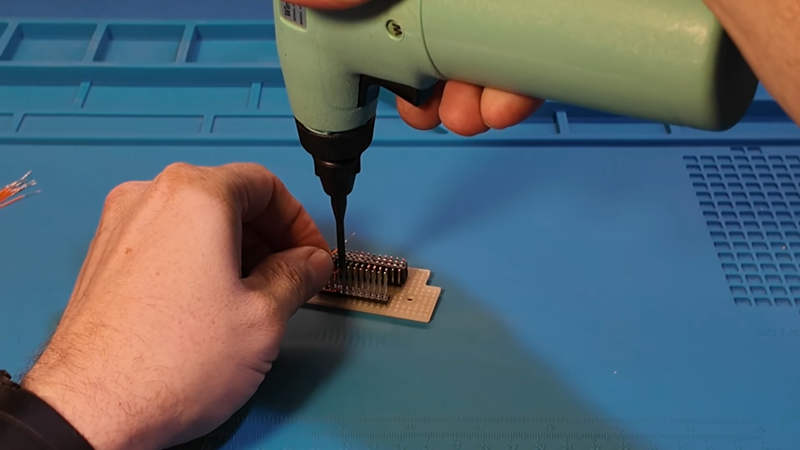
Before PCBs, wiring electronic circuits was a major challenge in electronics production. A skilled person could make beautiful wire connections between terminal strips and components with a soldering iron, but it was labor-intensive and expensive. One answer that was very popular was wire wrapping, and [Sawdust & Circuits] shows off an old-fashioned wire wrap gun in the video below.
The idea was to use a spinning tool to tightly wrap solid wire on square pins. A proper wrap was a stable alternative to soldering. It required less skill, no heat, and was easy to unwrap (using a different tool) if you changed your mind. The tech started out as wiring telephone switchboards but quickly spread.
Not all tools were guns or electric. Some used a mechanical handle, and others were like pencils — you simply rotated them by hand. You could specify levels for sockets and terminals to get a certain pin length. A three-level pin could accept three wire wrap connections on a single pin, for example. There were also automated machines that could mass-produce wire-wrapped circuits.
The wire often had thin insulation, and tools usually had a slot made to strip the insulation on the tiny wires. Some guns created a “modified wrap” that left insulation at the top one or two wraps to relieve stress on the wire as it exited the post. If you can find the right tools, wires, and sockets, this is still a viable way to make circuits.
Want to know more about wire wrapping? Ask [Bil Herd].












With the current copper prices it’s a bad time to turn to wire wrapping.
You need extra length on each wire, and I presume that CCA is not very secure when wrapped, although I don’t know that for sure.
Would be interesting to hear if any of you tried copper clad aluminium or copper clad iron even.
If it works with CCA then that would actually make CCA more viable since soldering the stuff is tricky, as soon as the copper layer is gone you can forget about soldering it, so you need to be very quick when attempting to solder.
You would sill need to use solid core wire of course for wire-wrapping, so there’s that caveat.
Addendum: I mainly mention CCA because I imagine copper clad iron might be too stiff for wrapping, not sure though.
Addendum to the addendum:
Actually since they still use wire-wrapping for nichrome wires I guess the stiffness of the wire is no issue in terms of attachment, although I wonder if you can do it with hand tools.
Wire-wrapping was used by NASA and on some critical weapons systems. If done right, reliability is very good !
it is really reliable… it was a mess on complex circuit through, and these long pins has serious freqency limits…. done properly it’s as stable as plain soldering
It is now the perfect time to become a copper farmer and visit your local scrapyard for a harvest season
A 1000 foot roll of PVC insulated 30 AWG wrapping wire is about $10. There’s not a lot of copper in wire that thin.
“Slit-n-wrap” was a small subset of wire wrapping, and AFAIK it was never very popular.
It always almost worked.
I tried it back in the day – 30-40 years ago, trying to make an S-100 multi-EPROM board. If I recall, the biggest drawback was the special insulation on the wire, regular PVC wire-wrap wire did not work. Also, the tool was battery-powered, and nothing like the AC-powered wire-wrap guns.
The post was square. This produces a small air tight nick in the wire at each corner and each wrap. When done correctly, t is very low resistance and, being air tight in the nick, not prone to oxidation.
If not carefully wrapped, there can be a one or more wraps with the kynar insulation around the post. As rise times increased this became an issue, along with the general capacitance and inductance of the wires laying side by side and crisscrossing around the board.
As noted there were machines that could mass produce large boards with thousands of wraps. These machines were at one point based on the PDP-8 and was the reason the PDP series was produced in quantities that were not surpassed until the IBM PC was introduced.
Apart from cost, the major problems with wirewrap for high speed signals are (1) inductance of Vcc/Gnd wires and (2) stub length of the pins. Crosstalk (both FEXT and NEXT) can be controlled by the route the wires take.
When I see string art, my mind conjures up wire wrap, OK when everything was bigger and more fun, but no good in the miniature world.
IBM used this for decades. I have done hundred of change orders on IBM cumputers over the years I was in the field.
I still have a few hand wrap pencils around here and an electric gun as well. I last used it about 15 years ago for a bit of telephone exchange work.
Wire wrap guns are cool but SO EXPENSIVE
The “squeeze” wrap guns are good for one-off wraps, but your hand will protest after more than one or two. Gun or wrap/unwrap tool worked best for me. I still have an elecric wrap tool. Built a lot of projects with it and they worked reliably.
“left insulation at the top one or two wraps” should be bottom one or two wraps, the stripped tail is wrapped last. Doing it the other way would require some sort of Rick Sanchez inter-dimensional W/W Gun.
Top as you have the board upside down to do the wrapping not component side up.
Yes, the insulated part is the closest to the board. At the bottom as you are working and the tail end closest to the end of the pin. And in 3 layers of wiring for the typical pin length.
Seeing the words “old-fashioned wire wrap gun” doesn’t feel right.
Can you imagine smart watch built with that technology?
Also, wire wrapping is a technique long used in jewelry making.
I bought my wire wrapping “pencil type” tool at Radio Shack and I still use it often. The stripping tool that comes with it fits inside the body of the tool for storage.
Re the video: who says “awg”? Call it gauge if you wish to be understood; in most places American Wire Gauge is assumed.
I have fond memories of buying packets of pre-stripped wires.
I never had a problem with the slit-n-wrap type wrapping gun, but it seems reasonable to assume the slitting blade would wear out eventually.
Most places = the US of A.
I was able to sharpen my Slitter..
I have Lots of Hours behind a Wire Wrap Gun.. My Gun ( I still have it ) I think was a ‘Victor’.. and looks Just like the Phaser on the TV Series Star Treck..
I recently used my mid-80’s era wire-wrap “pencil” to connect to the square pins on an ESP-32 module … It was easy and worked well – MUCH better and faster than soldering to them.
I remember wire-wrapping up boards for an S-100 computer system – the electric wrapper worked well !!!
a kind of dumb hack…i use wire wrap to secure wires before soldering sometimes. Like, for direct use on components that don’t have the square leads you need to make a strong wrap. I will just wrap it onto the round-leaded resistor, and then solder on top of that (making sure to get solder directly onto the lead) to actually provide the strength and low-resistance connection. In that case, i might make only 1 or 2 loops around the lead instead of the about-5 wraps that i use for wrap-only connections.
I know there’s other ways to use perfboard but that was my favorite for a long time.
kinda low tech and not really fast to make, but I have self made wire wrap tools made from a 3d printed handle (print half and glue together) and a strip of aluminum cut from a drink can. Wrap that strip around two needles to make the holes for the wire and the pin, then put between the 2 halves of the handle when gluing.
Isn’t fancy, but it works ok for the few times i’ve needed something like that