
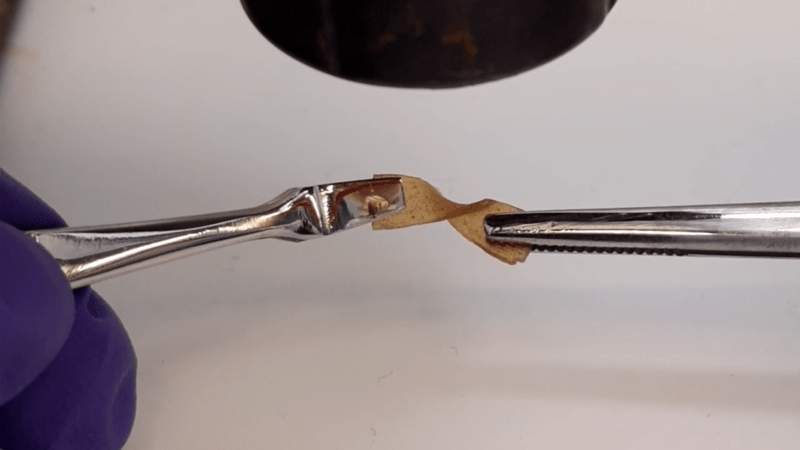
As anyone who extrudes plastic noodles knows, the glass transition temperature of a material is a bit misleading; polymers gradually transition between a glass and a liquid across a range of temperatures, and calling any particular point in that range the glass transition temperature is a bit arbitrary. As a general rule, the shorter the glass transition range is, the weaker it is in the glassy state, and vice-versa. A surprising demonstration of this is provided by compleximers, a class of polymers recently discovered by researchers from Wageningen University, and the first organic polymers known to form strong ionic glasses (open-access article).
When a material transforms from a glass — a hard, non-ordered solid — to a liquid, it goes through various relaxation processes. Alpha relaxations are molecular rearrangements, and are the main relaxation process involved in melting. The progress of alpha relaxation can be described by the Kohlrausch-Williams-Watts equation, which can be exponential or non-exponential. The closer the formula for a given material is to being exponential, the more uniformly its molecules relax, which leads to a gradual glass transition and a strong glass. In this case, however, the ionic compleximers were highly non-exponential, but nevertheless had long transition ranges and formed strong glasses.
The compleximers themselves are based on acrylate and methacrylate backbones modified with ionic groups. To prevent water from infiltrating the structure and altering its properties, it was also modified with hydrophobic groups. The final glass was solvent-resistant and easy to process, with a glass transition range of more than 60 °C, but was still strong at room temperature. As the researchers demonstrated, it can be softened with a hot air gun and reshaped, after which it cools into a hard, non-malleable solid.
The authors note that these are the first known organic molecules to form strong glasses stabilized by ionic interactions, and it’s still not clear what uses there may be for such materials, though they hope that compleximers could be used to make more easily-repairable objects. The interesting glass-transition process of compleximers makes us wonder whether their material aging may be reversible.









Yaaaay another plastic which will last longer in the nature and the soil!
eh, maybe? But that does not sound like a reason to stop doing chemistry research? Somebody earned his doctorate on this, and you start to whine about a largely still theoretical substance being non-biodegradable? Did you do any research on this, or did you just assume it to be non-degradable?
what alternatives do you propose? Do you realize that soda-lime glass itself is not bio-degradable either and is not as heat malleable (by a very large margin) as this invention?
wrong comparison. glass is mostly inert, like granite or basalt.
He has a point. look at the biodegradability of plastics and what percentage manage that in a reasonable time. its less than 1% of all produced. then look at the plastic polution is some asian cities.
Not making new plastics. The future doesn’t have to consist of “new, new, new, more more more”.
That’s an asset if it can be recycled/reprocessed.
3D Printing Filament of this could be interesting.
What happened to Titan and Hydro? They seemed interesting as far as recycle-ability..
https://www.prescouter.com/2017/03/new-class-polymers-titan-hydro/
An oddball question — if you make a Prince Rupert’s Drop with this stuff (or any other kind of plastic, for that matter), does it exhibit the same properties as one made of glass?
I wonder how the material properties compare to the similar Liquid Crystal Polymer filaments like Fabru’s “purefil” and NematX’s “Nema”: Super strong and stiff, high temperature stuff. Correspondingly eye-wateringly pricey.
I’ve had common products like bread or cheese that was packed in plastic that was insanely strong, you could not tear it with human strength and some plastics even maintain that strength if you make a cut in it to help you start, it will still resist tearing.
Problem though is that it is flexible and not rigid so it’s not suitable for lots of things.