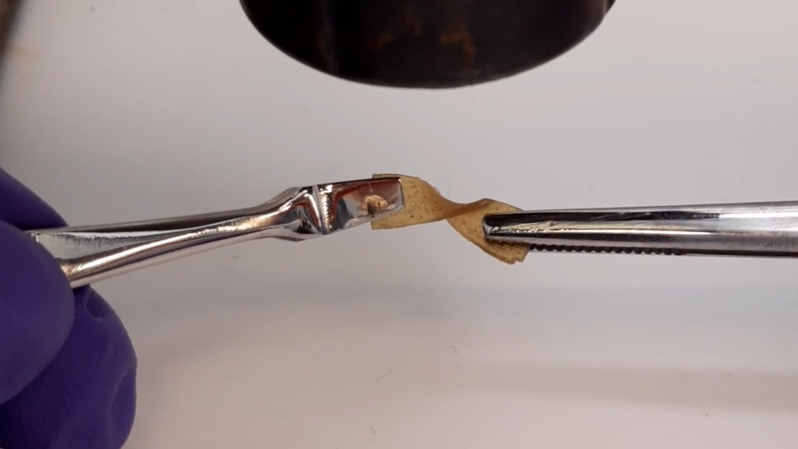
A small piece of brown plastic is held in two pairs of tweezers under a heat gun, and is being twisted.

A New And Strangely Strong Kind Of Plastic

As anyone who extrudes plastic noodles knows, the glass transition temperature of a material is a bit misleading; polymers gradually transition between a glass and a liquid across a range of temperatures, and calling any particular point in that range the glass transition temperature is a bit arbitrary. As a general rule, the shorter the glass transition range is, the weaker it is in the glassy state, and vice-versa. A surprising demonstration of this is provided by compleximers, a class of polymers recently discovered by researchers from Wageningen University, and the first organic polymers known to form strong ionic glasses (open-access article).

When a material transforms from a glass — a hard, non-ordered solid — to a liquid, it goes through various relaxation processes. Alpha relaxations are molecular rearrangements, and are the main relaxation process involved in melting. The progress of alpha relaxation can be described by the Kohlrausch-Williams-Watts equation, which can be exponential or non-exponential. The closer the formula for a given material is to being exponential, the more uniformly its molecules relax, which leads to a gradual glass transition and a strong glass. In this case, however, the ionic compleximers were highly non-exponential, but nevertheless had long transition ranges and formed strong glasses.

The compleximers themselves are based on acrylate and methacrylate backbones modified with ionic groups. To prevent water from infiltrating the structure and altering its properties, it was also modified with hydrophobic groups. The final glass was solvent-resistant and easy to process, with a glass transition range of more than 60 °C, but was still strong at room temperature. As the researchers demonstrated, it can be softened with a hot air gun and reshaped, after which it cools into a hard, non-malleable solid.

The authors note that these are the first known organic molecules to form strong glasses stabilized by ionic interactions, and it’s still not clear what uses there may be for such materials, though they hope that compleximers could be used to make more easily-repairable objects. The interesting glass-transition process of compleximers makes us wonder whether their material aging may be reversible.

Failed 3D Printed Part Brings Down Small Plane

Back in March, a small aircraft in the UK lost engine power while coming in for a landing and crashed. The aircraft was a total loss, but thankfully, the pilot suffered only minor injuries. According to the recently released report by the Air Accidents Investigation Branch, we now know a failed 3D printed part is to blame.

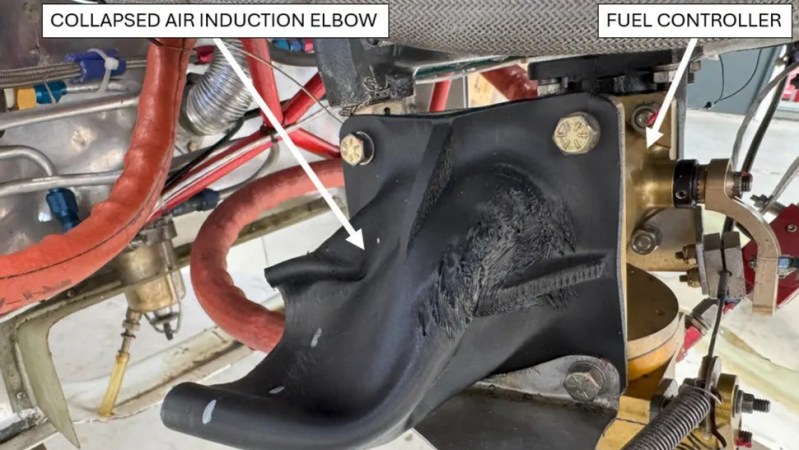
The part in question is a plastic air induction elbow — a curved duct that forms part of the engine’s air intake system. The collapsed part you see in the image above had an air filter attached to its front (towards the left in the image), which had detached and fallen off. Heat from the engine caused the part to soften and collapse, which in turn greatly reduced intake airflow, and therefore available power.

Serious injury was avoided, but the aircraft was destroyed.

While the cause of the incident is evident enough, there are still some unknowns regarding the part itself. The fact that it was 3D printed isn’t an issue. Additive manufacturing is used effectively in the aviation industry all the time, and it seems the owner of the aircraft purchased the part at an airshow in the USA with no reason to believe anything was awry. So what happened?

The part in question is normally made from laminated fiberglass and epoxy, with a glass transition of 84° C. Glass transition is the temperature at which a material begins to soften, and is usually far below the material’s actual melting point.

When a part is heated at or beyond its glass transition, it doesn’t melt but is no longer “solid” in the normal sense, and may not even be able to support its own weight. It’s the reason some folks pack parts in powdered salt to support them before annealing.

The printed part the owner purchased and installed was understood to be made from CF-ABS, or ABS with carbon fiber. ABS has a glass transition of around 100° C, which should have been plenty for this application. However, the investigation tested two samples taken from the failed part and measured the glass temperature at 52.8°C and 54.0°C, respectively. That’s a far cry from what was expected, and led to part failure from the heat of the engine.

The actual composition of the part in question has not been confirmed, but it sure seems likely that whatever it was made from, it wasn’t ABS. The Light Aircraft Association (LAA) plans to circulate an alert to inspectors regarding 3D printed parts, and the possibility they aren’t made from what they claim to be.

From Fail To Wail: Guitar Picks Made From 3D Printed Waste

Between failed prints and iterative designs that need a few attempts before you nail them down, a certain amount of wasted material is essentially unavoidable when 3D printing. The good news is that PLA is a bioplastic and can be broken down via industrial composting, but even still, any method that allows you to reuse this material at home is worth taking a look at.

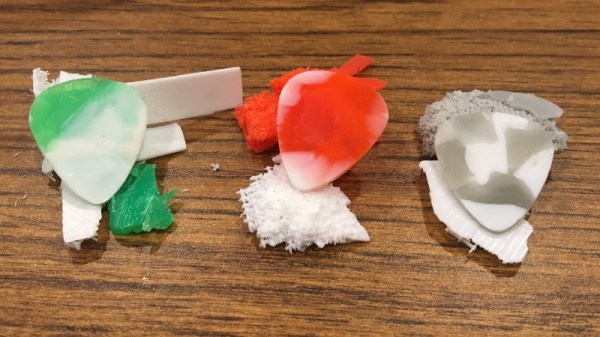
In a recent video, [Noah Zeck] details one potential use for your scrap plastic by turning his failed 3D prints into guitar picks. The idea here could really be applied to anything you can make out of thin plastic sheeting, but the fact that you can easily and cheaply produce picks with a commercially available punch makes this application particularly appealing.

The first step in this process is about as low-tech as it gets: wrap your scrap printed parts in rags, and beat them with a sledge hammer. This breaks them up into smaller and more manageable pieces, which is important for the next step. If the parts are small enough and you’ve got a decently powerful blender you don’t mind devoting to plastic recycling, we imagine that would make short work of this step as well.

Once suitably pulverized, [Noah] puts the plastic on a piece of glass and gets it warmed up with a heat gun. PLA has a fairly low glass transition temperature, so it shouldn’t take much time to soften. Then he puts a second piece of glass on top and squeezes them together to get a thin, flat sheet of plastic. Once cooled, he punches his guitar picks out of the sheet, with bonus points if the colors swirled around into interesting patterns. If you’re not musically inclined, we’ve seen a very similar method used to produce colorful floor tiles.

Continue reading “From Fail To Wail: Guitar Picks Made From 3D Printed Waste”