
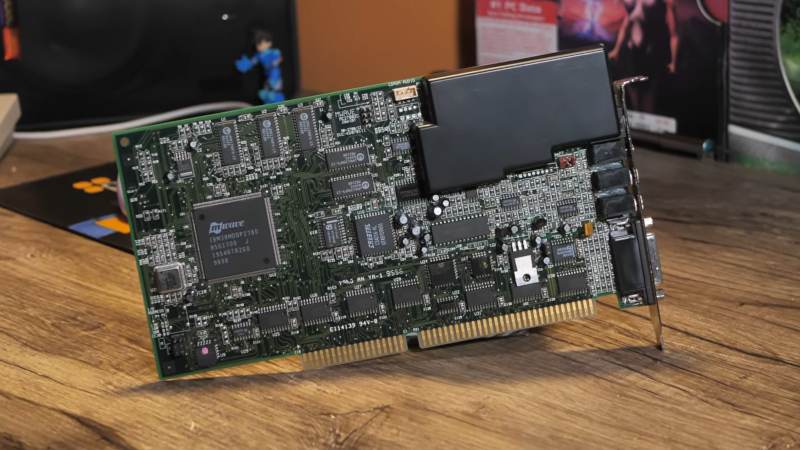
Even in a field you think you know intimately, the Internet still has the power to surprise. Sound cards of the 1990s might not be everyone’s specialist subject, but since the CD-ROM business provided formative employment where this is being written, it’s safe to say that a lot of tech from that era is familiar. It’s a surprise then when along comes [DOS Storm] with a new one. The IBM Mwave was the computer giant’s offering back in the days when they were still pushing forward in the PC space, and sadly for them it turned out to be a commercial disaster.
The king of the sound cards in the ’90s was the SoundBlaster 16, which other manufacturers cloned directly. Not IBM of course, who brought their own Mwave DSP chip to the card, using it as both the sound card and the engine behind an on-board dial-up modem. This appears to have been its undoing, because aside from its notoriously flaky drivers, using both sound and modem at the same time just wasn’t a pleasant experience. To compound the problem, Big Blue resorted to trying to bury the problem with NDAs rather than releasing better drivers, so unsurprisingly it faded from view. Perhaps the reason it was unfamiliar here had something to do with it not being sold in Europe, but given that the chipset found its way into ’90s ThinkPads, we’d have expected to have seen something of it.
In the video below the break he introduces the card, and with quite some trouble gets it working. There are several demos of period games which sound a little scratchy, but we can’t judge from this whether they’d have sounded better on the Creative card. If you’d like to immerse yourself in the folly of ’90s multimedia, have a little bit of Hackaday scribe reminiscing.












Seems to sounds better than AY-3-8910
Was that close to the pong game chip, AY-3-8500/8550?
Who knew it not ? It was not uncommon on Thinkpads
There was even a Linux kernel driver at some point:
https://mikebouckley.net/mwave/mwave.html
Yes, I agree. It was the king of the Sound Blaster standard, the sucessor of SB Pro 2.
The SB32, AWE32 and AWE64 (and AWE 64 Gold) were SB16+EMU8000 synth.
The EMU 8000 was directly supported by many DOS4GW games, also.
Some Pentium II/III chipsets included SB16 compatibility directly via on-board sound chip.
The SB16 also was emulated in Virtual PC and other emulators/virtualizers.
It became the reference by mid-late 90s, after the SB Pro 2.
That being said, popular competitors of the time were MV Pro Audio Spectrum 16 (PAS16), Gravis Ultrasound (GUS) and Windows Sound System (WSS, 48 KHz).
The WSS often was supported by SB Pro 2 compatible sound cards, too.
Lesser known cards were the Ensoniq SoundScape S-2000, MV JAZZ 16 series and ESS AudioDrive series, maybe.
Most ISA bus Sound Blaster clones were Sound Blaster Pro 2 compatible rather than Sound Blaster 16 compatible.
Most genuine Sound Blaster cards before the AWE32 were noticeably noisy. Many clones outperformed the real thing.
Sure, you’re right. The “king” of the Sound Blaster standard became the SB16, though. The author’s wording was spot on, I think.
By about mid-90s, CD quality audio was very important to MPC standards.
The SB Pro 2 was relevant for compatibility reasons, mainly, rather than for quality.
The demoscene used SB Pro 2 and GUS, often.
Old DOS games demanding for legacy sound support (SB 1.x, 2.0, SB Pro 2 stereo support etc) were also a factor.
Most SB Pro 2 compatibles had supported at least one other sound standard, too, because SB Pro standard was dated.
Years later, SB16 clones with full SB Pro 2 compatibility appeared.
They supported the SB Pro mixer, SB Pro stereo support and the SB16 modes.
Something the real SB16 never featured (it had issues with SB Pro stereo via DAC/ADC).
Notable is that the panning of a mono signal to hard right/left via mixer worked on SB16.
That’s why Wolf3D (?) as a popular exception sorta worked on real SB16,
despite being programmed for SB Pro (but it has some noise on SB16 due use of single-cycle DMA).
The real SB Pro stereo mode (interleraved?) didn’t work, though, because the SB16 DSP did swallow some bits.
Thus, SB Pro stereo sound became mono on real SB16.
The later SB16 clones fixed the flaw, as did some SB16 emulations.
Another thing I forgot to mention..
The original SB Pro (SB Pro 1) and the Pro Audio Spectrum (non-16) used two YM3812 instead of a YMF262 (4op and stereo).
That’s why a few titles don’t sound right on later Sound Blasters.
The earlier dual YM3812 setting had more voices to play, but lacked 4 operator mode (more complex wave forms).
The early “Noise Blasters” (CT1740, CT1750 etc) can be compared to early Gen 1 Sega Genesis consoles, maybe. Muffled sound, but deep bass!
Skipping the on-board amp and configuring for line-out helped a bit against the noises.
But the “thinking” sound was perhaps not completely surpressed that way. 😕
Another, positive thing was that the early SB16 models had required no driver software to function.
No CTCU or CTCM. Everything was selectable via jumpers.
That made it useful to users of OS/2, BSD, Linux etc because no DOS/Creative drivers were needed to init the card on boot.
It basically was set-up like an 8-Bit Sound Blaster.
Sure, since UniSound was released, ISA PnP cards are nolonger so much of an issue.
But having a fully hardware-configurable card is still cool to have, maybe. 🙂
I had a IBM Aptiva, actually I still do. We got it has a replacement to a computer Radio Shack was supposted to warrentry and lost it (with my moms college term paper).
It dual booted OS/2 Warp and Window 3.1. The only way I could get that damn Mwave card to work was under OS/2. In windows, if you thought about loading another piece of software or looked at it funny, that damn Mwave card would stop working.
Of course I was asked by my parents to upgrade to Windows 95 when it was released and it required you wipe OS/2. OS/2 was a much better OS.
I also had an Aptiva. Theoretically the mwave (also known by the codename “dolphin”) had a lot going going for it. High fidelity audio, soft modem (before we learned to hate them), wave table midi when that was an expensive high-end feature, and possibly some other things I’ve forgotten. But the driver situation was dire. If they weren’t working or IBM didn’t supply them for your OS, you were SOL. I also seem to recall it didn’t have the grunt to drive the modem function and one other major piece of functionality… The wave table synth?
On my Aptiva with Windows 95 and the MWave Dolphin card, using the sound card and the modem was fully an “OR” situation. When the modem was in use, there was no sound output at all. Occasionally, when the modem was in use and something tried to play a sound (e.g. If I unpaused Winamp or someone came online in AIM and the door opening sound played), the computer would hard lock.
If I had sound playing, then the modem just wouldn’t respond.
Back in the 1990’s, I worked for the US Treasury and one of my HR jobs was to laser scan the fingerprints of new employees. We had a dedicated LAN which consisted of two IBM PC’s with secure modems that were connected to the FBI Fingerprint database. These two computers used OS/2 as their operating system. If I remember correctly, the whole system was called the Identix TP 600.
I never had any problems running OS/2.
Indeed. That’s because sharing a device with OS/2 was tricky.
While there was a way (IOPL=YES in config.sys), it was of limited use.
Sharing the YMF262 FM chip worked that way, for example.
So DOS games could play music on OS/2.
The problem with Windows -or Win-OS/2, rather- was that the Windows 3.1 drivers didn’t unload automatically.
Once Win-OS/2 was running, the sound drivers conflicted with the native OS/2 sound drivers.
Using multiple Win-OS/2 sessions -one for each Windows program- made that worse.
There were solutions, though. That genaud driver comes to mind.
Or using soundcards with two separate devices.
Such as SB Pro/WSS cards. WSS part for OS/2, SB Pro for DOS/Win-OS/2..
Personally, I had used a PAS16 once for this purpose.
The SB16 native part was used in OS/2 for music/video playback,
while the Thunderboard part (SB 1.5 “clone”) was used in DOS/Win-OS/2 as a legacy device.
The common YMF262 could be used by either side,
provided that only one application or OS personality used it at a time.
True. Windows 95 was a downgrade, actually. But people fell for it, unfortunatelly.
Many even started to build their whole PC skill set solely around installing/configuring Windows (95)..
There’s even a parody comic about it from the 90s: https://tinyurl.com/4fw23hhk
The mwave was more than a sound card. As you said, it had a full DSP, meaning it could perform on board processing. Voice recognition was one of its standard capabilities, along with voice synthesis. You could do audio input and output across the phone line not limited to the soft modem, including the voice operations (subject to bandwidth limitations)and DTMF recognition. Put those together, and you had a viable pc-based telephone response system.
(I own one of these, still plugged into the expansion chassis for a luggable.)
Having a general purpose DSP coprocessor in a PC of the time was somewhat revolutionary. Unfortunately, it was not cheap, education in how to take advantage of all its capabilities was hard to get (most folks haf barely heard of dsps), and like other telephone interfaced cards of the time the telephone interface was vulnerable to over voltage (I don’t think anybody was offering surge protectors with telephone protection yet).
Remember the speed of machines at the time. A versatile processor that could respond fast enough to manipulate audio in near real time was an interesting beast. But people hadn’t yet started thinking about flexible audio on a PC, the learning curve to take full advantage of it was too steep, and there weren’t enough sold to motivate folks who were interested to write application and sell them at reasonable prices.
Heck, I still need to dig out a good introduction to digital signal processing and learn those skills myself, all these years later, with an eye toward writing DAW plugins…
This is when IBM had foreign subcontractors sabotaging everything they did over in” that country of cheap tech labour”
I saw an earlier offering from the 286/AT era where I had this IBM-made kit in the old software box of their style that was used for speech therapy and it included a microphone and sound card of sorts. I remember being amazed how well it would distinguish vowel vs consonant speech patterns in a simple game with surprising accuracy
When you mentioned IBM sound cards, I thought you were talking about this one:
https://en.wikipedia.org/wiki/IBM_Music_Feature_Card
I think it may have predated both the Adlib and Soundblaster cards.