
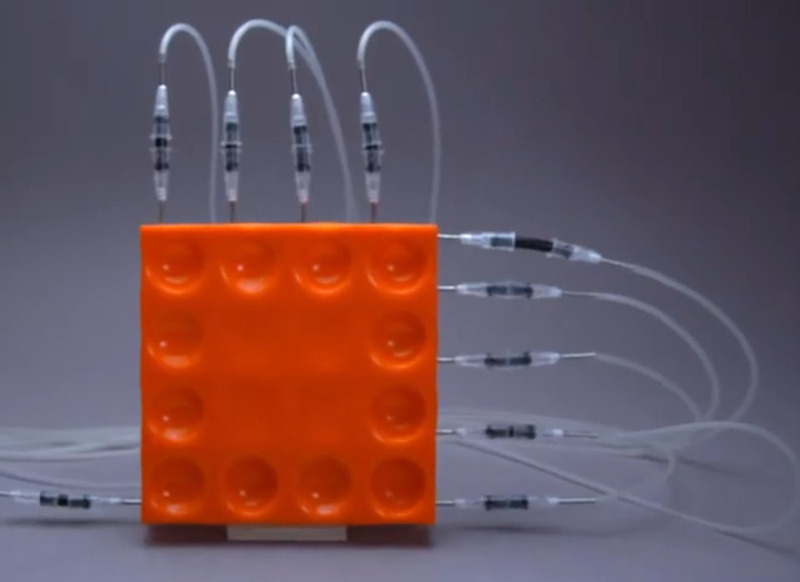
We’ve always been interested in fluidic logic and, based on [soiboi’s] videos, he is too. His latest shows how to use silicone and a vacuum to build a multiplexed dot matrix display. This is a fascinating look at how you design with air instead of electrons.
Just like a regular display, it isn’t efficient to control each element separately. Usually, it’s better to multiplex such that 16 “pixels” need only row and column air valves. Just as you might use transistors, the project uses “air transistors” to build logic gates.
Each pixel is a bit of silicone that can be sucked down only when a row and column are drawing a vacuum simultaneously. The air transistor is a similar membrane that a control input can suck down. In its relaxed position, two air channels are blocked by the membrane. When the membrane moves away, the two channels connect. This is analogous to a Field Effect Transistor (FET), where the channel conducts electricity when the gate is active and does not conduct when the gate is inactive.
We appreciated the step-by-step development. The video moves from a pixel step-by-step to small arrays and then to a 4×4 array. If this is your first encounter with fluidic logic, you can learn more about it. The last time we checked in with [soiboi], he was creating fluidic robots.












The old F-1 rocket engine had clockwork mechanisms to make adjustments in flight.
I wonder if exhaust products out of autophage rockets with 3D printed pathways/grains could do likewise.
Computation via combustion
The thrust profile of a solid rocket motor is dictated by the shapes cast into it, producing varying surface area, and therefore combustion rate and thrust, as the burn progresses.
It’s not “computation”, but it’s definitely programmed to adjust thrust in flight.
Ah of course the old air solenoid. Wait what. Never heard of this. It’s awesome!
Meant to say transistor… Need coffee…
Very neat. Well done.
There’s no particular reason it must be limited to a 2-input AND for each pixel. It could be n-input. Those 16 pixels could be addressed with just 4 solenoids (plus the release).
Though it wouldn’t scale particularly well: addressing (say) a million pixels with 10 solenoids would take many hours to update the array.
Total useless. But nice.
Useless in your small corner of the universe, perhaps.
“Sir, what is the use of a newborn baby?”
Microfluidic logic gates with built-in indication of state? Heck, yes, bring me that lab-on-a-chip with its integrated readouts.
Binary computation even fluidic amplifiers existed over a hundred years ago in player pianos. The power of a little air or vacuum. There was some experimentation with missile control during the first cold war to deal with nukes knocking out guidance.
This could be used for a braille readout.