
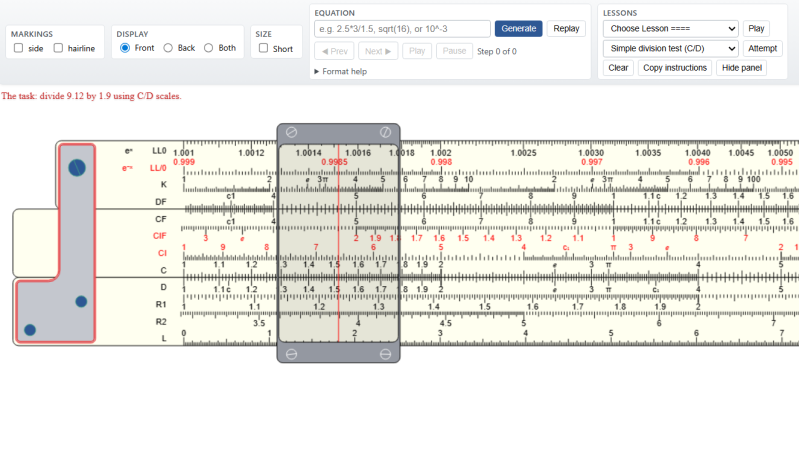
Ever wanted to know how engineers made their calculations before digital calculators were on every workbench? [Richard Carpenter] and [Robert Wolf] have just the thing—a sliderule simulator that can teach you how to do a whole bunch of complex calculations the old fashioned way!
The simulator is a digital recreation of the Hemmi/Post 1460 Versalog slide rule. This was a particularly capable tool that was sold from 1951 to 1975 and is widely regarded as one of the best slide rules ever made. It can do all kinds of useful calculations for you just by sliding the scales and the cursor appropriately, from square roots to trigonometry to exponents and even multi-stage multiplication and divisions.
You can try the simulator yourself in a full-screen window here. It’s written in JavaScript and runs entirely in the browser. If you’ve never used a slide rule before, you might be lost as you drag the center slide and cursor around. Fear not, though. The simulator actually shows you how to use it. You can tap in an equation, and the simulator will both spit out a list of instructions to perform the calculation and animate it on the slide rule itself. There are even a list of “lessons” and “tests” that will teach you how to use the device and see if you’ve got the techniques down pat. It’s the sort of educational tool that would have been a great boon to budding engineers in the mid-20th century. With that said, most of them managed to figure it out with the paper manuals on their own, anyway.
We’ve featured other guides on how to use this beautiful, if archaic calculation technology, too. We love to see this sort of thing, so don’t hesitate to notify the tipsline if you’ve found a way to bring the slide rule back to relevance in the modern era!
Thanks to [Stephen Walters] for the tip!












I went to secondary (aka High) school in the early 1980s, when slide rules were already obsolete. Even log & trig tables were simplified (just 3 figure) and on the way out. We were expected to use scientific calculators, like the Casio fx-82 (or in my case, the fx-180p programmable) or e.g. the TI-30lcd.
So, we never learned slide rules. However, I ended up learning them one afternoon when I had nothing to do in my work-experience week in my fourth year (age 15). My line manager showed me his circular slide rule and told me to work it out. A few weeks later I bought a British Thornton slide rule.
It’s quite an art form! Not sure I understood all 12-14 of the scales (about 6-7 on both sides)!
This is cool, you can zoom in on the slide rule and get better accuracy than a real slide rule!
OK, here’s an example, fairly complex calculation on a slide rule (though easy on a calculator). Cycling in the UK has increased by 50% in 34 years in the UK (ignoring the Covid blip, it’s now returned to the previous levels). So, the growth per year is 1.5^(1/34) . How do we do this? The answer is that we take ln(1.5), divide by 34, then compute exp(that_result).
On the back we have exp(x). So, we map 1.5 on the LL2 scale to X using the slider. This gives 4.055 (hairline says the same, wow!). It’s really 0.4055. Divide by 34 by moving 3.4 on the inner rule to the slider and then reading off the outer X scale where the inner rule says ‘1’. That’s about 1.192 (hairline says: 1.1926), but it’s really 0.01192, because we started with 0.4055 instead of 4.055 (÷10) and /34 instead of 3.4 (÷10 again). Great, now we just need to find exp(0.001192). It’s on the LL1 scale, because LL3 starts at e (exp(1)) and each scale down is the next power of 10 down. So, the answer is 1.012 (hairline is the same).
So, that means there’s a (1.012-1)*100=1.2% growth in cycling in the UK per year (on average) from 1990 to 2026. Not great, but better than negative growth!
How much accuracy can you get with the simulator?
The majority of my slide rules give 4 to 5 digits, even though some are 100 years old.
At first sight it’s the resolution of the screen you’re using. So, maybe up to 4K (3.6 sf). But you can zoom in on the screen giving you a better resolution, though the scale is the same, you can estimate between marks more accurately.
My British Thornton physical slide rule is about 30cm long, so I can probably estimate to about 0.2mm, a scale of 3.2 sf. Of course, since the scale varies, accuracy does too.
Mine’s model AA010 with LL01,LL02,LL03,DF{CF,C1,ISd,ITd,Td,Sd,C}D,LL3,LL2,LL1//S,ST,T,A{B,L,K,C}D,D1,Ps,Pt scales. I didn’t pick it because I thought I needed a super-complex one, it was merely the one being sold cheaply from a Stationery store as it was end of line. I never figured out many of the scales as it lacked a manual.
http://www.mathsinstruments.me.uk/page96.html
Slide rules are interesting even today, because one could make a simple one by hand. Actually it’s possible to print them out. For example:
https://www.sliderulemuseum.com/REF/scales/MakeYourOwnSlideRule_ScientificAmerican_May2006.pdf
Except I found it’s not rigid enough for any degree of accuracy and although I made a couple of attempts I didn’t succeed well enough. The nice thing is though that on a desert island one could still calculate the divisions for a slide rule manually (just start with 1.000 and multiply by 1.001 each time) and maybe build one out of wood or animal bones if you carve them into shape.
Used sliderule growing up, and still have a fair number of them. I was one of the last to regularly use one in college, though. Some of the nicer ones for daily carry were actually the Japan manufactured giveaways from trade shows, still showing up into the early 1980’s.
Been giving away the student models for a number of years and I am nearly out. At one time, I had more than a class set. My predecessor at a teaching gig in the late 80’s/early 90’s STILL made students use them, so when I stepped in, I bought a class set of Sharp Elsimate’s for, IIRC, $US0.50 each at one of the electronic surplus warehouses outside Boston (EFI? Aadams? I know it wasn’t Heffrons, as they didn’t go that low) and my supervisor told me to get rid of the sliderules.
I also have a classroom demo Pickett (1m version) in my office. Garbage picked from another teaching gig in the late 1990’s.
I was at secondary school from ’78 to ’83. Got the Casio fx-81 for my O-level. I got the fx-82 when I went into the sixth form in 83. Didn’t help. Failed everything. Joined army instead of going to college 😁
I do remember my dad having a slide-rule and watching him use it was amazing. He seemed to be just as quick with that as I was with a calculator!
I’ve never seen anyone use a slide rule for real, I was just left to work it out, but I can believe experts are fast. I’m pretty slow as I have to think about all the steps and then nudge the cursor or slide to an accurate enough position. Ironically some early scientific calculators, in particular, the revolutionary Sinclair Scientific, were as inaccurate, but slower(!) on many calculations!
https://static.righto.com/calculator/sinclair_scientific_simulator.html
As an aside. The Casio fx-81 is the same as the fx-82, except they left off the SD mode legends on the front fascia. So, if you hit [INV], [D-R-G] a little ‘E’ segment appears to tell you it’s an error, but it isn’t. You can clear stats with [INV], [AC]; enter data with number0 [M+], number1 [M+] etc then obtain the stats info: ∑x² , ∑x, n, avg, stddev, popstddev by pressing [1/x], [xy], [(..], [..)], [Min], [Mr] (or maybe you have to press [INV] and then the keys).
Also, [INV], [+] does Rectangular to Polar coordinate conversion and [INV], [-] Polar to Rectangular.
Ha I have the actual slide rule. Got it not long ago to do some redundant calculations. Actually got my dad a Dietzen (something like that) that is a Post clone. It has Teflon runners and is quite a bit better to use because of it. Both were picked up off of electronic-bay in basically literally new in box condition for not a lot of money. They are lovely and still useful.
For me in particular I use the thing to do kinetic energy calculations. Once set you just move the hairline and read KE off directly because if the way the B scales are set up. Super convienent and even easier than an electronic calculator.
Got a little disheartened when the first 2 instructions wouldn’t work correctly, but it looks like the slide rule modeled doesn’t actually have an A scale, and thus when asked to set window to a value on the A scale, the slide rule just disappears. The other instructions all work as intended as far as I can tell
I found the same, though I was almost frustrated enough after trying those 2 that I almost gave up. It’s a good thing you commented. Thanks for confirming I’m not going crazy.
I’m going to have to go home and dig out one of my several slide rules and work along with the lessons a bit!
Dr. Robert Wolf passed in 2023. There used to be a site called sliderules.org that hosted dozens of simulators created by him. His Github remains online and anyone can locally run the site. https://github.com/HERCsMusicSystems/Sliderule-Simulator-or-Emulator
That simulator is terrible. Its a great idea but done by someone that apparently doesn’t realize what its like to not know how to use a sliderule. Its essentially just as bad as asking someone that knows how to use one from childhood and they say essentially ‘you slide the thing up and down ‘like this’ and then you get the answer. See?’ And if you don’t see they don’t get why.
For example in the last one I tried it goes through and shows the 1st few steps.. slide the cursor.. adjust the slide .. and it shows you and does it. Thats great! Then a few more and you get to the last line.
‘Adjust the decimal place and obtain the result of 209.84.’
The demo adjust the slide and the cursor to something.. and then highlights the values . .. without explaining it. Then you get to the ‘obtain the result’ part. Somehow I’m supposed to get 209.84 out of this list of values:
1.00319 0.99682 32.25153 1.00000 1.00000 1.00000 3.14159 3.18310 3.18310 1.78412 5.64190 5.02850
None of which seem related. OR it made a big deal of animating and highlighting those values for no reason which is also bad.
Idea 10 out of 10. Execution 4 out of 10, all related to showing a cool animation and automation sequence.
oof I see it reset itself without resetting the values leaving the curor in a wierd place. So you only get a few seconds to see the actual solution before it yanks it away. Yowie thats painful.
The last line on the demos is “now repeat the steps” or something to that effect. The idea is that you repeat all the steps yourself and then you get the result. I can see how the slide/hairline moving at that point is a little annoying but I wouldn’t call it painful.
I would love a Hemmi/Post 260 version of this
I still have my Post Versalog slide rule from college, and if civilization collapses I will still be able to work with logarithms. I’ll build cabins with the natural logs, and use the common logs for firewood.
Recently got interested in sliderules after finding my old one hidden away, and became interested in relearning how to use it, together with why it works.
That led down a rabbit hole ending in a web page on the maths and usage of a slide rule, including Python generated illustrations of several scales in use (C, F, CF, DF and LL scales).
If anyone’s interested, the page is at:
https://bernie-skipole.github.io/sliderule/
with the source Lyx document, images and Python code at:
https://github.com/bernie-skipole/sliderule