
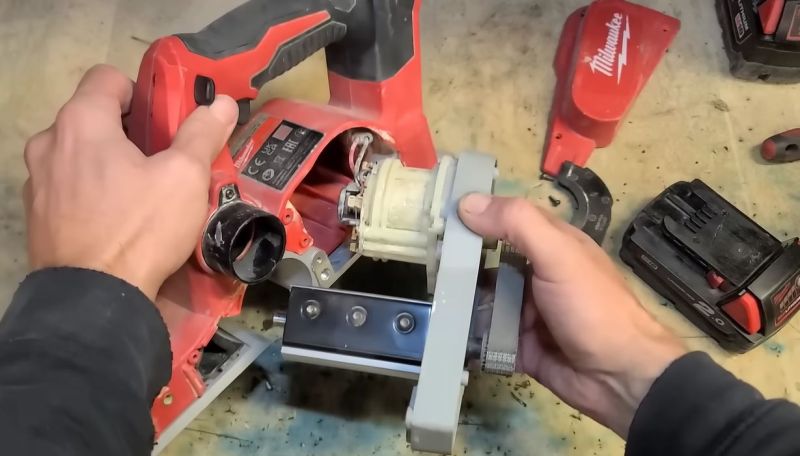
Despite the best efforts of the manufacturers, there are folks out there that try to repair power tools, with [Dean Doherty] being one of them. Recently he got a Milwaukee M18 cordless planer in for repairs, which started off with just replacing some dodgy bearings, but ended up with diagnosing a faulty controller. Consequently the total repair costs went up from reasonable to absolutely unreasonable, leading to a rant on why Milwaukee tools are terrible to repair.
Among the symptoms was the deep-discharged battery, which had just a hair over 7 V while unloaded. Question was what had drained the battery so severely. What was clear was that the tool was completely seized after inserting a working battery with just a sad high-pitched whine from a stalled motor.
After replacing both bearings and grumbling about cheap bearings, the tool had a lot of drywall dust cleaned out and was reassembled for a test run. This sadly showed that the controller board had been destroyed due to the seized rotor bearing, explaining the drained battery. Replacing the controller would have cost €60-70 as it comes with the entire handle assembly, rendering the repair non-viable and a waste.
Perhaps the one lesson from this story is that you may as well preventively swap the cheap bearings in your Milwaukee tools, to prevent seizing and taking out the controller board. That said, we’d love to see an autopsy on this controller board fault.
Thanks to [paulvdh] for the tip.











This may be why a lot of people I know refer to that brand as “willf*kee”….
There are plenty of these battery-powered tools from other makes (ie: DeWalt, all of the Harbor Freight lines, Craftsmen, etc) that can fall into this “non-repairable” hole. This is why the [olde-corded] tools from the 60’s and 70’s are so prized (if not inherited).
I’ve never understood the modern fascination with battery powered tools anyway… The vast majority of people who buy these tools are homeowners who are never more than a few feet from a mains socket.
Even if you take care of the expensive batteries they die. For big jobs you need more than one battery on stand-by, so people then buy into one of the major ‘eco-systems’ like my mate who has a shed-full of Ryobi stuff. It’s all pretty useless now because Ryobi changed their ‘standard’ battery, and all his are in need of replacement and all you can get now is Chinese crap.
I have a cordless drill/screwdriver which is actually really handy, but everything else is either corded and runs off the solar panels on the garage, or air powered.
For the same reason you like your cordless drill. I also think you underestimate how often the target market of these tools use them.
For any sort of full fledged project I do use corded saws, air nailers, etc. But for small stuff being able to grab a tool and immediately use it is really nice. Especially if you’re packing up your tools to help out a friend or family member.
As for the batteries: a lot of brands use those same batteries in their yard care tools.
Like, a manual brace, or an eggbeater drill?
It’s cordless, and you never have to wait for a recharge before using it.
How did ryobi change their standard battery?
I still have ryobi 18v batteries if he wants to unload some of those old tools!
Ryobi’s new batteries are backwards compatible with all of their tools you twit.
Your opening statement is completely incorrect. Take a look at Milwaukees tool lineup and you’ll see well over half of them are tools the homeowner probably has never seen, used or had a need for. Specialized, high powered, and crazy durable. It’s obvious what audience they target. Milwaukee m18/m12 batteries haven’t changed their connection compatibility since they were released in 2008. I’m not familiar with all the brands, but I wouldn’t say it’s a big problem.
If your cordless drill is handy why would you assume that any other cordless tool wouldn’t be just as handy? Solar panels are not available during the construction phase of a project, And air hoses to every tool on a job site would be Impossible. Corded tools still have their place, but that’s quickly Changing. Battery technology is just about at the point of being able to power anything that used to plug into a wall as well as or better than that wall power. I’m guessing you’ve never worked on a large scale construction site before or I don’t think you would’ve made the statement that you made. Battery technology is revolutionizing to construction industry.
Ok tti shill can you plz explain why the forge batteries don’t self balance even tho they have the capability on the board to do so which tti has disabled kthnx lmaogg
Good to know, even though the hate is strong in this one.
My shop is all Milwaukee red. My very handy M12 driver has been well loved and much abused in near-daily use for 20 years, and the gearbox is showing signs of stripping. Thinking about repair, but after this many miles on it, it really doesn’t owe me anything.
I’ve been lusting after a new brushless one anyway…
20 yrs ago my tools were all yellow, but as they broke I replaced them with red (and some blue), and was rewarded with significant increase in tool longevity, despite increased use. Where’s the hack? I have a (non-functional) yellow drill I use to smack tight wood joints into alignment. Bam!
I plumbed a car cigarette lighter (“convenience outlet” in newspeak) plug onto my old department-store brand 12 V drill whose NiCd died. Does that count as a hack?
What does “Dismal” mean in the title?
Poor, lousy, crummy, pitifully or disgracefully bad
It is being used in it’s usual sense– it can mean gloomy, pitiful, or disgracefully bad. In this case, the latter two would fit well.
As soon as drywall dust was mentioned I wasn’t surprised. Let a fine abrasive into your planer (why was drywall dust inside a planer???) and bearings will die. Lack of mechanical sympathy cooked the controller, which through an unfortunate design, hurt the battery.
I have a bunch of Milwaukee tools, and I don’t think they are the best, but I also don’t think any manufacturer is the best. They happen to have a very long support cycle for M18, which made me switch to them. I had Makita tools before and when they stopped all sales of NiMH batteries, they orphaned my tools. That was enough to walk away.
If you have mechanical sympathy, common sense, and don’t abuse your tools, they will last a long time.
They tools aren’t as good, but Ryobi support is great. The latest lithium 18v batteries are compatible with tools I bought 20+ years ago that originally came with NiCd. I have worn out one drill, but the refurb replacement was $20.
I’ve put an 18 Volt Bosch battery on some old Japanese drill… can’t remember the brand anymore. Works, but it gives off a puff of smoke every time it starts spinning.
Agree, that tool was abused.
not a design defect.
The only tool that I’ve seen that can resonably withstand drywall dust is my Rotozip. I needed to make a hole in drywall and didn’t own a Rotozip so I mistakenly used a Rotozip bit in a Dremel once. Just once. The Dremel was never the same afterward. Now I’m actually more likely to use Dremel bits in the Rotozip than the (new) Dremel.
i agree with this, my friend got a broken Milwaukee wet vac for free from his brother in law because…you guessed it…it was abused.
the first thing i saw inside was a popped MOSFET.
it took some investigation (enhancing an image of the vac’s board from a long-dead eBay auction) to find its replacement on DigiKey, but it worked again right after, and i think it will for many years.
This is why it’s better to buy cheap no-name tools and throw them away when they break. Brand-name stuff is just as bad and twice as expensive.
How terribly wasteful. I buy good tools and take care of them. Buy once, cry once.
If all of your tools break, the tool using them might be using them wrong.
Spending exorbitant amounts on tools just squanders your own resources, and enriches the sales people and the company executives and the rest of the food chain. It leads to them taking trips in jets to far away vacation spots and making unnecessary environmental impact. That’s terribly wasteful.
This reads as if it were written by a teenager that is just discovering how capitalism functions, rather than by someone that works with power tools either as a hobby or for their job.
I do both. I use anti-theft teal tools at home, and my employer provides red tools at work. I’ve used cheap tools, and it’s awful. They’re not the same.
Nah, it’s often a false economy. I picked up a Chinese multitool; it died after 2 jobs. Needed a replacement fast so bought a real makita one. Far more powerful, and hasn’t died.
The cheap stuff is great for the money – amazing even – but not a patch on the power or quality of most of the genuine ones.
I can’t justify £200 per tool but I can justify 20-30 for a fake one to see if it’s going to be useful. I recently upgraded from fake makita impact to a real one and the real one is an absolute beast by comparison.
Thats terrible advice for a tradesman. Expensive tools are built with a longer duty cycle. I use primarily three brands (milwaukee m12, bosch professional 18v and metabo cas 18v) and they are all heavy duty for specific tasks i require them for. If I used a light duty brand like einhall, ryobi or craftsman they would likely break. One of my drills is specialised and is used for creating taps. Nobody makes a drill like this except for metabo and it cost me a huge amount of money. The duty cycle of the drill means ill be able to do thousands of taps in steel. I would never be able to do that with a ryobi drill.
Time is money and if my tools are broken, I can’t earn money. Its why also a lot of construction sites use hilti because they pair it with a service plan so there is no downtime. If the tool breaks, you get a loaner whilst it gets repaired.
When I bought my house after college, my parents got me an electric set of Skill tools. After a few years of use, the drill broke. I opened it up and found a plastic gear that had a tooth broken off. I looked up the exploded diagram on their website and found out the part number for the gear. Then I called their tech support and asked if I could pay for a replacement gear and their reply was “Just throw away the drill and order a new one.”
I still own the plug-in electric drill that my grandfather owned, and gave to my dad, and he gave it to me. It’s so sad that nothing today can be repaired.
Often enough I can find that stuff on AliExpress or a parts supplier that sells to repair shops. Trick is getting AliExpress to co-operate and show you the thing you asked for. Google is helpful as you can follow a link into something likewhat you need and they will recommend similar products. Merely searching on their site is fairly bad.
I had a low-profile Thermalright fan and wanted to turn it 90° on an AMD platform, which is quite difficult because the mounting pattern is not square. I was able to find proper brackets for $3 on AliEx. You better believe I reamed the customer support who turned me down. I feel a little bad because it was not their fault, they are the customer support for this continent/country and don’t really have much to do on the engineering side. And their prices are super low so I’m really not owed proper engineering support, oddly they have 2 suppliers of the same products on Amazon, go figure.
Anyway, upshot is at some point either the parts are so generic or have a knockoff that is compatible, or the factory is selling spares on the side for repair.
American branded tools, made in China. Paying for a name, and none of the quality.
Funny thing is, you can get good quality stuff from China, if you pay for it. Americans just don’t want to. Not to mention “Made in the USA” hasn’t signified quality for decades, even if it’s genuine. It’s mainly just exploiting boomer nostalgia.
I really wish that I could argue with you on this subject. Sadly, for the most part, you are correct. I agree also that many things from China are of very good quality; I’m sick and tired of Americans dismissing everything from China as “junk” or “copied”. How did that work out with Japanese electronics and cars 50 years ago? They ate our lunch, and breakfast, and dinner. You can only rest on your laurels for so long.
I worked for a company that designed things here and had them contract built in China (with our observers/inspectors). The quality was as good or possibly better than what we designed into it IMO.
The difference between Japanese manufacturers, back then, and Chinese manufacturers today is that the Japanese actually made quality stuff.
Thing is you need those observers/inspectors in China otherwise they can and will cut corners and reduce your product reliability. Another thing they do is run three shifts in their factory; two for your part and one more for their “off brand” part.
This is very pertinent. I see people coming to Chinese manufacture’s defense all the time trying to make this comparison, but these people haven’t been on the ground to understand why shì bàn gōng bèi is cultural zeitgeist.
That’s very true. The Chinese have the tools and the skills to do precise work.
After all, China is an ancient civilization and high culture with a history spanning a thousands of years.
Unfortunately, they’re historically being exploited by western companies.
Production in China often was appealing because of lack of worker rights, lack of environmental laws and because of low production cost.
After all these years, though, China has gained a lot of experience and became self-reliant and raised its own living standard, too.
It’s now us western people who are dependendant on them, who can’t financially afford “normal” quality anymore.
Our own industry has eroded because we outsourced our production, staff and knowledge over to China.
All because of money thinking and little foresight.
Meanwhile, China has its own machineries on eye-level with our German equivalents.
Maybe surpassing them eventually.. sigh.
“Made in China” might become the new “Made in Germany” (after WW2 also “Made in W-Germany” or “Made in GDR”)..
Because both didn’t start out as seals of quality, originally.
A long long time ago, the British wanted German products to be labeled as a warning.
A difference I can imagine might be that China will be colder and more calculating at doing business.
The country perhaps isn’t so focused on western values as us.
Here in Germany we used to have taken a certain pride in delivering quality, even if it caused less profits. It was an identity thing.
China obviously understands how to do its math and be more flexible, by comparison.
I missed “repairability” on the marketing swanky on the box of my last Milwaukee tool. In all seriousness, pick your brand. None of them are meant to be repaired…. planned obsolescence is how they stay in business. Pick your team if that makes you happy, but this information is not “news”. Its business.
Back in the day, German cars were over-engineered and as a result too expensive for anyone to own. Nowadays they’re still over-engineered and expensive, but somehow less reliable.
Hi, I’m no car expert but I think the good times were up until the 80s or 90s, maybe.
After that, German cars nolonger were the same as they used to.
Up until the mid-90s, we had industries that still made whole productions within Germany.
Even using semiconductors being made from here (Siemens still built parts and CPUs etc).
By turn of the millennium, a lot has changed.
Internalization and globalization happened, among other things.
The companies also changed a lot themselves within with staff changes etc.
But again, I’m no auto expert. 😅
I can only say that things built in the 70s or 80s lasted.
Things Bosch drilling machines (SB 350) or Krups handy mixers..
The washing machines weren’t bad, either.
A VW bug was neither over-engineered nor expensive. Mercedes-Benz and BMW fit the profile, and Audi somewhat. Opel was middle of the road. Porsche was expensive but I suspect the engineering was aimed for performance rather than durability.
The idea of using a planer on drywall…..nuff said.
Might as well spray conformal coating while its apart, Milwaukee tools are afraid of water.
Used to be a fanboy; have probably spent 10k on Milwaukee tools.
Though, its starting to feel like a scam… Both the tools and batteries are designed to fail, rather quickly in my experience.
I use Milwaukee almost exclusively for handheld tools outside my shop. Have not counted them, but likely in the 30-40 range. Over the years I have had one tool and two batteries die. Overall I am satisfied with them and the robust pipeline of new ones coming has been great. Are they the same quality as 25 years ago? Don’t know so cannot say. But they are better than the DeWalt from 15 years ago.
I am reasonably happy with them and haven’t found anything better with the same wide range of tools available.
i’m with the guys who are upset at using a planer on drywall. Maybe the bearings could stand to be better, but drywall dust is a surefire way to destroy bearings. And a lack of “mechanical sympathy” indeed! Once the bearings seize, let go of the trigger. Not exactly rocket science.
I do have one sad story about Milwaukee tools…i traded a 2 year old laptop for a 20+ year old sawzall. After a few years, i noticed that the main difficulty is the trigger was unreliable, so i tracked down the “correct” replacement part online from some semi-reputable vendor. Reasonable price. The wire going to the trigger was held in with one of those push-in-once / remove-never connectors so i had to cut the wire shorter but it was long enough. New trigger was physically compatible. But after that, the sawzall was always weak, like the old trigger had a range from 0-10 and the new one just from 0-3. Sadly threw it away. I got more use out of it than my buddy did out of that laptop though.
I think what happened is Milwaukee stopped making the replacement part for the old unit, but some parts catalog somewhere said the trigger for a newer model would be compatible, but it wasn’t really.
That’s nothing compared to the trouble i run into with modern appliances. It seems like every appliance has a characteristic failure point that kicks in about 10 years after purchase…but they only make the replacement part for 5 years! Really vexing to have that twice in a row with a water heater and a hydronic ‘boiler’. But at least it means i don’t have to decide whether it’s worth buying a replacement part that costs half what the new unit costs. No choice to make.
But for tools, the happy story is…i recently took apart a worn out angle grinder and it had multiple problems so i went to the store to buy a new one. $10 at harbor freight, and the new one is bliss. If i used it every day, i’d probably buy the milwaukee or the dewalt but for the way i use it…what a great deal! A lot of things are disposable simply because the new price is so good. That’s not all downside.
There is a major benefit to the $10 harbor freight angle grinder. You can buy a phalanx and put them on a “grinder tree” with all different attachments and work a lot quicker than stopping to change the disc all the time. An old hospital IV rack might be perfect for a base to start. Or the wheels from an office chair and a piece of exhaust tubing.
Became wary of Milwaukee and decided to standardise on Makita. We shall see.
One set of batteries is better than three.
If you have three batteries one of them will be charged when you need it. Definitely want more than one.
An interesting situation: someone who can fix mechanical bits, but is stumped by electronic bits. He just needs to find his opposite (someone who can fix electronic bits, but not necessarily mechanical ones) and they could both help each other out. Repairing the controller may be as “easy” as replacing a couple of mosfets.
It obviously works because the motor turns for a bit and then stops – the problem seems to be some sort of a software lockout that has bricked the device. There’s probably absolutely nothing wrong with it except the fact that it won’t run, and you need a new controller.
Yes. Interesting observation. At first I thought that one of the three phases was blown, but the motor can run more then a full resolution (See @22:30) and that does indeed suggest something else is going on.
When he tries to operate it, I don’t see the motor turning a full revolution. In any case, speculation here doesn’t really do much. All I can say is check the common failure points first.
It turns multiple times with successive trigger presses. If one phase was broken, it would simply turn to some position and stay there.
It’s also a brushed motor, not BLDC, so the controller is able to give it power but then immediately cuts off. That means the power mosfets are working, there’s no reason it wouldn’t turn, except the controller saying “nope”.
Heat kills electronics. Turning the device on while the motor is stalled probably shorted the battery and heated up the electronics. I could see how a FET or Resistor might be damaged such that when you apply a current it opens up. Circuit traces and solder joints may fail the same way. I imagine we can get a fairly large current from a Lithium battery. Electronics in the battery may be damaged too and the battery might be turning off when you try and run.
I had a Phillips hair trimmer like that once. The built-in battery was done, so I desoldered it and put in a new cell.
Removing the power triggered some software lockout, which made the trimmer do a single “Bz” at the press of the switch and refuse to run. Nothing was wrong, it just wouldn’t run, so I wired the switch directly to the output mosfet gate and kept on using it.
Thanks for the heads-up. I’m about replace the battery in a car keyfob… this is the reminder I needed to bridge the old battery with alligator clips while I put the new battery in. Keep it powered the whole time so I don’t run into any issues with pairing the keyfob to the car again.
I worked for the Milwaukee Electric Tool Company for 14 years as a tech in one of their branch locations. In the mid 90’s they built a new switch and electrical component facility in Brookfield Wisconsin next to their tool plant. Two years later they shifted their switch manufacturing to Mexico because of cheaper materials and labor. It was a sign of what was to come then and it’s a sign of what is happening to manufacturing now.
My oldest power tool that I still use is a makita hand saw that I bought in 1984. Still works fine, the only thing I’ve changed is the blade.
My oldest electric appliance is a 1950’s vitamizer which my father bought new in the 1950, which I now have.
Thing is, for both of those tools, if I bought a current one it wouldn’t last a fraction of that time – as back then they were trying to make quality that lasted, now it’s as cheap as they can make it to last the warranty period..
I’m with one of the posts above – anything that doesn’t require specific quality I pretty much by cheap as I can that is function. Anything that does require quality ie no use having a saw with the bottom plate flexing, or a drill press that wobbles the bit – I either find find something current that is good, find an old one, or use the old one I have..
The words planner and drywall dust should not be in the same sentence. This tool failed due to misuse not a manufacturer issue. The bearing were not built to handle drywall dust but wood shaving. Anything after that is related to abuse and not the tool.
I don’t really see this as non-repairable, just need to source a generic motor controller. If it’s DC you could probably get by for a while with a plain switch.
Maybe buy a cheap copy from China and use its controller, or it’s very possible they sell controllers separate from China. I mean it’s just a damn battery and a motor basically.
Now you might say ‘NOO NOT CHINA’. And to that I reply that AFAIK the Milwaukee brand is owned by a Hong-Kong company nowadays.
American consumers buy based on price. It doesn’t matter that the Country that produces the product recruits children to reduce the price. Or the Country buys discounted Russian Oil to reduce the price. Or the Country processes rare earth materials with no regulation to reduce the cost. That cheap Harbor Freight product is not really inexpensive. Unfortunately the expensive Milwaukee tool is made in the same Country so we really no longer have much choice. Ditto with the parts in our “American Made” cars. Its hard to have loyalty for an “American” company when its selling product made elsewhere. If you manufacture overseas are you really still an “American” company? If your Capital is overseas, and your employees are overseas, and your supply line is overseas then maybe you are too.
“In 1976, Milwaukee Tool was sold to Amstar. It was later sold to Merrill Lynch in 1986, Atlas Copco in 1995., and finally, Techtronic Industries in 2005.”
Techtronic Industries Company Limited (TTI Group or TTI) is a Hong Kong–based multinational company.
In 1985, TTI was founded by Horst Julius Pudwill and Roy Chi Ping Chung as an original equipment manufacturer for overseas brands. In 1987, it began to produce Craftsman cordless power tools for Sears followed by cordless, handheld vacuum cleaners for Bissell.
In 1990, TTI listed on the Hong Kong Stock Exchange under stock code 0669 by initial public offering. Its ADRs also trade on Nasdaq as TTNDY. In 2019, the company’s shares became one of the 50 constituents of the Hang Seng Index.
So you see, manufacturing has been done outside the US/EU/etcetera for many decades, in various countries.
Or in the poor region of their own backyard, like the poorer US states or middle/south america for the US and the former soviet region for the EU.
And the output doesn’t have to be bad, they have good craftsman in those places, but if the companies cut too much cost on materials and don’t look after nor visit their production facilities and correct manufacturing issues then you end up with poor products.
On the “Chinese crap” theme I needed 5 garage doors, 2 off 8×7, 1 off 8×17, and 2 off 8×7 in glass. I was quoted about $15,000 + installation. I found several suppliers in China on Alibaba after several conversations I settled on one. Cost? $3,000 + $3,000 shipping and as it ended up another $2,000 in customs, and other paperwork. The door came with everything required (including motors) and the quality is fantastic, smooth operation and they are fully insulated.