
During the Cold War, the specter of a nuclear “dead man’s switch” was central to the concept of Mutually Assured Destruction (MAD). In the event that one side was annihilated by the other, an automated system would be triggered to deliver a revenge strike that would ultimately destroy the attacker. It was the ultimate defense, as your enemy will never attack if they know doing so will inevitably lead to their own destruction.
The same idea has occasionally been employed by whistleblowers and journalists as well. Should the individual fail to check in regularly, a series of predetermined events will be set into motion. Again, the idea is defensive in nature. If somebody is in possession of information so damning that they could be abducted or even killed to keep it quiet, making arrangements to have that information be released to the public in the event anything should happen to them is a great way to stay safe.

But what about for the average person? In the past, there was no need for most people to think about something as elaborate as a dead man’s switch. But we live in interesting times, to say the least. In an information society such as ours, whistleblowers have never been more common, and the Internet has significantly blurred the definition of what it means to be a journalist.
For those living under a repressive regime or in a war zone, simply posting to social media can provide the outside world with an unfiltered look at what’s actually happening on the ground. A teenager with a cell phone has the potential to reach a wider audience than the legacy media — a powerful, but dangerous, proposition.
Even if you’re not in the middle of political upheaval, there are still reasons you might want to have previously secret information made available in the event of your death or incapacitation. Perhaps you’d like to send your loved ones a final personal message, or make sure the passwords for all your accounts get in the hands of whoever will be handling your estate.
Of course, one could argue that could be accomplished with little more than a notebook hidden in your sock drawer. But this is Hackaday, and over-engineering is the name of the game. So do you have a dead man’s switch? How is it implemented? Or is the whole idea just a bit too out there for you?
The Software Approach
We started discussing this topic internally here at Hackaday a few days ago after I came across LastSignal, an open source dead man’s switch application written by Claudio Benvenuti. It’s by no means the first piece of software of its type, as the idea has been floating around for years and there are both open and proprietary implementations available. But LastSignal has the sort of slick modern design that gets people interested, and the fact that you can self-host it is quite appealing.
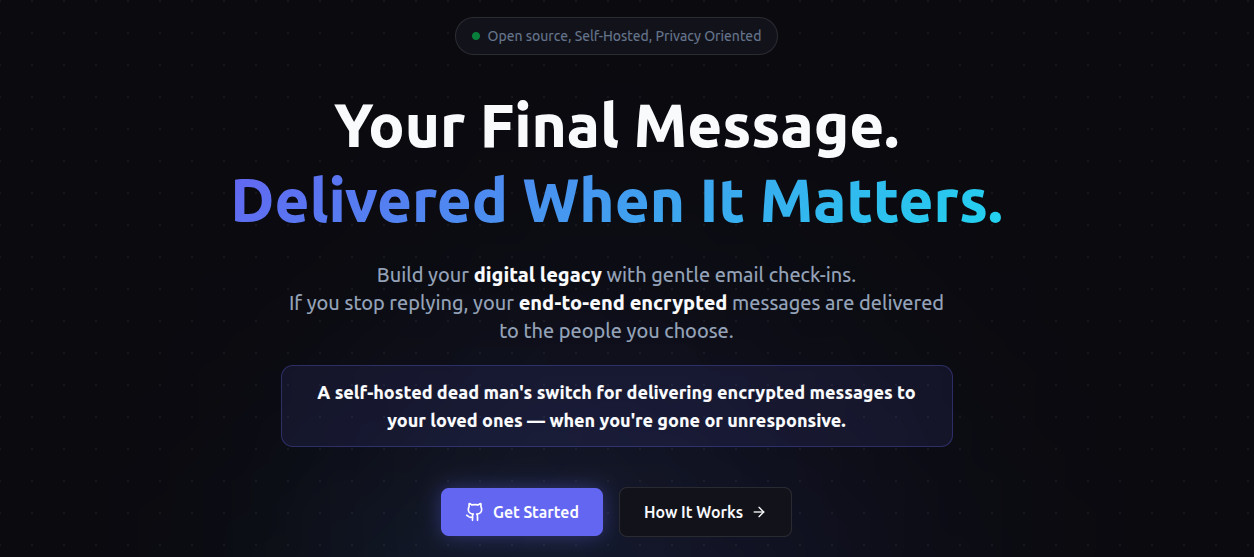
LastSignal is designed to let you write encrypted messages that will remain a secret until the system has been triggered, at which point they will be sent off to the recipients you’ve configured. The default behavior is to try and contact you every month via your primary email address, and once the software picks up that you’ve missed enough of your normal check-ins, it will try to get in touch with your emergency contact. If it still doesn’t get a response, then the automated messages start getting sent out.
Again, this is not a new idea. Searching around, you can find other open source tools to achieve the same goal, such as dead-man-hand. If you’re not concerned with the behind-the-scenes implementation, you can even pay a service to handle it all for you. But there is something to be said for using a package that’s already been thoroughly tested and vetted by the community. Otherwise, you could just throw something together yourself with a Python script — although we’d hate to spend eternity roaming the astral plain in torment because our final messages didn’t get delivered due to a library update breaking our script.
Most of the projects we found along these lines are focused on sending messages that would be a secret until the time of their release. That makes sense, but we wondered if there were other tasks you might like your personal dead man’s switch to fire off in the event you’ve signed out permanently. For example, Al Williams suggested that some users might want to have their drives securely wiped in the event of their death. Any speculation as to why this was the first thing Al thought of will be left as an exercise for the reader.
Why Not a Physical Switch?
While a software solution is the easiest way to implement a dead man’s switch, it does have its downsides. As already mentioned, if you’re self-hosting the solution and aren’t careful, some seemingly inconsequential change or update could potentially knock out the software before it even has a chance to run. When we think of all the weirdo software issues we’ve had over the years, it makes us more than a little skeptical about trusting such an important task to the whims of our operating system.

So what about a hardware solution? With so many WiFi capable microcontrollers on the market now, it would be trivial to put together a little dead man box that has just a display and a button on it — the display counts down the remaining time before the switch is triggered, and the button is used to reset the timer. If you don’t press the button in time, the MCU connects to the Internet and performs whatever task you’ve programmed. We bet you could put it together right now using stuff in your parts bin.
Now, we won’t pretend going from a pure software solution to a piece of custom hardware will completely remove the chances of something going wrong. After all, there’s still code being run, and that code could have bugs. But it does take away the innumerable variables that are introduced when said code is being run on a modern operating system. If your DIY dead man’s switch works today, you can be sure it will work the same way in a year from now as the whole system is in a fixed state.
Tin Foil Hat Not Included
Or maybe this is all crazy talk. Perhaps the complexity of either solution makes no sense for the average person, and just writing your important information down and telling your next of kin how to get access it after your passing is enough. Obviously there are downsides to this approach as well, notably the potential for your written information to get stale and no longer be valid when the time comes, but it’s a method that has worked for the vast majority of people for generations.
Is this a problem that needs a modern solution? Is a dead man’s switch best left to secret agents? The fact is, we’re all going to go sooner or later, so it’s something we need to give some thought to while we still have the chance. We’d love to hear what you think in the comments below.












I think the original Star Trek tackled this with the Doomsday Machine.
Trek fans know the “The Corbomite Maneuver” is more closely aligned.
Capt. Kirk: This is the Captain of the Enterprise. Our respect for other life forms requires that we give you this… warning. One critical item of information that has never been incorporated into the memory banks of any Earth ship. Since the early years of space exploration, Earth vessels have had incorporated into them a substance known as… corbomite. It is a material and a device which prevents attack on us. If any destructive energy touches our vessel, a reverse reaction of equal strength is created, destroying -…
Balok (voice): You now have two minutes.
Capt. Kirk: – -DESTROYING the attacker. It may interest you to know that since the initial use of corbomite more than two of our centuries ago, no attacking vessel has survived the attempt. Death has… little meaning to us. If it has none to you then attack us now. We grow annoyed at your foolishness.
The Doomsday Machine was simply a weapon that it’s creators (no relation to Nomad), lost control of. Most likely destroyed by their own creation (shades of Frankenstein), and ST-TNG “Arsenal Of Freedom” episode. However, Kirk did theorize about The Doomsday Machine… “it was meant primarily as a bluff, never meant to be used, so powerful it would destroy both sides in a war”…. “they don’t exist anymore, but the machine is still destroying”….. one of the best episodes.
Nerd 🤓
Definitely one of the better arguments against Mutually Assured Destruction as a concept.
Do you really want to annihilate everything else just because somebody else dared to attack you? And what’s the risk of your counter measure being activated entirely by accident? What if the expected attack never comes?
“encrypted messages that will remain a secret”
Um, no. do you have any idea how juicy a target would be a single site where everyone’s deathbed secrets are kept?
What does “self-hosted” mean too you?
To me, self-hosted means that after I miss a couple power bill payments, my computer will be permanently off line and my self-hosting will have ended before the “two monthly check-ins” triggers. Or even if I have enough solar/wind capacity that I’m selling power to the grid every month, my Internet service will have been cut off — perhaps because my bank learned of my demise and froze my account(s), even if I’m on auto payments. Or if I don’t leave my computer on 24/7 (as I might not if I’m trying to contribute less to climate change) this is all moot.
It’s not “a site”, so there’s no reason anyone would ever know of its existence until it’s triggered.
Sort of an IRL https://en.wikipedia.org/wiki/Watchdog_timer
Related, with similar intent: https://en.wikipedia.org/wiki/Warrant_canary
Something similar saved a friend’s life. ‘John Doe’, living in the middle of the desert, had an esp32-based box that sent something out to ‘Bill Smith’ if he did not reset a 48-hour watchdog timer. Bill Smith called me. I immediately flew out to John Doe’s place. As I was landing, caught glimpse of something red above the area. Found my dear idiot friend up on the side of the mountain with a leg broken in several places.
If you live alone in the middle of nowhere, design and build something like this, or die alone.
And make sure you have great, reliable friends. With planes. And excellent eyesight.
You mean Gerard Bull.
You mean Gerald Bull.
I’ll be getting a personal locator beacon for exactly that purpose this year.
They’re not that big and not that expensive (roughly $400), and they tap into a statewide radio alert system.
In m,y state (NH), emergency rescue is free so long as it’s an actual emergency.
Do you have any brand or mdoel names? I’m not familiar with such devices
Garmin inReach is the most common one. Just be careful traveling with them as they are illegal in some countries!
That’s definitely a good idea… but also… that’s what emergency beacons are designed for, and they’ll actually lead your rescuers to the right place.
Hard problem.
Assuming a nation-state actor wants you to disappear quietly… They cut your cards, associated services, and all known/associated internet the same day.
Host on someone else’s service, its an easy target to silence with a court order.
Host on your own property, its an easy target to silence.
Your best method is probably a block chain contract.
yeah you’re on the same thought i was. the struggle is to find a mechanism that can’t be muted by an advanced persistent threat. I was thinking about how to hide the mechanism, but something like a blockchain that can’t really be destroyed even if your adversary knows it exists might qualify. Though..perhaps a limitation of my own imagination, i don’t know a way to unlock your hidden-in-plain-sight information passively but actively keep it locked.
Hire a lawyer, give him an envelope, and tell him to open it and follow instructions when you die.
If it’s not your existing personal lawyer, this is a very hard to track and circumvent.
The internet (and the physical world), are big places. Honestly I think it’s doable to hide a message (or encryption key) in such a way that even a first world threat actor couldn’t reasonably find it if you were not under surveillance while you placed it.
The dead mans switch aspect is harder. The easiest is probably a trusted acquaintance. Someone close enough to be trusted, but distant enough to not be interrogated by default.
You obviously can’t contact your dead mans switch to reset it, because a nation state could easily see you doing that. So it would have to be something that can watch you passively. Maybe it sees your posts online or something, or looks for your obituary in the news. Something like this would be only a page or 2 of code which could be slipped into any one of the billions of computers that are connected to the internet.
Then, if your system is totally passive, you have problem of knowing whether it’s even working. I suppose you couldn’t. Any signal sent to you would be a huge risk. Maybe you place new ones periodically? Of course you would have to take care not to compromise the old ones.
This is an interesting problem.
Point 1. Any system developed today will have changed by the time I’m likely to die. We can’t even keep an IoT light bulb operating for a decade, so any “dead man’s switch” will likely go the same way. Either the servers shut down, or nobody will be around to read the email because people don’t use emails any longer.
Point 2. I prefer to live like I’d never die, and die like I’d never lived.
… ” I prefer to live like I’d never die, and die like I’d never lived… ”
That is a Great Line, however its not Helping your Offspring..
I am, where I am in Life, because of the Ancestors I know of, and have been able to Study and Get Inspiration From..
My Ancestors walked out of Prussia in the 1880’s.. Fleeing the Royalty Control.. They Carried Every thing they brought with them as they walked across Europe. Took a Boat to NYC, kept going and Stopped in a California Valley where I can still visit the Grave Sites.. and where I live today. Four Months walking as they headed out from Saint Louis Mo. in a Wagon Train.. But they walked..
History is Great to know.. Personal History is even better.. Personal History Items are even better..
I have a Lathe My Great Great Uncle had in a Blacksmith Shop in 1900, in the Local Town. It was a Foot Powered South Bend Lathe, 6″..
As for the Tattle Tale stuff or Secrets you might have on someone or some Entity.. That is not really Important in the Big Picture..
Unless it’s the Map to the Location of the Treasure on Oak Island.. then please share.. :)
Cap
Why would that matter?
Mind, there’s also another line that says “I wish all my good deeds were done by my shadow”
There is no benefit in taking pride in the fact. That’s why it’s fine to die as if you’d never lived.
“Why does helping my offspring matter?”
Incredible.
You assuming everyone has offspring. Incredible
I can’t read anything you wrote because of the arbitrary capitalization.
I can’t help thinking there is a testing issue with this sort of thing – how do you test it?
And an accident or hack issue – releasing the “bomb” before it was suppised to be released.
They once had a bunch of US soldiers die in Germany when the installation they were working in had the self-destruct go off accidentally.
Seems it is a thing.
It’s odd though since in Iraq and Afghanistan they just let any old maniac walk off with the discarded weapons.
Addendum: I did once hear that when the US closed a base in Afghanistan the locals thought they could their hands on the tents but then found they meticulously shredded them.
I guess tents are more critical than weapons.
Can you stop posting made up AI slop?
I’m starting to think you are a bit dim-minded Carl.
The things I mention are from regular news from before the AI nonsense started.
I mean I’m talking about the freaking Afghan and Iraq war.. and the cold war era, does that not give you a clue it’s not that recent perhaps?
It’s always fun to read the sections in manuals that start with “Procedures for destruction [of xxx] to prevent enemy use”. Because of course it’s documented, complete with detailed drawings, training procedures for the actions, expected time required for the procedures, prioritization of what elements to disable first, etc.
It’s great entertainment. I imagine some poor grunt reading the manual by flashlight while under fire, doing his best to break stuff per instructions.
Set it send “test message 1”, do nothing.
Reset it with “test message 2“, then do nothing.
Then reset it with the real message?
Epstein and all world leaders and billionaires all thought and (probably still think) E-mail is secure it seems.
I would conclude the world is NOT run by master plotters and geniuses HaHa.
an alternative interpretation is that epstein’s approach to infosec was rational, that he correctly judged that someone reading his email wasn’t ultimately going to be the thing that gets him. Refusing to care about something that doesn’t actually matter is one of the better tricks of genius out there.
Don’t assume everybody is as dumb as Hillary Clinton.
What you say is mostly true.
An ever growing % of billionaires are coming from the intelligence services.
That is a % that is impossible to get data for.
How many ‘self made’ billionaires/multi millionaires have history with national intelligence services? (including controlling the TLAs budgets or giving the TLAs root)
Nobody can tell you.
Sure you can name some examples…Putin, Cheney, Perot, Bush, Pelosi, Cortez, Gates, the Zuck, Ellison, the Google guys.
But the unknown ones?
We are not permitted to know.
But also note:
Those are the money grubbers.
Power grubbers are much worse.
Some overlap, e.g. Clinton, Putin, Bush, Cortez.
But some pure power grubbers, e.g. popes and commies.
The problem with a dead man’s switch is that some alternate actor may want it triggered. The easiest way is to merely kill you.
It’s why I don’t like fingerprint readers, if its important to break in, someone will just cut off your finger. Retina scanners are worse.
Sorry about being so grim, but safety deposit boxes are probably a better idea.
Your heirs can always just get it drilled.
I think the presumption when calling it a dead mans switch is that it’s something your adversaries DON’T want to trigger.
The only people who should know about your switch are those who would be harmed by its activation. Thats kind of the point, its insurance against the person you are leveraging.
All but the most expensive fingerprint scanners can be fooled without the need to remove a digit. Its like the old saying, locks only keep honest men honest.
As for retina scanners your concerns are shaded by hollywood falsehood, Removing an eye without damage is actually quite difficult and in the unlikely occurrence of success on the first or second attempt most modern iris scanners would not accept the disembodied eye as they employ several mechanisms to determine that the subject is alive, ranging from infrared signature, iris response, to eye movement detection.
Wow I thought I was kinda paranoid. Some of the people on here are over the top. Nice.
At first I thought if someone had a need for this they would have to be sitting on some really awful stuff but I do see more innocuous reasons for it.
For example. When I get old, or if I get sick there’s certain people I don’t want taking care of me. Nope! They say to put stuff like that in your will I guess but I could still see reasons for having your own thing.
In old age, always have a lawyer on retainer.
Otherwise all the bastards have to do is convince some bendjo judge that they should run your life and they will own you.
Having your own lawyer aprori Fs that plan up.
Of course you have to trust him, but generally good lawyers already steel enough completely legally.
My lawyer knows that if I become incapable of running my own life, he must provide me with sufficient tequila and Tannerite to keep me amused.
It’s in writing.
I’ve got the ammo covered.
Also:
Financial assets in family trust is best protection from tax thieves.
Beware divorce, don’t tell wife if married.
Also also:
Still looking for a teaching hospital that I can donate my body to, for medical student pranks.
Hung like a bear, so great potential fun.
HaHa you’re basically family to me now. Good advice. A good chunk of it doesn’t apply to me. Except the extremely well hung part of course. I’m also seeing people talk about nation state this or that. I don’t think any of that applies to people here. I do think everyone could up their privacy and safety concerns though. Sometimes I wish someone had enough guts to make a down to earth write up for the average person. Maybe one day I will. Unless someone takes me out of course (kidding).
I too have a large penis! Who else would like to discuss it with me?
You have the tables attention sir. Let’s get down to brass tacks.
Putting major assets in a trust in a great idea. And all it takes is a piece of paper. It doesn’t have to be complicated! It can save you or your family a lot of hassles.
Sure, but ask my buddy Dave about what happens when you have your house in a family trust and you get divorced…
It’s already legally the kid’s house.
Wife get the kids, you are screwed.
It’s a fair argument that the marriage was the mistake…
Can’t conceive a reason for having one such device, but a consistant observation is that they all can be hacked. I do have a failsafe system where all my heirs get whatever porion of my estate they earn, but that is a different system
God forbid the Secret Service or FBI get peoples novel pop culture gossip and untouched git clones.. They might steal and patent how to put a Linux SBC in something instead of reverse engineering circuits and hide it in the national archives XD
my wife was diagnosed with cancer in 2013, she was told she had 6 months, she made it till 2019. Unbeknownst to me, she setup something of a deadwomans switch, a week after she died I started getting emails from her. The first set were mostly estate planning, passwords, instructions, etc. In the years since I get little love letters on various dates of significance. I have no idea how many she wrote, or how long they will continue to arrive. There are times I hope they never end, there are times I feel more hurt receiving them than joy. Theyve certainly complicated and probably extended my grieving process, but I dont think I could ever take measures to block their arrival.
So sorry for your loss. Your wife loved and still loves you. She must have been really special. I hope you find peace. This is an amazing use for this type of technology.
One can employ an attorney to deliver to the mailbox a letter under a similar scheme.
This may sound gruesome, sorry. It is my my culture to abhor the prospect of becoming dependent on others at a very old age or being painfully debilitated.
When faced with the potentiality of being in that position 30 years ago (I got better :-) ) I did the thought experiment imagining a wristwatch like appliance that would painlessly poison me if I didn’t wind it at least once a month.
In the USA and most of Europe, the magic phrase is ‘Extremely aggressive pain management’ (or it’s foreign gibberish equivalent).
Don’t put them down like dogs.
Kill the pain, which drastically shortens it.
I think this article misses the point. If I am paranoid enough to believe I need a dead man’s switch, I wouldn’t make the existence of it known to anyone, nor the location(s) of it, nor the mechanisms.
There’s no point in setting up anything if it can be discovered and shut down by any old idiot with a warrant.
That reminds me:
John has a long mustache.
The chair is against the wall.
There is a fire at the insurance agency.
I wouldn’t say it is missing the point. I imagine lots of people would love to know if anyone on the Internet has one of these things by hoping they blab about it online thinking they are anonymous.
You can install this service self-hosted on any VPS scattered in any corner of the planet, and the guy with the mustache can go suck it.
I think this article misses the point. If I am paranoid enough to believe I need a dead man’s switch, I wouldn’t make the existence of it known to anyone, nor the location(s) of it, nor the mechanisms. There’s no point in setting up anything if it can be discovered and shut down by any old idiot with a warrant.
That reminds me:
John has a long mustache.
The chair is against the wall.
There is a fire at the insurance agency.
“Otherwise, you could just throw something together yourself with a Python script” My kingdom plus 40,000 Quatloos for a HaD article that doesn’t mention Python. Otherwise, you could just throw something together yourself with a Python script that generates HaD articles.
I feel like the “dead man’s switch” should be “deadman’s drop” not to fiddle about with semantics, but unless someone’s riding around with a nuke strapped to their heartbeat ala “snowcrash”, it’s just a data dump. Would a solar powered LORA mesh make sense for this? Something built for some bit of longevity with redundancy that has no fixed service related needs?
The deadmans switch works the same whether its a bomb or a file. In one you are blowing up by dropping your detonator in the event of being shot/killed. In the other you dying/being killed/incarcerated prevents you from resetting your mechanism. electronic, digital, or human agent causing the damning data dump to be initiated, blowing up the lives of those who you used it as leverage against.
If you were to have one of these I think the point should not be to say blast social media, or host a website or something.
I think you can bet on a few things still existing long into the future. The Internet being one and protocols like smtp. Another being trusted but distant friends or attorneys. Public buildings, parks, etc.
Lora mesh is an interesting idea. I don’t know though, it’s pretty niche. I guess it would depend on the goal. Personally, I would think low tech. Say someone is after you, are they also going to go to foreign countries to exterminate all of your long term acquaintances? Probably not. If ya got information you need to keep safe there’s a lot of old wisdom around how that should be done and that type of stuff will never go out of style no matter how the landscape changes technologically.
Google accounts have a ‘dead man’s switch’ available.
I’ve set mine up to share all passwords with my wife and to send ‘thank you’ messages to her and my close friends.
I don’t want my Google account to outlive me.
Fidelity (the financial services company) recognized this need, and created a free service available to everyone (including non-customers) called FidSafe to hold up to 5GB of digital documents that can be released to the people you select upon your death. One of your contacts has to notify Fidelity of your death and provide a copy of your death certificate to trigger the unlock of the files to all of your named contacts.
I haven’t signed up, but I am tempted. I expect FidSafe is far more robust and secure than anything I could cook up. Remember, Fidelity provides web access to accounts that hold over $15 trillion dollars of assets. I think it is safe to assume they know more than most when it comes to cybersecurity and business continuity.
(To the moderators… I don’t work for them, I just really like the concept, and kudos to them for making it available for free)
Once every few years I print out my address book and my accounts&passwords file and my wishes for how to be buried. It is stored in the attic of my parents home.
The passwords miss one little thing so they are all useless for anyone but me. So the whole package can be safely stolen in worste case.
Having the printed accounts identifiers plus a proof-of-death thing, it should be easy for my relatives to shut down all subscriptions like insurences when I die. It hopefully saves them time and energy. And with the addressbook they can invite everyone to my funeral, hopefully.
Once every few years I print out my address book and my accounts&passwords file and my wishes for how to be buried. It is stored in the attic of my parents home.
The passwords miss one little thing so they are all useless for anyone but me. So the whole package can be safely stolen in worste case.
Having the printed accounts identifiers plus a proof-of-death thing, it should be easy for my relatives to shut down all subscriptions like insurences when I die. It hopefully saves them time and energy. And with the addressbook they can invite everyone to my funeral, hopefully.
Not sure if you would call this a dead man switch……..I built a Tesla coil with a Faraday glove. I trigger the Tesla coil with a foot switch and if for any reason I get zapped (never have) then my foot would release the kill switch and power off the Tesla coil.
i forgot to include my link
https://www.youtube.com/watch?v=ohGsdv1wRZk
Some folks in China made a mobile application for this. You tap a button in the app every day to let your friends know you’re still around. It’s called “Are You Dead?”: https://www.bbc.co.uk/news/articles/c3381r5nnn6o
This is already something that stalking and domestic violence victims– and sometimes workplace abuse victims– already have to do. They may write their wills so that information is automatically disseminated to multiple entities. Similarly, the Evidentiary Abuse Affidavit, EAA, https://documenttheabuse.org/, provides a way for victims to call out their abuser in a way that won’t be considered hearsay in court. Their account is documented in their own words so that a friend, associate, or family member isn’t claiming that it’s what they said.
Given the appalling number of people affected by domestic violence, stalking, and workplace violence, I call upon this community to think of better ways to record what is happening– and a way to release information in legally impactful ways if the victim is missing, incapacitated, or dead. If ANY group of people has the power to make change in this arena, it’s this group right here. Everybody knows somebody who’s being affected by this.
4 8 15 16 23 42