
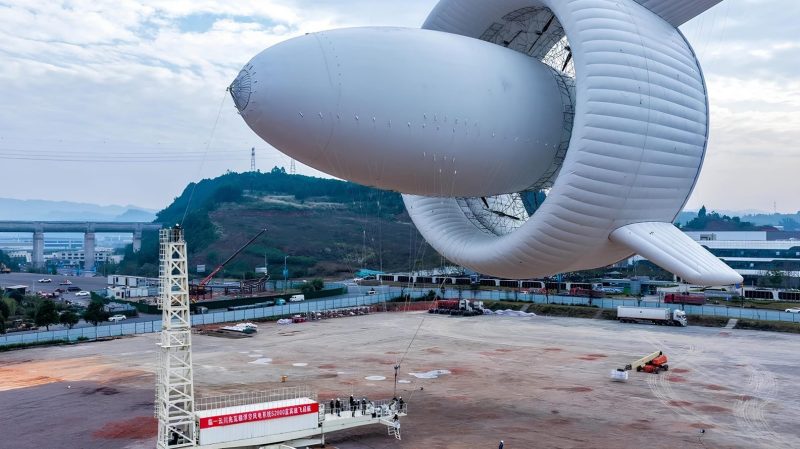
2000 m above ground level (AGL), winds are stronger and much, much more consistent than they are at surface. Even if the Earth were a perfect sphere, there’d be a sluggish boundry layer at the surface, but since it’s got all these interesting bumps and bits and bobs, it’s not just sluggish but horribly turbulent, too. Getting above that, as much as possible, is why wind turbines are on big towers. Rather than build really big tower, Beijing Lanyi Yunchuan Energy Technology Co. has gone for a more ambitious approach: an aerostat to take power from the steady winds found at high altitude. Ambitiously called the Stratosphere Airborne Wind Energy System (SAWES), the megawatt-scale prototype has recently begun feeding into the grid in Yibin, Sichuan Province.
The name might be a bit ambitious, since its 2000 m test flight is only one tenth of the way to the stratosphere, but Yibin isn’t a bad choice for testing: as it is well inland, the S2000 prototype won’t have to contend with typhoons or other ocean storms. The prototype is arguably as ambitious as the name: its 12 flying turbines have a peak capacity of three megawatts. True, there are larger turbines in wind farms right now, but at 60 m in length and 40 m in diameter, the S2000 has a lot of room to grow before hitting any kind of limit or even record for aerostats. We’re particularly interested in the double-hull construction– it would seem the ring of the outer gas bag would do a good job funneling and accelerating air into those turbines, but we’d love to see some wind tunnel testing or even CFD renderings of what’s going on in there.
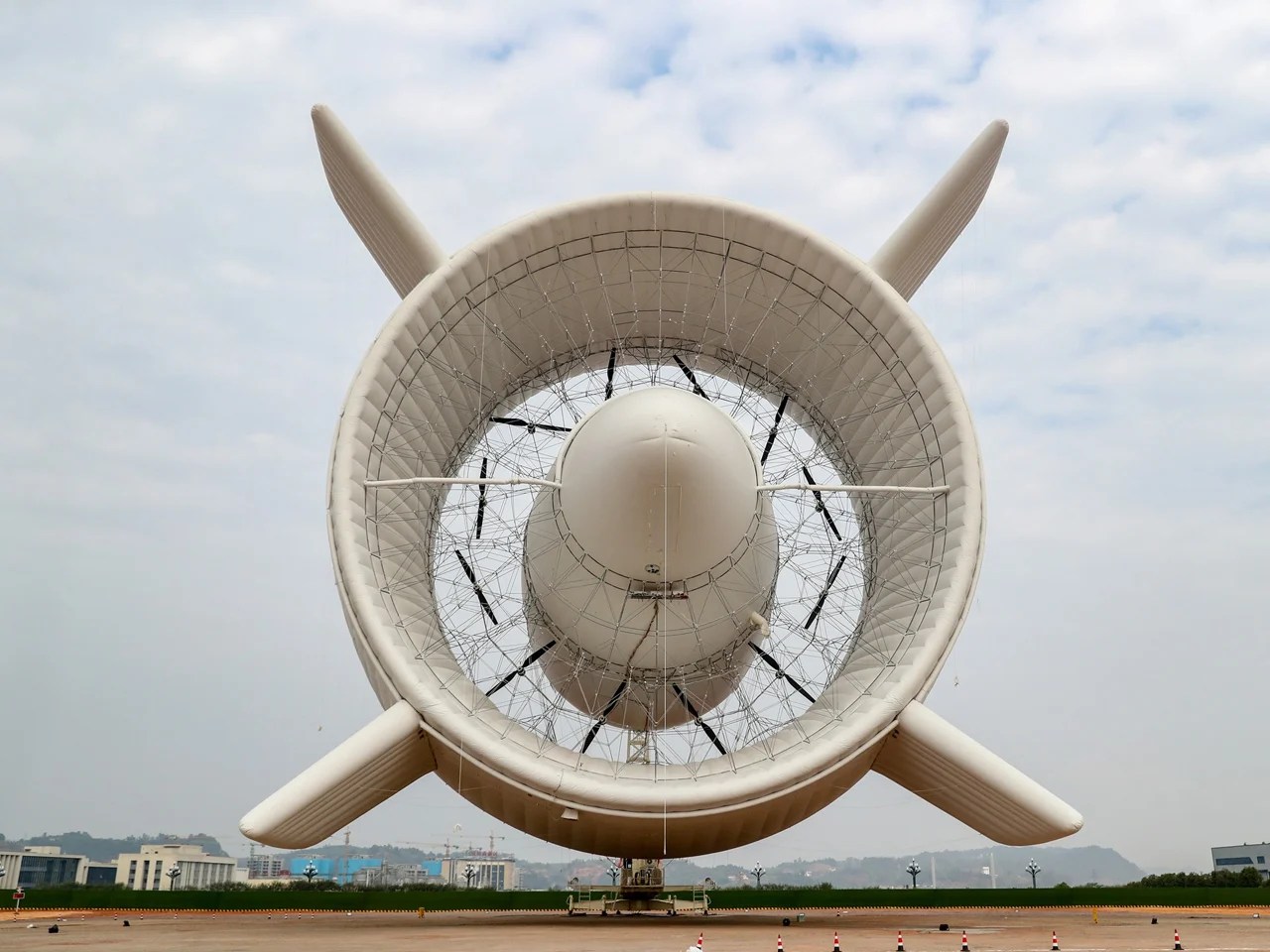
During its first test flight in January 2026, the system generated generated 385 kilowatt-hours of electricity over the course of 30 minutes. That means it averaged about 25% capacity for the test, which is a good safe start. Doubtless the engineers have a full suite of test flights planned to demonstrate the endurance and power production capabilities of this prototype. Longer flights at higher capacity may have already happened by the time you read this.
Flying wind turbines isn’t a new idea by any means; a few years ago we featured this homemade kite generator, and the pros have been in on it too. Using helium instead represents an interesting design choice–on the plus side, its probably easier to control, and obviously allowing large structures, but the downside is the added cost of the gas. It will be interesting to see how it develops.
We’re willing to bet it catches on faster than harvesting wind energy from trees.
All images from Beijing Lanyi Yunchuan Energy Technology Co., Ltd.












For an unmanned aircraft perhaps hydrogen as a lifting gas could be acceptable? It could even have a rainwater capture device and could use its own power to top itself up…if you want to vent all the lifting gas for safety when it lands for maintenance, no big deal.
and it comes with lifting capability and availability clear advantages, yes. for unmanned vehicle that seems really desirable despite the flamability issues…
Venting H is a bad idea .. it is an indirect greenhouse gas.
Then simply burn it off :)
I laughed way too hard at your comment.
Better to just, let it vent off.
Why? If you burn hydrogen what you end up with is just water. Use the generated power to electrolyse rainwater and get hydrogen, then just burn it at the end to get back to water.
If you thought hydrogen was a great greenhouse gas, water vapour is way more so! Can’t release that stuff into the atmosphere, we’ll all burn for it
You really should stop listening to those monochromatic scaremongers.
Hydrogen is not a GHG, indirect or otherwise, it’s too ‘light’. All GHGs are ‘heavy’ molecules, e.g.
Direct
Carbon Dioxide
Methane
Nitrous oxide
Hydroflourocarbons
Perfluorocarbons
Sulphur hexafluoride
Nitrogen trifluoride
Indirect
Nitrogen oxides
Carbon monoxide
Non-methane volatile organic compounds
Sulphur dioxide
Hydrogen generates about 8% to 10% more lift than Helium.
Ok it will leak away faster, Hydrogen’s effusion rate is 1.41 times greater than Helium’s because the rate is inversely proportional to the square root of the gas’s molar mass.
But with enough water vapor collection it could, at least in theory, be fully replenished without the need to land.
Steam airships are attractive except for the energy needed to keep the water from condensing on the interior of the envelope, the heat lost to convection needs to be replaced.
There is plenty of energy available here! Use some of it to maintain the temperature of the steam, maybe even just the generator heat that would otherwise be waste. The volume of the steam balloon needs to be about twice the volume of an equivalent-lifting-force hydrogen balloon, but can be a very simple device.
I’m guessing it’s not cost-effective given the current price of He compared to the extra insurance needed to cover hydrogen-associated risks.
yeah i don’t know if hydrogen is a good choice…i’m thinking hot air myself. In fact, a rigid body filled with vacuum would float my boat just fine and i have the illusion that the problems with that idea are just a few materials-innovations away. I just get anxious looking at anything that seems to be based on the assumption that using massive quantities of helium forever is going to scale. The blimp article a couple days ago really rubbed me the wrong way too.
just make sure it doesn’t leak, the vacuum puddles on the ground would suffocate all the ants
Upvoting this to be the best monochromatic comeback to the monochromatic scaremongering.
I could totally be wrong here but I made a spreadsheet for displacement vs wall thickness needed to withstand vacuum pressure, and the required material strength for a buoyant solution of any size above microscopic required materials strengths like two orders of magnitude higher than anything we have. (I didn’t model something with multiple layers of reduced pressure but I’m not sure that would help.)
Math is easy to make work.
Negative pressure is the key.
It is tethered so it would become a huge lightning rod.
Maybe this could be mitigated with a rigid wire structure across the top attached to a dedicated ground wire as a lightning rod system? That system might get bent or vaporized when it does its job, but would hopefully save everything else. Lightning can still be problem for non-tethered aircraft BTW, especially airships.
Bonus free power. :)
Not really, the number of electrons in a typical lightening strike is about the same as a 10 to 15 coulombs. Where as a new alkaline AA Battery holds a significant charge, roughly 3,600 to 5,000 coulombs.
And I know what you are thinking a battery is only 1.5 volts whereas a lightening strike is possibly 300 million volts (10,000 Joules vs 1-10 Billion Joules of energy). But the vast majority of that huge potential energy will be lost as an incredible current flows through the conductor generating heat and a wide spectrum electromagnetic pulse. Neither of which is energy that can realistically be captured. So you are left with the energy from the electrons.
Lightning is the electrical discharge in the sky, lightening is removing mass from an object.
… enlightening is removing darkness, and enlightning is … using a taser on someone?
Surprised a HaD reader doesn’t know that a lightning rod exists to prevent lightning strikes by dissipating atmospheric charge before it builds up enough to break down air into a conductive plasma. This thing definitely already has the equivalent to a L.R., even if it uses helium. (Unless the designers are complete morons.)
yeah i noticed this when they installed a big substation by my house…at the substation itself, they have a complicated sub-surface grounding structure and a bunch of (apparently) ground wires flying through the air…and then they have ground wires above the 3 current-carriers on the many-kV lines going too and from it as well. I don’t know how it works but i can confirm that the electric company knows about / plans for lightning!
Actually I did read the paper work my father had on managing such problems in military radars. It isn’t as simple as you suggest, at best there is a level of protection within a fixed range and beyond that boom. It is a game of chance where you just get some opportunities to the weight the dice, a little.
I thought we were running out of helium.
Hydrogen works better anyways.
Anyone an idea why they are using turbines with two blades instead of three blades?
If it is similar to propellers then less blades is more efficient but more blades produces more thrust for a given rotation speed.
So maybe it is similar for wind turbines? Maybe more blades means more power for a given speed but less efficiency?
I thought so too, but apparently, while there was a shortage in 2022, more sources came online and as of the end of 2024 there’s now a surplus:
https://www.gasworld.com/feature/the-2025-worldwide-helium-market/2165923.article/
Cool. Excess helium is stored in the ground. So the earth will get lighter and float away…
Only temporarily. Helium is separated from natural gas coming from wells. As the price of Helium goes up it becomes profitable to separate the Helium from natural gas containing smaller fractions of Helium.
I’d be interested to see how they mark the tethers and power lines to keep aircraft from hitting them.
simle, just use a white and red flashing light bulb every 50 mtr amounting to a total of 385 kwh.
Oh. uh…
Limit aircrafts to commercial and declare the zone off-limit
Huge orange plastic spheres. Same kinds they attach to the power wires : – ]
Kidding, of course, I just honestly don’t think they would be THAT stupid as to fly these anywhere near airports or inside flight corridors’ exclusion zones.
That and how big of a circle they occupy.
I assume they turn as the wind changes?
So do they move on the tether in a circle?
is that circle a significant fraction of 2000m?
Can we only have one of those within that circle?
Can they share a tether?
That is probably a pretty easy to solve problem. Just don’t build it near an airport or in any flight paths. Most commercial planes unless taking off or landing will probably be significantly higher anyway.
Insert Big Hero 6 reference here…
I’m stoked — looking forward to seeing some brightly coloured ones.
Well, I imagine that delivering Megawatts to the ground need a fairly big section of cable. A 2000 meters cable to be precise. How to lift that weight ? And keep it stationary in the wind flow ? Or are they planning to build 2000 m high towers (and break the record of the highest building) ? In any case all of this looks for me close to the impossible.
With the total weight of the tether stated at roughly 3,000 kilograms While the tether is heavy, the S1500 flying component itself is designed to be lightweight, with the entire flying unit weighing less than 1 ton. With 20,000 cubic meters of helium providing approximately 20,930 kg of lift on its own, without considering any lift generated by the wind across its structure, they seem to have the basic metrics figured out already.
Nuclear engineer weighs in. He isn’t optimistic it’ll get far beyond trials.
https://youtube.com/shorts/BF7NDVItCDY?si=9aVu0Ow_47vYJvxv
It’d be more convincing if this was an aerospace engineer. A nuclear engineer’s expertise doesn’t really apply here, and they’ve naturally got a bias against any competing technology.
As Donaldo Trumpo recently said, Chine does not care about wind power, but is happy to sell you the infrastructure. This device has all the markings of Solar Highways, and it will make Green Party politicians very happy. It has also been tried several times in last century. It works, but does not scale up.
They tested it at 25% capacity. I’m wondering how that big balloon will behave when they try to run it at full capacity when the drag is much higher.
I remember this idea back in the 80’s.
Good luck making the tether visible to aircraft.
Unless they make the wire with led’s or something in the ground wires but that will increase the costs of the project itself.
Not as much of an issue as several in the comments here seem to think.
Look up Aerostats, they’ve been in use for many years, quite often literally on airports, especially very active military bases:
https://en.wikipedia.org/wiki/Tethered_Aerostat_Radar_System
Have there been incidents where the tether has been hit? Yes. But there are also plenty of incidents out there where literal buildings have been hit. Sometimes pilots just screw up. But these installations are published, marked on charts, and generally well known to any pilot operating in the area. There are much bigger threats to aviation out there.
For VFR, yes. IFR, not so much. Theres a delay string built into IFR changes in addition they’re not necessarily looking out the window when in clouds
IFR even moreso, actually. When IFR aircraft are under ATC control, who are going to keep you well clear of a published obstacle such as a known tethered balloon. These things wouldn’t pop up overnight and without coordination.
FWIW, I’ve got over 1k hours flying out of a field with a tethered aerostat on the airport. Deconfliction is a solved problem.
If you know its there, yes it is easy to miss. In my 4K hours, sometimes they forget to tell you about stuff that is kinda important
Attach radar reflectors to the tether
“Boundry”?
Boundary maybe?
Got a hunch fusion reactors will come online, before this…
And if they’d just send up a charge collector up on a balloon and connect it by wire to a fractal design based switched-capacitor-convertor on the ground, they’d get cheap power without any moving parts.