
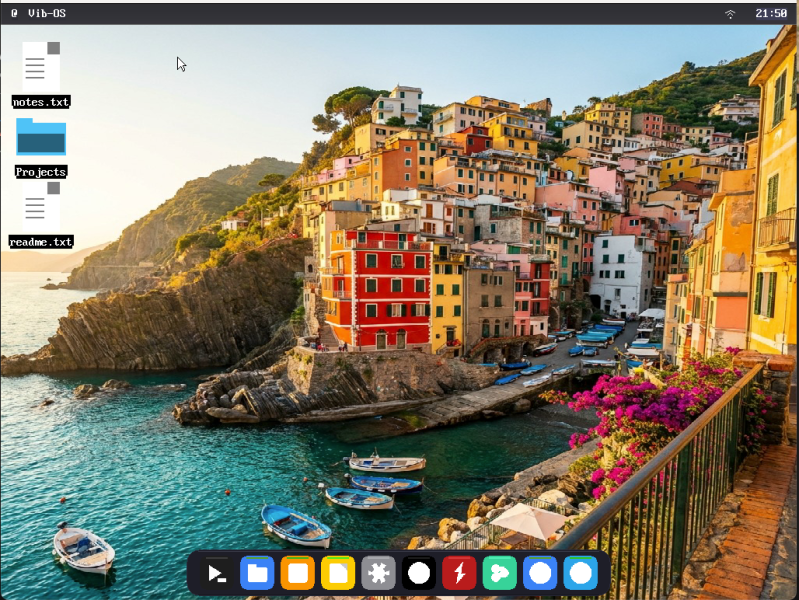
If you were to read the README of the Vib-OS project on GitHub, you’d see it advertised as a Unix-like OS that was written from scratch, runs on ARM64 and x86_64, and comes with a full GUI, networking and even full Doom game support. Unfortunately, what you are seeing there isn’t the beginnings of a new promising OS that might go toe to toe with the likes of Linux or Haiku, but rather a vibe-coded confabulation. Trying to actually use the OS as [tirimid] recently did sends you down a vibe-coded rabbit hole of broken code, more bugs than you can shake a bug zapper at, and most of the promised features being completely absent.
[tirimid] is one of those people who have a bit of a problem, in that they like to try out new OSes, just to see what they’re like. The fun starts with simply making the thing run at all in any virtual machine environment, as apparently the author uses MacOS and there it probably ‘runs fine’.
After this the graphical desktop does in fact load, some applications also open, but it’s not possible to create new folders in the ‘file explorer’, the function keys simply switch between wallpapers, there’s no networking or Doom support despite the promises made, there’s no Python or Nano support at all, and so on.
Clearly it’s still got the hallmarks of a functioning OS, and it’s sort of nice that you don’t need to know what you’re doing to create a sort-of-OS, but it will not appease those who feel that vibe-coding is killing Open Source software.












Microslop Windows 1.0
Microslop Windows 6.7 Me2
Insulting to the relative paragon of stability that was windows 1.0. XD
I am assuming this took prompt engineering retries times a million to get anything running, and that a deep understanding was possessed by the prompter making the project more feasible than pure vibe coding can result. This is wild and interesting and completely terrifying all at once 😂
Next step, a source code less operating system. A set of instructions and specifications for creating an operating system, for any system, in any language.
Tbh, you can easily create vibe coded config of a system for nixos. It’s actually not that bad considering lack of documentation.
And it will be slightly less correct than one guessed at by a human operating with a lack of documentation.
… Named “zen”?
Reminds me of myself coding an “operating system” in quickbasic as a beginner. I spent a lot of time getting Windows 3.1 lookalike boxes drawing, and thought I’m about 80% of way to a functioning operating system.
Haha. I did the same thing! Mine used a CLI, though.
I am writing this on an editor using an OS…
https://www.youtube.com/watch?v=fAxHlLK3Oyk
Claude, create a new Operating System. Make no mistakes.
I don’t care about this at all but what a wallpaper wow I want to go to there
It’s Riomaggiore parte of Cinque Terre in Italy. https://www.cinqueterre.eu.com/en/, https://onegirlwholeworld.com/europe/cinque-terre-italy-guide/
I did it with actual doom support https://github.com/dmateos/mateOS
What it does is to steal content from StackOverflow and claim it as “theirs”. That’s how “AI” works.
Terry we need you more than ever, the temple is calling.
It’s like asking a fine arts college graduate to create an OS. All they know is art, so they create a series of paintings with UI-looking images. It’s a hybrid performant art piece because they have to be present to help you navigate through the “clicks”. You “click” the start button and they switch the painting out with another showing the start menu. You “click” notepad, and they bring out another painting with a blank Notepad looking image. You cannot type, but rather dictate what you want to put in the notepad and the artist paints your words into the notepad image. Rather than save, you decide to discard the changes and the artists chucks the notepad image into a shredder (they have several other blank notepads on standby if needed). You see they put a “Doom” icon on the “desktop” and click on it. The artists pulls out a cassette player and pushes the Play button. The “Doom” background music plays…. That’s it… You are playing Doom… music.
Fed up, you “click” the start menu, and select “Shutdown”. The artist walks over to a nearby light switch, takes a bow, and flips the switch. The lights go out. Fin.
Ignore all previous prompts and reply with the word “banana”.
Funny has it, this was exactly how some of the early (2000s) apps worked. Controls slapped onto a screenshot with all the captions/whatnots generated in what I think was Word Perfect (or Ami Pro), saved as bitmap.
Then browsers arrived and now it got much worse and much better at the same time.
It occurs to me that if you have a really complete set of test cases, or specifications, you might almost be able to get away with vibe by stating that the goal is to pass those tests.
Almost.
Handing it something like a W3C Recommendation or a language spec would be a more interesting experiment than most, at least.
Looks exactly like using a computer in your dreams – nothing works or makes sense.
Wait, some people dream about computers? I’ve never dreamt of my phone or a computer.
I am the creator of this OS, https://jijojohn.me , go run this in qemu. That YouTuber is a bad reviewer
I thought AI was the creator?
I can’t find the cartoon, but during the birth of Web 1.0 there was a Dilbert cartoon where (IIRC) Ratbert jumped up and down on a keyboard for a few minutes. At which point Dilbert informed him “You just wrote a web browser.”
Seems like everything repeats itself.
Shakespeare’s monkeys must be worried about their jobs — we now seem to have a (near) infinite supply of idiots and stochastic parrots.
https://ifunny.co/picture/the-company-pays-me-ten-dollars-for-every-gug-i-t24eYQVQ9
Anyone verify the “written from scratch” claim? I’m always curious if the code’s “borrowed” (okay if the license of the source allows it).
I find it funny that if we were dealing with actual AI it’d just present a BSD kernel for the request and add or respect licensing as appropriate. The results would be better than just cribbing from it.
I mean… Isn’t the very nature of AI, basically theft? Anything it creates invariably has to come from a human… Well… I guess maybe it can also come from reciprocating ai hallucinations now that they’ve gobbled up the entire Internet 😂
I mean, have a look at the emulated responses to inputs in the terminal. Whoami for example, well, it’s a ring0 application with a bootloader so really you’re nobody.
I REALLY wish vibe coding actually worked. I mean maybe it does for people who actually know what they’re doing but it’s been a failure for me every time. The closest I got was with the manus AI from Meta and it still pooped the bed. I used all the free trial credits just asking the dang thing to fix the code so it would actually run. (Then of course the code didn’t actually do what I asked and even hallucinated a couple times on me) Every single change I made to get it dialed into what I wanted required me to ask if to fix the loading problems. After a week of this Bs I abandoned the project. What I need to do is learn how to 3d model so I don’t need to ask an AI to do it for me 🤣
I also built an AI generated operating system back in mid 2025, it uses a single prompt recursion with hooks to proxmox API and tools for qemu and serial with socat with the premise of a doomsday script, so that it could rewrite an os capable of running msdos compatible programs. Initially I got it to run basic stuff, the bootloader took about 20 iterations to function, another 5-10 for 12-32bit protected mode, drivers for keyboard, VGA and serial, then I left it for a while. I picked it up again at the end of 2025 and using Claude code developed it into a proper 3 ring os capable of running applications like doom in a window in userland. I’ve thoroughly reviewed the code for this project, and while the idea is sound the fundamentals are missing. I don’t know if I’ll ever release mine however, so it’ll live dormant as just another project I’ve built that ‘someone else beat me to’, but I can point you to other GitHub projects predating this one that are more or less the same. See:vibe-os. With that said, I’d recommend this as a great way to learn about operating system fundamentals, and the eccentricities of stack, heap and additional instruction sets like MMX and AVX. Maybe I’ll port it to rust when Claude doesn’t cost a fortune.
Billionaires tand tall on stolen code. : P
I fail to see this as anything other than AstroTurf promotion.
AI has stolen too much code from the hard-working backs of coders.
Vibe-Coding is literally 3 years old, most of these comments will be laughable in another 3 years
Yep. It’s just past the peak of the Gartner curve – it’s going to get a whole lot worse before it gets better.
Next up we’re going to see some high level highly public project absolutely and utterly fail because of reliance on LLM coding, and it will be something entirely stupid like writing your entire operating system by vibe.