

Until the fall of the Soviet Union around 1990 you’d be forgiven as a proud Soviet citizen for thinking that the USSR’s technology was on par with the decadent West. After the Iron Curtain lifted it became however quite clear how outdated especially consumer electronics were in the USSR, with technologies like digital audio CDs and their players being one good point of comparison. In a recent video by a railways/retro tech YouTube channel we get a look at one of the earliest Soviet CD players.
A good overall summary of how CD technology slowly developed in the Soviet Union despite limitations can be found in this 2025 article by [Artur Netsvetaev]. Soviet technology was characterized mostly by glossy announcements and promises of ‘imminent’ serial production prior to a slow fading into obscurity. Soviet engineers had come up with the Luch-001 digital audio player in 1979, using glass discs. More prototypes followed, but with no means for mass-production and Soviet bureaucracy getting in the way, these efforts died during the 1980s.
During the 1980s CD players were produced in Soviet Estonia in small batches, using Philips internals to create the Estonia LP-010. Eventually sanctions on the USSR would strangle these efforts, however. Thus it wouldn’t be until 1991 that the Vega PKD-122 would become the first mass-produced CD player, with one example featured in this video.
The video helpfully includes a teardown of the player after a rundown of its controls and playback demonstration, so that we can ogle its internals. This system uses mostly localized components, with imported components like the VF display and processors gradually getting replaced over time. The DAC and optical-mechanical assembly would still be imported from Japan until 1995 when the factory went bankrupt.
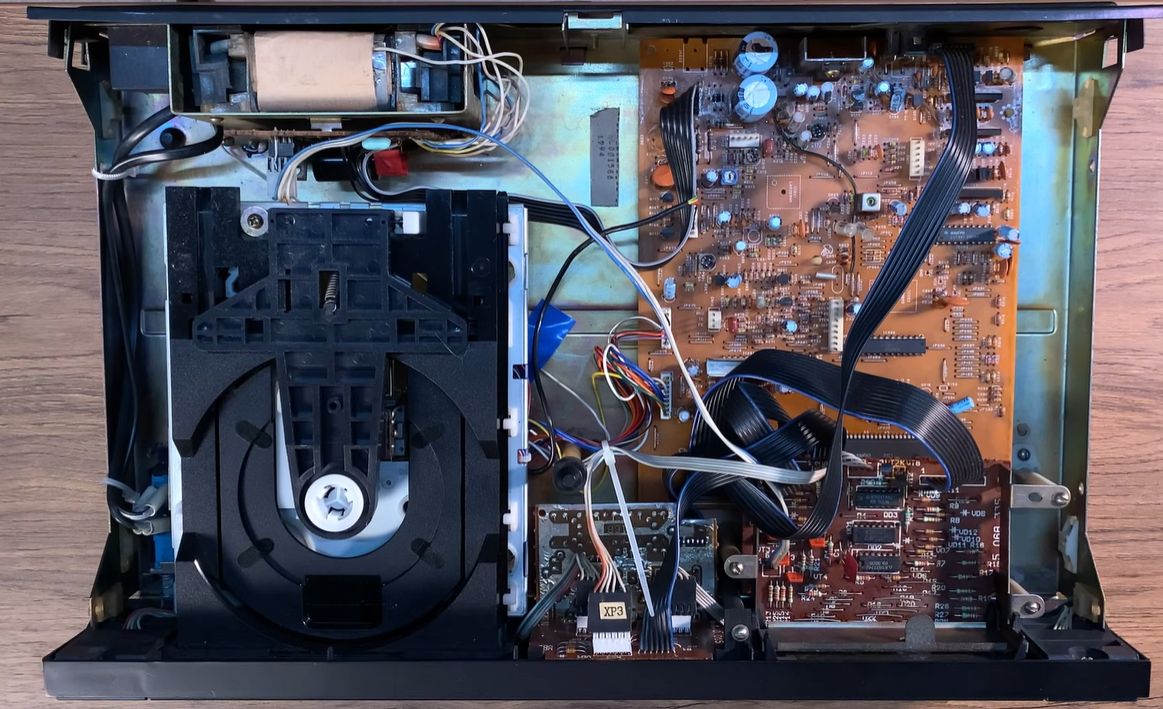
This difference between the imported and localized part is captured succinctly in the video with the comparison to Berlin in 1999, in that you can clearly see the difference between East and West. The CD mechanism is produced by Sanyo, with a Sanyo DAC IC on the mainboard. The power supply, display and logic board (using Soviet TTL ICs) are all Soviet-produced. A sticker inside the case identifies this unit as having been produced in 1994.
Amusingly, the front buttons are directly coupled into the mainboard without ESD protection, which means that in a Siberian winter with practically zero relative humidity inside you’d often fry the mainboard by merely using these buttons.
After this exploration the video goes on to explain how Soviet CD production began in the 1989, using imported technology and know-how. This factory was set up in Moscow, using outdated West-German CD pressing equipment and makes for a whole fascinating topic by itself.
Finally, the video explores the CD player’s manual and how to program the player, as well as how to obtain your own Soviet CD player. Interestingly, a former employee of the old factory has taken over the warehouse and set up a web shop selling new old stock as well as repaired units and replacement parts.












Maybe I’m missing something obvious here? This Russian CD player looks exactly like almost every other entry-level CD player from that era (late 80s and early 90s)…no matter where it was manufactured. Everyone used Japanese transports, and almost everyone added some of their own local assemblies to make manufacturing cheaper (the worldwide cheap Chinese JIT economy did not exist them), which makes especially sense in a society with a Cyrillic alphabet.
What I do however find interesting was the use of ISO symbols on the front-panel. I am not aware of anyone else using it.
Nope, that’s the whole story.
The use of the ISO symbols was because the people assigned to design it had never seen a CD player, they were probably industrial engineers by formal training, so they just opened the standard on “Graphical Symbols for Use on Equipment” and picked the first symbols for “Start” and “Pause” as they would appear on generic industrial automation – or the machines they were familiar with.
We now look back with kitch aesthetic of Soviet propaganda. We view it with irony, as an obsolete design aesthetic. Captialism still needs to push it’s own propaganda. “Weren’t they so backwards and how much better the West had it!” Well, it was because of the threat of Communism that the US had a strong, even growing middle class. The masses in the West are now seen by the ultra-wealthy with at least as much disgust as the Czarist Russian aristocracy viewed their serfs. The future middle class is being destroyed with student loans and we pretend it’s not deliberate. It’s just market forces. Well, they can shove those Western CD players up theirs. It wasn’t worth it. None of it was worth it. We just threw away our future and will end up pretty much the same as we would in any dystopia where the USSR wins. Techno fuedalism. Even just touching on Soviet vs “Western” subjects now sucks all the fun out for me. We won the Cold War for nothing. Oh, I’m sorry, slightly better Optical Disc players from… Communist China.
The interesting part is how they built up the rest of the ICs and other stuff around it, and the story of the economic failure it was. Also how extremely built down in price and tech it is, because of the constraints of the soviet system.
The article highlights the difficulty in properly discussing the implications of trade policy in a globalized marketplace, when it describes “difference between the East and West” with USSR as “East” and Japan as “West”.
In principle, it is not false to claim that going far enough east, you’ll find yourself in the west. Whether you should attempt to do so, we cannot publicly recommend.
My parents are just about to take a holiday which involves only east-bound flights, right around the world, so they’ll be coming back home from the west.
I used to work for Vega in Novosibirsk in 1991 for short time. It was fun back then. Then there was a store that sold “illiquids” at the factory where you can buy components for Vega electronics and make like a cassette player yourself. Was a good time…
Vega “walkman” https://youtu.be/4CoIWpZTXLw?si=W39-PykgjBil1yOn
The design and production quality was far from Japanese, but worked.
Is the sovietrock article AI generated? It has some odd mistakes: “no CD player made in the US using only American parts ever made it to the consumer market”.
Nope. To err is human…
Maybe the video explains it better but I don’t see why they would ever have had to import the VF displays. There were excellent Soviet VF displays in consumer equipment in the 1980s, e.g in the “Elektronika” calculators (featured here on Hackaday) and a range of digital clocks from the same brand. Lovely displays, still working fine in 2026.
…and I agree with Johan above. It doesn’t look much different from an equivalent western CD player of the same era. I still kinda want one though.