
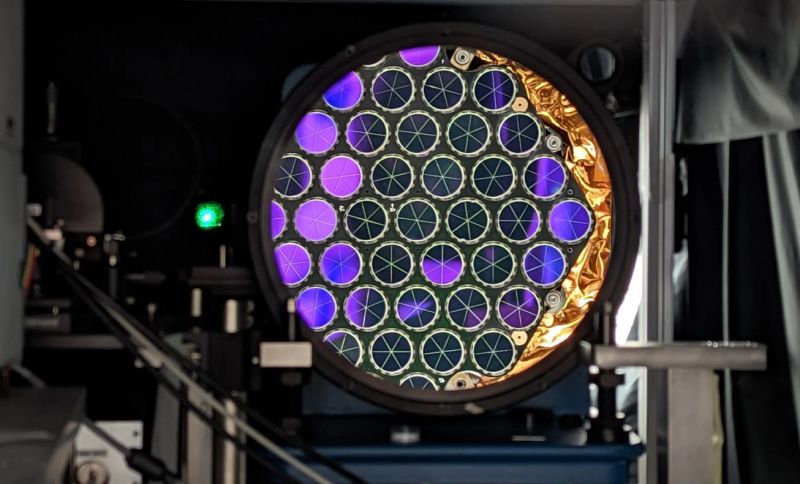
Although GNSS systems like GPS have made pin-pointing locations on Earth’s sphere-approximating surface significantly easier and more precise, it’s always possible to go a bit further. The latest innovation involves strapping laser retroreflector arrays (LRAs) to newly launched GPS satellites, enabling ground-based lasers to accurately determine the distance to these satellites.
Similar to the retroreflector array that was left on the Moon during the Apollo missions, these LRAs will be most helpful with scientific pursuits, such as geodesy. This is the science of studying Earth’s shape, gravity and rotation over time, which is information that is also incredibly useful for Earth-observing satellites.
Laser ranging is also essential for determining the geocentric orbit of a satellite, which enables precise calibration of altimeters and increasing the accuracy of long-term measurements. Now that the newly launched GPS III SV-09 satellite is operational this means more information for NASA’s geodesy project, and increased accuracy for GPS measurements as more of its still to be launched satellites are equipped with LRAs.












I wonder how much this could help with jamming/spoofing.
I.e. determining a true signal by confirming the satellite position.
Perhaps, but do you want to be shooting laser beams into the sky while your enemy is nearby jamming your GPS.
Looks like this is the real purpose. If you don’t see the satellite on received position, you are jammed, Mr. Helmet.
Rule # 42 of HAD is that for every topic, there is an XKCD that applies. In this instance,
https://xkcd.com/2170/
The retroreflectors on the moon are frustratingly difficult to hit for an amateur because the return loss is so high and the ping time so long.
I wonder if optically pinging GPS satellite targets will become a new sport? Return loss and ping time are going to make it easier, but now you have a nearly invisible moving target to hit, with sub-arcminute accuracy — a whole ‘nother challenge.
Thinking about it a moment longer. The GPS satellites broadcast their own freakin’ position, with an accuracy more than sufficient to hit them with a beam a few arcsec wide.
So it reduces to some arithmetic. And some possibly non-trivial tuning of a good mount.
Back of the envelope says I should be able to see a million photons per second coming back, with modest optics (a few inches aperture) and a source with sane power (less than a watt average).
Sounds like fun, actually.
Especially to tune it down to a minimum. Think an off the shelf medium distance range finder could be modified to do it? They already have a high gain receiver.
And I have one already disassembled.
If it does proper photon counting detection, and can handle the 135 ms return time, and has a decent narrowband optical filter, and can be coupled to a reasonable size lens to get the tx beam down to a few arcsec wide, and similar gain on the receiver, and can put out more than a few dozen milliwatts of average power, then sure, maybe.
No. The most popular infrared wavelengths(750nm, 850nm, 905nm, 940nm) were selected by the low environmental “noise”. In practice this means on those wavelengths the natural emission is low, because the atmosphere’s attenuation is high, so it blocks the sun’s radiation. But if you want to pass through the atmosphere twice it will turn into a barrier.
Sorry, that’s not correct. There is a few percent loss due to water vapor around 940 nm and a deeper band around 1150 nm, but most of the NIR wavelengths shorter than 1300 nm pass as well as visible light. Or even better, since scattering is much lower.
Wavelengths are chosen for multiple reasons: Mostly due to availability of sources and detectors with the correct characteristics for the application, along with cost, compatibility with optics, and eye safety.
Few percent? According to this gap it isn’t a few percent at all, and 1064nm or 1300nm even a magnitude better than 850-940nm wavelengths:
https://vitroid.github.io/water-science/water/images/sun.gif
You’re right, that graph does show a dramatic drop at 940 nm and other bands.
The total water in the atmosphere column determines that attenuation, and it’s the way the total precipitable water is determined by weather satellites; they measure the ratio between the absorption at the 940 nm band compared to adjacent clear bands.
The atmosphere within a few degrees of the equator contains in excess of 50 kg/m^2 of water, and in that case, a path to sea level at 940 nm does experience an attenuation around 50%, consistent with that graph.
Over most of the rest of the world, away from the equator, the total precipitable water, and thus the attenuation at 940 nm, is less than a fifth of that, “a few percent”. At high latitude or high altitude favored by telescopes, it would be even less. Measurable, yes. A barrier? Depends how tolerant the design is to a few dB of attenuation.
So, yes, the 940 nm attenuation band is real and, yes, you probably would select a different wavelength to bounce two-way paths to space retroreflectors. Particularly from sea level at the equator, or at extreme slant ranges from low elevations in more temperate latitudes.
https://en.wikipedia.org/wiki/LAGEOS
The Lageos satellites are larger targets and in a medium orbit.
But those are entirely different beasts from the GPS satellites being discussed.
Which actually puts in question of the stated purpose of these being mounted on GPS birds “for geodesy”. The LAGEOS reflectors are a quarter as far away as the GPS satellites, so presumably can get better precision for measurements.
So what’s the real purpose of adding high precision ranging capability on military navigation satellites? Seems obvious, doesn’t it?
“in todays news, scientific research just so happens to advance weaponry by doing stuff. In other news, the sky is reported as blue.”
So I wonder, do retro-reflectors for audio exist/work?
So a brief search shows yes but they are much more complex than you would think.
Although a flat surface is easy, having it bounce just right to various incoming angles is not it seems.
It’s probably so much easier to just detect the source and rotate a single flat plane that it ends up the preferred method I guess.
A corner reflector would likely retro reflect audio waves, but the size of the corner reflector would have to rival the size of the wavelength of sound. I expect a 1 meter corner reflector could handle 5-20 kHz sound.
Where did all the comments go?
Where they belong? LOL. Lets be honest, nothing productive or of value was lost.
Not true at all! And we’re working on restoring them as you type this.
There have been a number of “issues” on the backend lately, which have decoupled comments from their parents, and now seem to have had an even bigger glitch where ~5,000 comments got sent to our review queue. Unfortunately, it has mixed up previously trashed spam comments with the valid ones. I think I have figured out a way to triage it, but it may take a while, even so.
Isn’t there a white knight upon a fiery steed?
Late at night I toss and I turn
And I dream of what I need
I need a hero, I’m holding out for a hero
‘Til the end of the night
He’s gotta be strong
And he’s gotta be fast
And he’s gotta be fresh from the fight
The USSF and NRO called, said to remove the comment that suggested that the reflectors might be for something other other than benign geodesy :-)
Ack. The reply bug that won’t die.
Old and busted: Satellites zap you with their space lasers
New hotness: we zap the satellites
With by God Python!