
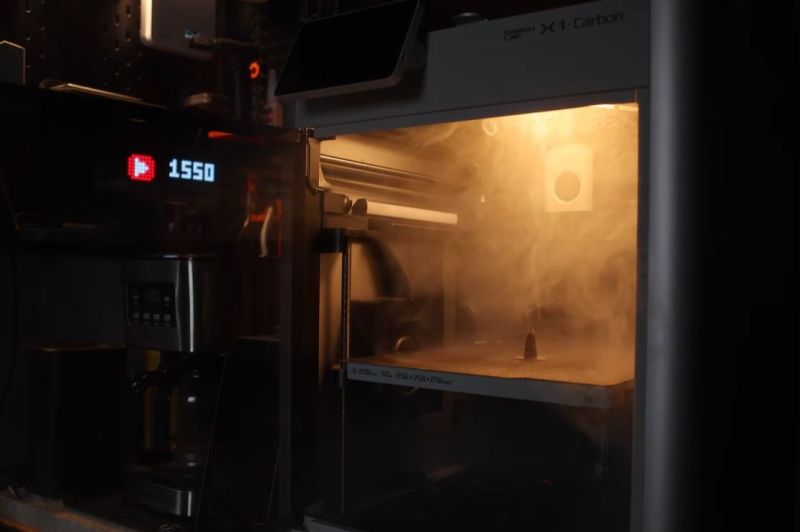
FDM 3D printing is fairly messy on a molecular scale, with the filament being heated up to temperatures high enough to melt it, which produces ultra-fine particles (UFPs) and volatile organic compounds (VOCs) in addition to the new plastic item on the build plate. Recently [Simon Pow] got somewhat worried about this pollution considering that he spends a considerable amount of time in the same room as FDM printers, sharing air.
While there is a lot of context within the topic, it’s notable that even ‘low risk’ PLA already emits formaldehyde, a group 1 carcinogen. Studies like this 2022 one by [Taehun Kim] et al. on formaldehyde, PM10 and PM2.5 show that common filaments like PLA, ABS and TPU score pretty bad here, even compared to the often maligned resin printing, also in the study. Having good ventilation in a room helps a lot, but it doesn’t reduce the levels to zero.
As noted by [Simon], PETG is much better in the VOC area, while TPU emits siloxanes, some of which are dangerous but most are considered harmless. Once you hit nylon (e.g. PA6), you’re adding caprolactam, which is mildly toxic but mostly just an irritant. Where things get serious is with ABS and ASA, when you add styrene to the mix. This substance is very dangerous, being toxic, mutagenic and possibly carcinogenic, but on the plus side it smells kind of sweet.
Polycarbonate (PC) emits BPA, with its worrying long-term health implications, while carbon fibers in particular can have asbestos-like long-term effects, as we covered previously. Definitely wear PPE while doing things like sanding CF parts and safely dispose of any debris.
Of course, you can do something about this problem, such as having an enclosure around the printer, with HEPA filtration and activated carbon, potentially exhausting into the outside air. The options here are covered in the video, including a BentoBox filter. For [Simon] the biggest improvement – as measured by a whole room sensor – came from a big fan in the window, while the default activated carbon filter in the Bambu Lab printer did effectively nothing.
The problem here is mostly one of long-term exposure, so even basic precautions like filtration and ventilation can already make all the difference. Ideally you’d not have the printer in the same room as where you work, of course, but adding a good filtration setup doesn’t have to be expensive or hard.












My first thought is enclose it and suck to exhaust fan, negative pressure.
The second thought is NIMBY or planet, all that filter stuff needs to be buried after it’s full.
Third, wood and metal.
there’s no chars limit on Hackaday.com, or at least, you have enough room to expand about this.
thank you
What in goda name are you babbling about?
Most likely NIMBY = Not in my back yard, but yeah, if you’re gonna use an uncommon abbreviation, maybe expand it for those who might not know.
No wonder PLA smells more noxious than PETG. I should get an exhaust vent on that. I have one on the resin printer.
It’s a hardware store special: 4-inch flexible ducting, a vent hood with a non-return flap (backdraft damper, whatever you call it), XPS insulation board to fit in the window, hose clamps, a 12V PC fan with high static pressure, and some printed bits to connect the printer exhaust to the fan and duct.
Pretty easy. The only effort was wiring the fan into the printer power. I could’ve avoided that by buying a commercial duct fan.
813 ppm CO2?! Good lord, man, open a window!
Is this really newsworthy? It is just the same old article that FDM printers release fumes and particles. Still nothing from studies on the measurable effects of hobbyist 3D printing on health.
https://share.google/GbZEBaPs6o3NIIPRV
Inhaling fumes from plastics should do nothing but promote positive health effects over the long term
My point is not to argue that it is harmful but there has been very little done to quantify how harmful it is. Loads of things in our everyday lives are harmful, how does 3D printing compare to other things we are exposed to every day?
Thanks for sharing such useful information. Ground campaign worker provide yes.
im not going to let the microscopic particles get me down. every time somebody tells me something is going to kill me it never happens. i dont listen to those people anymore.
But what about seed oil?!
/s
One surprising outcome of the Ozempic era is that when you prevent over eating, a lot of other “modern” diseases decline (cancer, depression, arthritis, dementia, addiction… etc). So if you are controlling your weight, moderating your alcohol intake, and abstaining from smoking then you are most of the way to a healthy life.
That being said, “I haven’t died from it yet” is almost the definition of survivor bias.
Well, you can’t say until you get a “I’ve died from it, so I know”, but it’s a dead bias anyway too.
I had once to work in the same small unventilated room as the large office laser printer, for a whole day. I got literally a fever and irritated “dusty” nasal cavity for two days.
Spirit duplicator.
It is worth looking at the results of that 2022 study, e.g. https://www.nature.com/articles/s41598-022-25957-x/figures/4
3D printer room on the left, control office on the right. Note that the particulate pollution averages lower in the 3D printer room than in the office. Also note that the red line on the formaldehyde graphs is not a “toxic” limit, but close to what you get sitting next to a sheet of MDF.
I recently bought a new roller blind to install it inside a triple-pane window. Even after months of use, the offgas from the synthetic fabric is enough to form a visibly gray film on the glass in a week.
For comparison, our hackerspace 3D printer enclosure does not have any visible residue on the glass door after 6 years of use.
So yeah, I wouldn’t be surprised if normal furniture and fabrics are worse offenders than basic 3D printing.
I don’t think I would have kept the blind up if it is offgassing that much. Does it smell? Do you notice the gray film on anything else like windowsills or walls near the window?
People just see particles and gasses from 3D printing and act like it is especially dangerous. We are exposed to so much worse throughout our normal lives anyway from things we don’t even think about.
In the UK the Government;s Health and Safety Executive effectively enforced all educational facilities to utilise Safety Cabinets. This was after a 5 year study. We used http://www.kora.co.uk if that helps anyone.
Makes me feel smug as I rarely print PLA; mainly PETG for 10 years now
The fast printing ELEGOO and Anycubic PETG was making me sick with nausea and headaches until I installed forced ventilation to the outside. The slower eSUN PETG and PLA never affected me.