
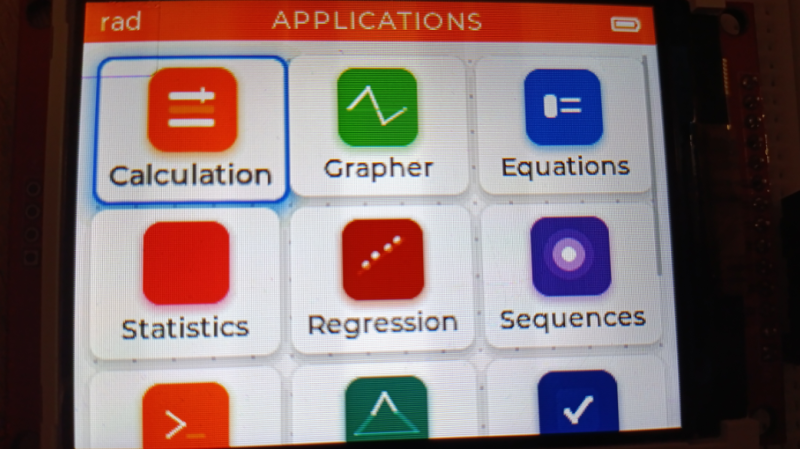
Graphics calculators are one of those strange technological cul-de-sacs. They rely on outdated technology and should not be nearly as expensive as they are, but market effects somehow keep prices well over $100 to this day. Given that fact, you might like to check out an open-source solution instead.
NumOS comes to us from [El-EnderJ]. It’s a scientific and graphic calculator system built to run on the ESP32-S3 with an ILI9341 screen. It’s intended to rival calculators like the Casio fx-991EX ClassWiz and the TI-84 Plus CE in terms of functionality. To that end, it has a full computer algebra system and a custom math engine to do all the heavy lifting a graphic calculator is expected to do, like symbolic differentiation and integration. It also has a Natural V.P.A.M-like display—if you’re unfamiliar with Casio’s terminology, it basically means things like fractions and integrals are rendered as you’d write them on paper rather than in uglier simplified symbology.
If you’ve ever wanted a graphics calculator that you could really tinker with down to the nuts and bolts, this is probably a great place to start. With that said, don’t expect your local school or university to let you take this thing into an exam hall. They’re pretty strict on that kind of thing these days.
We’ve seen some neat hacks on graphics calculators before, like this TI-83 running CircuitPython. If you’re doing your own magic with these mathematical machines, don’t hesitate to notify the tips line.











My 12 year old self just arrived in a time machine and is very very happy. He’d had to content himself with optoisolators bridging buttons on a calculator to make it “programmable.”
Did he have to harvest them from damaged electronics like I did?
Wouldn’t that run on a CYD?
Honestly? $100 seems to be nearly the lower limit for a functional computer in the US. It’s not the CPU power: it’s the screen, keyboard, link connection, case, assembly, etc. It’s about where low-end tablets end up. I haven’t seen a device go much below without a lot of subsidization in the business model.
Now putting a z80 or 68k in a modern product? That you can blame on the monopoly.
You can get a functional Pentium 4 for free in you’re local e-waste facility. If it could ran Firefox and Thief 3 in 2004 then it can also run Firefox and Thief 3 in 2026. The main issue is not the computing power itself but people who are too incompetent to utilize it to the fullest extent provided by engineering solutions inside the chip.
This isn’t entirely untrue, but it’s incredibly pessimistic and patronising. Once dual core machines in the 2.5~ GHz range, 8gb+ ram and any kind of SSD became the basic models, most people haven’t needed to upgrade except to satisfy OS requirements.
I think the problem is they have a bit of monopoly because they’re the only devices allowed during tests.
From memory, TI went after US schoolteachers. Conferences, teacher’s aid books, etc.
“When teaching X, use calculator steps A, B, and C”.
Result: you can ONLY get help in class, if you have the “right” calculator. Which helps guarantee sales, every year.
100% this^^^^ When my daughter started high school they specified the calculator used and indicated that all others were not allowed. I asked about an HP product and they just about laughed me out of the classroom! Everyone can be different as long as they are all the same.
In high school (1990s)we were allowed to use whatever graphing calculator we wanted. TI83 was recommended and was what was used by the teachers. Anything else you were definitely allowed to use it but were on your own for tech support. I used a TI85 because way better programming and several of us used HP graphers too but we were already fine with RPN. Most teachers didn’t know though.
And to the comment below. In my science and math classes the majority of work was symbolic and you solved general solutions then sometimes plug and chug an answer at the end. College you could use whatever you wanted too but I basically used a 4-function calculator for the plug and chug as, again, the majority of work was symbolic. Only grad school we started using stuff like Matlab or Mathematica etc.
I used a somewhat capable Casio someone had run over in a parking lot. Aside from a somewhat buggy basic implementation it lasted me through college until I started using computer based tooling like you did.
That is just a side feature for them.
Their dominance comes from being STAGNANT INTENTIONALLY, as a feature.
Being known old-tech means they get approved for use during tests, which means they have a built-in market.
Since you can use them during tests, that’s what you use during class.
And since they don’t change, it is easier for teachers and proctors to know all the little details of them.
We are SO used to the current trend of updates for update’s sake, and people just assume that things NEED an upgrade.
They don’t.
Adding more features or functionality, or even moving menu functions/buttons around, is a DOWNGRADE to these calculators.
This is really cool! I hope they’re available for sale soon.
Interesting how maths is thought in the US (?).
I barely used a calculator in my highschool maths classes.
There wasn’t much to calculate in the first place and even if there was, the actual result only got you like 10% of the points assigned to a question.
What mattered was applying the correct solution method and verbally explaining your reasoning behind it.
For that reason Multiple-choice questions were never part of a test – in any subject.
This is actually part of the scam. There’s little reason for students to do this, as you say, but profit is why companies lobby to have curriculum use certain types of products.
It seems to me like if you want a calculator to take an exam, you will still want a TI or whatever. And if you want a calculator because you use it so much that having one with real buttons / a consistent hardware interface, then you still want the product. The more common case (my case) where you want a calculator but you’re willing to deal with soft buttons or relatively raw software is perfectly served by apps on your phone?
I’m saying that as someone who wrote his own calculator for Android out of frustration with the offerings that were handy at the time.
oh i looked at it and i can answer the question of which niche this fills…the clue is that it has a good number of very sophisticated features, as if it was an impressive feat for a generalized CAS engine…but it’s oddly focused on a single implementation and is apparently missing core functionality.
you guessed it! it’s ai slop. the need it’s filling is the urge to feel like a programmer even while using AI. i probably sound pretty derogatory but honestly i am marvelling at the way we meet our emotional needs. i mean, if you dig through my pile of half-completed projects, i can’t say you’ll find better.
Fair criticism to raise, I was transparent about AI assistance in the README. That said, the architectural decisions are mine: the DAG with hash-consing, the Pratt parser chosen specifically because recursive descent overflows the ESP32’s 8KB task stack, the Slagle heuristic for integration. Happy to walk through any of it. The 85+ unit tests pass on real hardware.
Worth mentioning is NumWorks, which has open source firmware and schematics:
https://github.com/numworks/epsilon
https://www.numworks.com/engineering/hardware/electrical/schematics/
The firmware never really was open source (https://blog.mfriess.xyz/Numworks-lock/). It was “source available” with a licence preventing re-use. And recently it got worse, with part of the firmware source code being removed and locked : bootloader (since epsilon 16.3), low level code (hal) https://github.com/numworks/epsilon/issues/2358, and so on.
It was never really Free, and is now a lot more closer, and will be probably keep on getting so.
Cry וֹs free lel
Checking the website. The work is really impressive from a software point of view.
Hardware-wise, there seems to be mostly.. breadboard with some documentation about how to wire stuff.
yep, and I wonder if it can be made to run on the cheap yellow display… same display controller, ESP32 (and not ESP32-S3)… that would be kinda awesome tbh
Correct. It’s currently breadboard. PCB design is Phase 8. The focus so far has been validating the software stack, hardware iteration comes next.
All these calculator articles in the last few years have missed the point.
The old Ti-xx calculators are still the same for THE BEST possible reasons.
Not only are changes to them entirely unnecessary, they are flat out UNDESIRABLE.
They are a test taking tool. Full stop.
No one NEEDS a graphing calculator outside testing conditions in 2026, except that people should “Train how they fight”, meaning they should use the real tools/methods while practicing as they will use during a test.
In your free time or at your job after testing?
No you will just be using a computer.
Upgrades for the sake of upgrading is a terrible thing.