
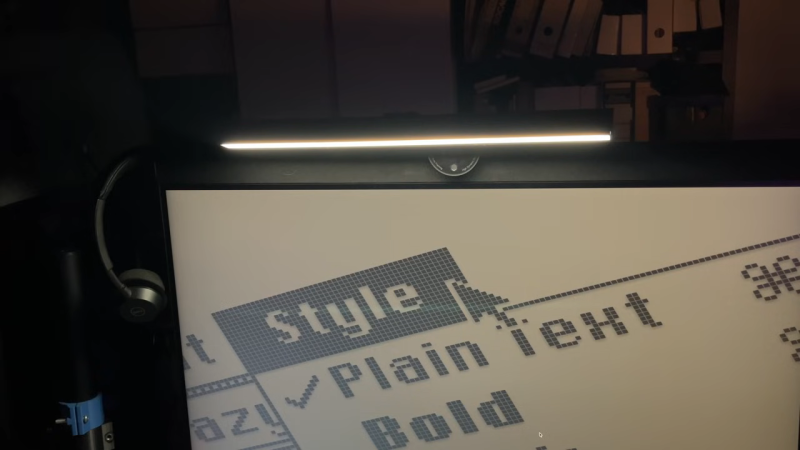
If you’re intending to work at your desk for long periods of time, good lighting is a must, as it can help stave off eye strain and mental fatigue. It was a desire for more comfortable productivity that drove [Jade] to whip up a monitor-mounted lighting system for her workstation.
The build uses an ESP32 to run the show, with a rotary encoder for manual control and firmware that allows the monitor light to be neatly integrated with Home Assistant. The light itself comes from light strips that feature both warm white and cold white LEDs. Simple MOSFETs are used to control the brightness of the LEDs and which of the warm and cold LEDs are activated at any time. Everything is wrapped up in a 3D printed housing that neatly sits on top of the monitor with the aid of a simple printed clamp. The LED strips also have a nice soft glow thanks to a strip of diffuser material that [Jade] snatched from an old television.
We love a good lighting build, from the work-focused to the creative and beautiful.












“If you’re not overengineering simple things, are you even a maker?”
We like how she thinks. :-)
poor bored ESP32…
Overengineered solutions to simple problems is my golf.
I think I’ll be ripping this off for replacing the guts of my two desktop task lights. Right now I have HA switching their power, but it has no control over brightness or, more critically, color temp.
Fun fact that original controller CAN dim the light if you long press it.
You can get those controller chips on AliExpress pretty cheaply, either single or dual colour. Not sure how the dual ones work, like if they mixes colours and whatnot.
You can get the single colour ones in a nice metal button for not that much as well.
With the diffuser close to the surface light spills out over a nearly 180 degrees which means light on the screen or in your eyes. Lighting spilling out into the house is the “in” thing since MTV, but has no place in productivity lighting. Nothing indoors lights up a work area like cross lighting by movable arm small flood lights over a desk, and a screen-less TV for light on the ceiling.
If the diffuser was deeper into the fixture it would shade the light to a more limited area. Keep the diffuser as the zebra shadows of spots of light need taming.
What problem is this trying to solve?
If it’s dark, it’s hard to see things. You may have experienced this occasionally yourself.
A bright screen against a dark desk/wall is tiring for the eyes.
As others have noted, this implementation isn’t doing a great job of solving it due to the position.
My desk is definitely too dark and I have researched methods to change it for quite a while. That’s why this build drew my attention. After a closer look it has one flaw that I’d like to avoid: light is distributed in a too wide angle. The flat surface of the diffuser scatters the light uniformishly 180° “above” (below, around) it’s surface. In practice one may want this angle to be 40°-60° so neither the screen below the lamp nor user’s eyes in front of it are exposed to light coming directly from the lamp.
Of course the build itself is cool and I hope it works for [Jade].
PS. The article is not visible on the /blog pages.