
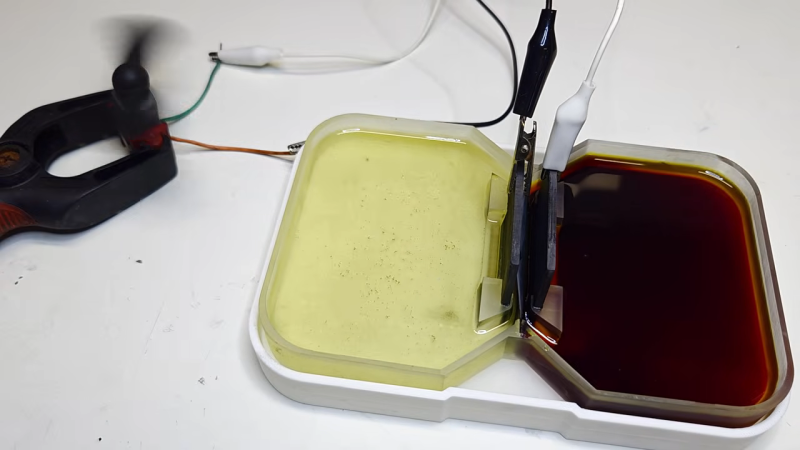
Flow batteries are rather unique. They generate electricity by the combination of two fluids flowing on either side of a membrane. Typically, this involves the use of some kind of pump to get everything moving. However, [Dusan Caf] has demonstrated another way to make a flow battery operate.
[Dusan]’s build is a zinc-iodide flow battery. It uses two 3D printed reservoirs, each holding a ZnI2 solution and a graphite electrode. Unlike traditional flow batteries, there is no mechanism included to mechanically push the fluid around. Instead, fluid motion is generated by the magnetohydrodynamic effect, which you may know from that Japanese boat that didn’t work very well.
When charging the liquid-based cell, current flows through the conductive electrolyte that sits between both electrodes. This sees zinc electroplated onto the graphite anode, while iodide ions are oxidized at the cathode. There’s also a permanent magnet installed beneath the electrodes, which provides a stable magnetic field. This field, combined with the current flowing through the electrolyte, sees the Lorentz force pushing the electrolyte along, allowing the flow battery to operate. When the cell is being discharged, the reactions happen in reverse, with the flow through the electrodes changing direction in turn. Neatly, as current draw or supply increases, the flow rate increases in turn, naturally regulating the system.
[Dusan] notes this isn’t feasible for large batteries, due to the limited flow rate, but it’s fine for small-scale demos regarding the operation of a flow battery. We’ve featured some more typical flow battery designs in the past, too.












Reminds me of these old electromagnetic electricity meters. Those had extremely low power low impedance electric motor in them spinning the counter mechanism as household current flow through them. It was like partialy shaded aluminum disc in coil with few turns or something… probably can use something similar to provide actual stir bar in the electrolyte…
Did you mean to say “the combination of two fluids, one flowing on either side of the membrane”.
I’m not being pedantic – I actually had to look up the Wikipedia article “Flow Battery” to be sure of whether the process involves a total of two fluids, or four fluids.
No numbers on the capacity, or how quickly that 500mA drops when the local ions have been depleted, but that is still quite impressive! 1.2V open circuit, 500mA short circuit, still translates into a few hundred mW of usable power from a single cell.
The idea to use the existing current flow to replenish the electrolyte seems novel to me. If the design is refined further, with a bigger and more intricate electrode design, it wouldn’t have to circulate all the electrolyte, it would just have to promote mixing.
Or run a output wire through it and have the lorentz force circulate it (only during use)?
Perhaps a latticed electrodes would work for increasing exposed area.
Am I right in saying that the energy is lost to the magnetohydrodynamic effect when charging and discharging the battery.
I guess the question at the back of my head is the efficiency achievable with a single motor driving a peristaltic pump less than the efficiency of a magnetohydrodynamic.