
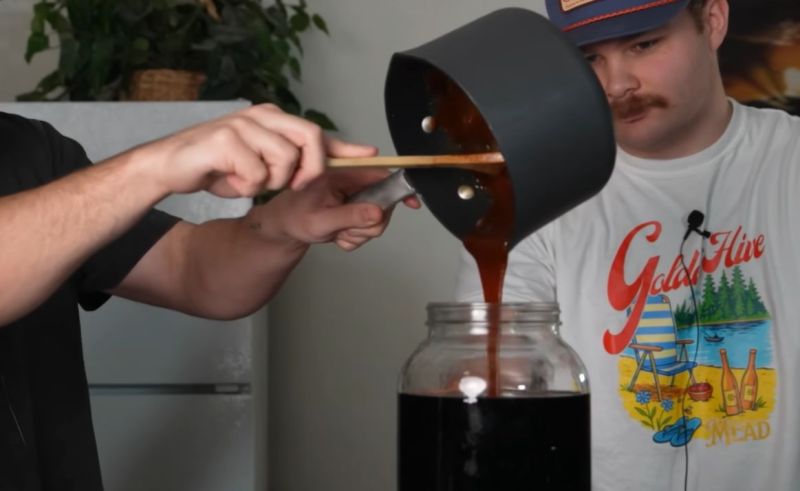
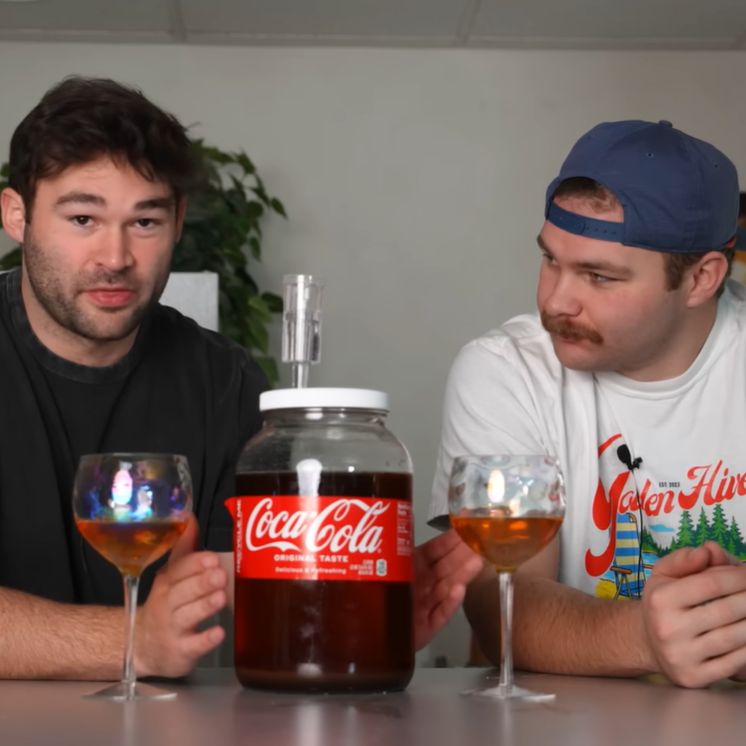
You can certainly just chug down that bottle of soda you purchased, but if you accept the premise that the preparation of food and drink is just a subset of chemistry, and that chemistry is fun, then it naturally follows that using soda as the basis for brewing up some mead makes perfect sense. Thus the [Golden Hive Mead] blokes over on YouTube decided to create some Coca Cola flavored mead.
Mead is essentially just water mixed with honey that is left to ferment after adding yeast, resulting in what is also called ‘honey wine’, with an ethanol content of usually between 3.5% and 20%. Since soda is mostly water and comes with its own supply of sugar for yeast to feast on, this isn’t such a crazy choice in that respect. Just make sure to remove the carbonation, as the CO2 makes the soda too acidic for the yeast to be happy.
Instead of straight honey, caramelized honey was used for extra flavor after which the brew was left to ferment for a while. For extra flavor notes aged oak, vanilla and cinnamon were added as well, to ensure that the fermentation didn’t erase those core notes of the coke. The result was apparently rather flavorful, with about a 10.5% ethanol content, receiving the full approval of both tame test tasters.












colour me intrigued
Most people can’t get it above 8-10% ABV because the conditions aren’t ideal for the yeast and the fermentation stops half-way through. Even if you remove the CO2, soda is way too acidic because of all the phosphoric and citric acid added to it. The PH is around 2.6 – 2.7 while the yeast would like it around 4.
You could remedy that by adding a bunch of sodium bicarbonate, but that has a side effect of making it taste metallic or mineral because of the sodium, so it comes out like wine mixed with flat club soda. You could then remedy that by adding the carbonation back, which makes it come out like a breezer/alcopop.
One tricky question in brewing is how do you get the drink to turn out sweet rather than dry, especially if you want to carbonate and bottle it. If the yeast is perfectly happy, it will keep consuming all the sugar until the alcohol kills it or it runs out. If it’s bottled up with leftover sugars, the CO2 keeps rising until the bottles explode.
Of course you could just add way too much sugar, so the yeast will kill itself with alcohol before it consumes all the sugar, but then you’re left with a drink that’s up to 15-20% ABV with off-flavors produced by stressed and dying yeast , and it takes forever to get there – or you get a stuck fermentation around 10% and end up with a drink that’s way too sweet.
If you want something moderate like 5-6% ABV that brews quickly, tastes clean and still has some sweetness to it, that’s harder to pull off without adding non-consumable sugars like lactose or dextrin, or artificial sweeteners like aspartame. What gives you non-fermentable sugars is roasting, which is what the caramelized honey is doing.
Filter out solids, clarify, sweeten to taste, pasteurize (killing any residual yeast), carbonate, bottle, cap.
If you didnt catch it, the answer to your overcomplication of ceasing fermentation is simply heat. Once you reach 55-60° C yeast dies. Easy peesy.
If you kill the fermentation, then you have to do forced carbonation. That’s an option if you have the equipment. If you don’t, then you have to do bottle fermentation with priming sugar to get the bubbles.
No, don’t try to do it with a sodastream – it just ends in a mess.
soda stream is too low volume and theyre poorly manufactured.
We use a 5 gallon corny kegs (~$50ea) set in kegerators made from used chest freezers. We pay $60 to fill a 50 pound co2 tank and get about 100 corny kegs per fill.
Yeah – if you’re in the soda wine territory, you’re basically brewing and storing it in a jar or a “borrowed” water gallon, or used soda bottles.
People will be tempted to try an carbonate their flat brew in a sodastream machine, but the sugars and proteins in the drink will foam up and the foam shoots out of the pressure release valve when you open it. That’s why they say carbonate water only.
If I’m going kill the yeast, I would actually boil it first – because the dead yeast drops out of suspension faster and you don’t necessarily need to use gelatin or clay to clarify it.
If it’s a “soda wine” – or similar “student juice” – I don’t think I would bother to pasteurize it for bottling, because it’s probably going to be consumed almost as soon as it’s done. For that point, I would brew it dry and high ABV anyways and skip the carbonation, then mix it with sugar and plain carbonated water at the point of serving.
Booking is a waste of fuel and a risk to flavor. You dont need that much heat to kill yeast. You just need to hit 55-60° C for a minute or two.
Despite a decent amount of fallout, if you want a nice clear product, bentonite is the cheap easy solution.
If you filter out the solids before heating you reduce the residual yeast flavor, prevent any risk of scorching, and minimize the amount of bentonite needed to clarify.
autocorrect ate my homework!
Booking should have been boiling.
You might want to hit 77 C to denature any remaining enzymes that might continue to break down sugars after the yeast has died. It’s basically simpler to just bring it to a boil.
If you boil it, you’ll boil off the alcohol.
Eventually, but that would take hours of boiling.
Hours…Just how low an alcohol content are you looking for?
If you get it to 100C, 99% of the vitamin ethanol is already gone.
Even at 20%, I doubt it would ‘boil’ at ethanol’s boiling point.
IIRC the Baptists tried to do some ‘science’ 40 some years ago, they were saying that wine added to sauce leaves too much alcohol for one of ‘them’ to consume.
Nobody has ever been able to reproduce their results.
Technically it won’t get to 100C until nearly all the ethanol is gone. How long that takes is a matter how how much heat you’re applying.
But the point is just to bring the brew to a boil so everything in it is dead and denatured, and then let it cool down. You’re not going to simmer it on the stove until the alcohol evaporates.
That’s correct. The mixture doesn’t have a single boiling point, but a “boiling range”.
If you heat it very gently, it’ll begin to boil at 78 C which is the ethanol’s boiling point, and the steam that’s coming off of it will contain more ethanol than water. If you increase the heat to boil it faster, the temperature of the liquid goes up and the resulting steam will contain more water than ethanol. That’s why you won’t make good moonshine in a hurry.
It’s easy – different strains of yeast eat different sugars. Some strains consume absolutely everything leaving you with a totally dry beverage whilst others can’t metabolise e.g. lactose (most if not all brewing yeasts won’t consume lactose).
For beer brewing, the mash temperature determines which enzymes are most active. Lower temps create more easy-fermentables wherease higher temps produce less fermentable sugar and starch molecules giving you a less dry finish – with the caveat certain yeasts will happily gobble these up still, these being known as diastatic.
Yep. Trouble is, for most of the sugars that yeasts won’t eat, people may not appreciate either.
Like lactose. Another common “bulking” sugar is pyrodextrin, which is basically roasted corn or potato starch. It’s not even that sweet, it just adds that slick mouth feel like you get from sugar. Yeast won’t touch it, and it’s also a bit difficult to digest by people, so you get beer s**ts out of drinking it.
Pyrodextrin is also the glue you lick on envelopes and postage stamps. Now you know why it tastes like that.
Artificial sweeteners have their own problems. The mouthfeel is all wrong. I did a lot of experiments with fermented apple juice and stevia, none of which were satisfactory. In the end, the most convenient way to fix it was to ferment out super dry, then add a little sugar to bottle carbonate, then add a splash of cheap fizzy soft drink (e.g “Sprite” or your local supermarket equivalent) to the glass right before drinking. This added enough sugar back to the drink to taste (and feel) right, while still preserving some of the fizz.
Of course if you have the hardware to efficiently force-carbonate the drink, filter out the yeast 100% or pasteurise, then you have other options. I was constrained by what I had in the kitchen of a student house. The intersection of “convenient” “cheap” and “doesn’t taste like arse” was apple juice, fermented out 100% dry, sweetened at point of consumption with cheap fizzy drink. Keep the old soft drink bottles to put the fermented juice into for carbonation, they are designed to handle the pressure.
Substitute Potassium Bicarbonate it has a similar alkalinity to sodium bicarbonate but lacks the salty/soapy, metallic taste, making it ideal for taste-sensitive recipes.
Or Calcium Carbonate – some people throw in eggshells to moderate the acidity. Works well for Pilsner beers, since these are traditionally brewed in hard water. Dunno what would happen with soda wine.
chalky, earthy, or bitter off-flavors
Potassium Bicarbonate is a better choice
Another suggestion I found is Calcium Hydroxide, which would drop the phosphoric acid out of solution as Calcium Phosphate, eliminating both form the solution.
Calcium Hydroxide introduces an earthy, astringent, or slightly bitter taste to foods
Yes, as calcium hydroxide, but it would all react with the acids and precipitate out.
I’ve made a lot of mead. I didn’t do anything special and averaged around 17% each batch.
I did leave it ferment for a long time. I have a second bathroom that for years was just mead storage. I left it to ferment on average a year before bottling it.
The trick is to use champagne yeast. Most yeasts can’t go above 8-10% as the yeast dies off. Champagne yeast on the other hand, can go a lot higher and by just leaving it alone for so long, it has all the time it needs to reach the higher percentages. Depending on the type of champagne yeast you can reach 15 or even 18%. The premier stuff I used should be able to reach 18% but I usually ended at 17%.
I found some yeast that I left in the bottom of a closed bottle 5-6 years ago. It didn’t turn to mold, but the smell is really funky. I wonder if it’s even yeast any longer.
I should pitch it and see whether it comes out booze or vinegar.
Common bread yeast can survive to 12-14%. It’s actually pretty hardy and vigorous in fermenting, because it’s been bred to survive and multiply quickly on bread dough which is mostly starch instead of sugar.
The problem is that it goes in hard and fast, causing the PH to crash down which makes a stuck fermentation at around 8-10%. It needs a mash with lots of nutrients and some PH buffer, which isn’t happening if you’re feeding it with plain sugar and flavor additives like soda.
Interestingly enough, some sources I’ve seen suggest, if you’re doing what is essentially a “sugar wash” you can provide the nutrients by adding more yeast. That’s because the yeast will cannibalize itself. No idea what that does for the taste of it.
The search term you want is “turbo yeast.” It comes in a packet with the buffers and nutrients already present. Just add sugar. It is used extensively by people who distill their drinks after fermenting. If you don’t distill, you might get some funky flavors, but it will ferment out 100% and do it fast.
Potassium bicarbonate is more common for this purpose because its taste isn’t quite so noticeable/offputting
My usual brewing supply stores don’t carry Potassium carbonates (E501), only Calcium carbonates (E170). Apparently it’s been classified as hazardous (too caustic) for home use in the EU, so they refuse to sell the pure stuff to private individuals.
You can get it from garden supply stores though, but I’m not sure that’s food grade. It’s probably mixed with other stuff.
But don’t you feel safe?
I’ve been around seriously caustic dust enough to know that you really don’t want that stuff in your eyes.
I can imagine some hapless fellow (me) carelessly opening a bag of finely ground carbonate and getting a good dusting on the face. Of course I should have read the MSDS before touching it, but who gives a s*** about that…
I can’t imagine you doing it twice.
Is ‘not to be put into eyes’ a good reason to ban things?
Are pointed sticks still legal?
English food tells me that spices not good for eyeballs are also, apparently, illegal.
Note that E501 as a category contains both Potassium Carbonate (PH 11.5) and Potassium Bicarbonate (PH 8.4) so if you’re buying from industrial suppliers, you get one or both in a mixture.
The difference is about how much CO2 it has been absorbing. The carbonate is slowly turning to bicarbonate on exposure to air, but then it can be reverted to carbonate by heating it. Kinda like slaked lime and burnt lime. One is mostly harmless, the other melts your skin off.
It’s not banned, you just need to be more “convincing” to buy it. It’s kinda like… you can’t buy a handgun from a supermarket, doesn’t mean handguns are banned.
Of course if you’re in the US, you can buy a handgun from a kiosk on the street while buying lottery tickets, right?
In comparison, Calcium Carbonate has a PH of 9.4 in a saturated mixture. Note that the PH scale is logarithmic in base 10. It means Potassium Carbonate at 11.5 is 21 times stronger than Calcium Carbonate on a linear scale.
The same problem would technically apply to Sodium Carbonate as well, but when they sell you a thing of baking soda they make sure it’s completely Sodium Bicarbonate so you don’t injure yourself with it by accident. In fact, being bicarbonate is the whole point of it: it gives off CO2 when you bake it, so it makes cookies puff up in the oven. The remaining carbonate is diluted in the mix, so it’s not going to burn your esophagus when eating the cookie.
You can, if you must, bake your sodium bicarb by itself into plain carbonate, and then proceed to spill it around your kitchen as you’re handling it.
In the same sense as, “Don’t look into the laser beam with your remaining good eye.”
Weirdly enough, I can easily buy all kinds of funky and laboratory or food grade purity chemicals from “discount” lab suppliers.
Though even more weirdly, most of them seems to be Dutch, but they’ll gladly sell me just about anything as a private individual.
Only thing I’ve personally noticed they’re not keen on selling to regular folks, is Hydrogen Peroxide at concentrations above 12%. But that’s most likely because high concentration H2O2 is a key ingredient in “satans mother” AKA TATP.
See also https://www.colawp.com/colas/400/cola467_recipe.html
I’ll buy it in a heartbeat, if someone decides to sell it. I have drank alcohol only twice in my life. Both times in college. Both terrible experiences, never touched it again.
But I really like drinking coke and soda. Its a guilty pleasure, they’re too sweet and clearly not good for you but they’re so fun to drink.
No.
This not meant for you.
It will be clearly worse than any other alcohol drink you can think of (Even Jepson’s Malort or Baijiu.)
It’s for Fins, Russians, Koreans, Irish, Wisconnies and other ‘professional drinkers’.
Protip: Germans bitch about soda being over-carbonated, too sweet and served with ‘rip-off’ amounts of ice on the good side of the pond.
They don’t understand that pouring soda over ice drastically reduces the carbonation and waters it down.
How stupid they sound.
Like an American redneck telling a frog that Lafite-Rothschild tastes bad when poured over ice and drunk with a straw.
Yes I just compared soda to overpriced frog juice.
Have you ever tasted Unicum?
Nope.
I did try Ratzenputz, it’s no worse then Jägermeister or Underberg.
All herbal stomach tonics, one that demonstrates the power of marketing.
Honestly haven’t personally tried Malort either.
As the saying goes ‘sewer rat might taste like caviar, I will never know.’
I did try Baijiu, as bad as they all say.
Barf essence in a bottle.
Long ago, one of my dad’s students brought him a bottle of the fancy stuff.
Still 90% there…wonder what a partial bottle of Moutai from 1975 brings…(packrat is genetic.)
Imagine.
Nice ripe Surstrumming warm w half melted Corsican maggot chesse (served when the first maggot pops, like a ripe boil), Malort chaser?
All while listening to Kraftwerk at full volume while surrounded by marching German ‘tauncers’ wearing only banana hammocks.
I’m a modern day Dante Alegre, visions of hell.
Come to think of it, all the bad alcohols around the world are just made of the cheapest available sugars and brewed or distilled to the highest ABV possible with the technology and fuels at hand. Then, in the attempts of making them palatable, people added herbs and spices to cover up the foul taste.
Meanwhile, beer, cider and wine, remain the drinkable alcoholic liquids because they don’t try to min/max the whole equation.
Someone’s never tried a cocktail like a properly mixed mojito or long Island ice tea.
Or the higher-end Alco-pops for that matter.
All of those can easily make you misjudge the alcohol content because none of them have a significant “alcohol like” taste to them.
A couple friends of mine wanted to make wine out of their huge strawberry patch. They used a three-liter soda bottle for it. Everything was going great, but their “reactor vessel” design failed to account for the production of yeast waste gases. I was never consulted on the project.
Seemed like every surface in that room was sticky for a long time after that. Smelled nice, though.
Stupid friends are endless fun.
I know from experience with CO2 bombs that plastic soda bottles give you tons of warning creaks before they blow.
That you’d be a fool to handle one the was creaking bad, you could easily end up short fingers.
FO like an Antifa tard that liked throwing flashbangs back.
Brewing stuff in closed soda bottles to hide the odors and smuggling them in and out of the house for a “burp”… you remind me of my youth.
It’s kinda like the baby egg project in school, except you get to be drunk when it’s done.
You can bypass the fermentation process by just adding rum to your coke.
But what fun is that?
I invented a drink.
‘The restraint chair’.
Jolt cola and 151 proof rum.
And yet you didn’t like Ratzenputz, Jägermeister or Underberg. I recommend Fernet Stock. It’s like Jagermeister for grownups. No sugar, just bitterness. It really cuts through the grease after a big dinner of pork knuckle and beer.
“receiving the full approval of both tame test tasters.”
He domesticated his friends?
Perhaps those are not the first tests that they are (forced to) taken. Kind of Stockholm syndrome, but with alcohool.
I’ve brewed fermented or otherwise converted every manner of sugar containing anything into home ethanol products. What I learned from mead is it takes forever. Like a year at least in primary then a couple years in bottle. Especially if you add herbs. It will taste like cough medicine for a really long time then eventually magically convert to ambrosia itself.
My fav is bone dry and sparkling (I artificially carbonate) and yep- you can use normal yeast first but then can re-pitch Pasteur/champagne yeast for the long haul. Overall the super long waits make it an occasional project compared to ….well anything else haha
What crappy low grade yeast are you using? Primary fermentation of mead typically takes 3-6 weeks, another 2-4 weeks for secondary fermentation and clearing
I cant argue with you on aging though. Many meads will peak at 24 months but many take 36-48 to reach their finest and finished form.
I think he’s just leaving it in the primary to age. There’s a whole debate about whether you should rack it or just leave it. Some say the dormant yeast is giving off bad flavors, others say it’s giving it character.
I was the assistant brewer and cellerrman for a microbrewery for a hot minute. We got second place at Strange Brew in Port Townsend WA with a Mountain Dew IPA “dry hopped” with Cap’n Crunch Oops Only Crunch Berries.
The trick was to just use the syrup, not the diluted carbonated product you get in cans or at the fountain machine. We dumped something like 27 boxes of the stuff into our hot liquor tank and sparged in with it. So the syrup was present at every stage of the brew process. It turns out that the two flavors in Mountain Dew are Orange and Ginger. The cereal’s only flavor was generic “berry’.
The yeast didn’t much like the adjuncts and shelf stabilizing chemicals in the syrup or cereal, and it took an extra day or two take off. Once fermentation got going the yeast at up most of the weird chemicals and took them with it when it fell out at the end of fermentation. Bonus effect was the acidity of the syrup scoured our brew system on the way through and saved us a cleaning cycle.
We wound up with a 7-8% citrus ginger IPA with a berry finish on the back end. It looked like hazy, cloudy pond scum but tasted amazing. It’d also keep you awake well into the night. I remember having two pints and laying in bed at 0130 wondering why I wasn’t snoozing away already. Oh right… caffeinated beer.
Our tag line was “We drink it on purpose”
Everything about that sounds like the forbidden cocktail of “hold my beer and watch this” mixed with actual knowledge and wisdom.
I love it.
Thanks for the anecdote. If you had a blog, I’d read it. Nice to see someone actually thinking about this beyond “hurr durr sugar + yeast = booze derp.”
I think there are some real gems still to be found in this space, but as you say, it’ll take some experimentation to find ways around the weird preservatives, shelf stabilizers and flavours that make sense in cereal or soft drink, but not adult beverages.
I’m here for the article title