
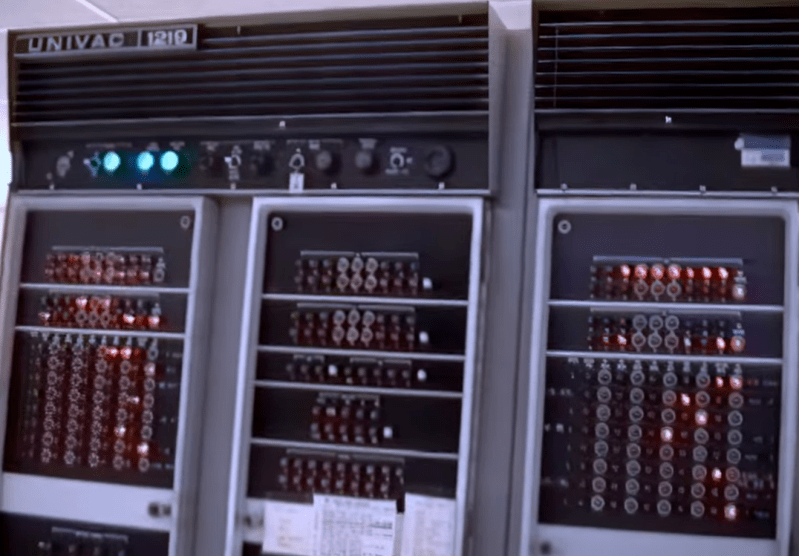
Have you ever wanted to see the computers behind the first (and for now only) man-made objects to leave the heliosphere? [Gary Friedman] shows us, with an archived tour of JPL building 230 in the ’80s.
A NASA employee picks up a camcorder and decides to record a tour of the place “before they replace it all with mainframes”. They show us computers that would seem prehistoric compared to anything modern; early Univac and IBM machines whose power is outmatched today by even an ESP32, yet made the Voyager program possible all the way back in 1977. There are countless peripherals to see, from punch card writers to Univac debug panels where you can see the registers, and from impressive cabinets full of computing hardware to the zip-tied hacks “attaching” a small box they call the “NIU”, dangling off the inner wall of the cabinet. And don’t forget the tape drives that are as tall as a refrigerator!
We could go on ad nauseum, nerding out about the computing history, but why don’t you see it for yourself in the video after the break?
Thanks to [Michael] for the tip!












Thank god no smartphone comparison! 🙂🙏
That being said, I couldn’t help but had to think of a line from a cartoon that said “speed is no substitute for common sense”.
And that’s right, because processing speed is not the only measurement of performance.
Some models of these dinosaurs maybe had interrupt driven processing, a special form of parallelism or simply a lot of interface devices that modern comsumer technology lacks.
That’s also why the Apollo AGC is very fascinating even by todays standards.
It’s not fast, but it’s mostly bug-free and reliable.
It has priority based processing of its progeam code,
which is fail-safe even when being overloaded with information.
A modern system would either stall, sliw down or reset if all the resources (disk, RAM) are exhaused.
Not so the old systems. They had error handlers installed to prevent this from happen in first place.
Modern embedded OSes use the concepts developed for the AGC and can handle similar conditions, if programmed correctly. Consumer stuff, yeah exactly what you said.
He mentions something about thinking “the wall would be there forever” so it must have been sometime after the Berlin wall came down. That would put the video in 89 or later.
They also talk about the Ulisses encounter with Jupiter (9:58), which was on February 8,1992.
This is 853 days after the Ulysses launch, so February 5 1993 if my math is correct.
Yes, was about to say that: you can read “Ulysses launch : 853 06:35:xx” at 13’03, so yes 853 days after launch on october 6th 1990.
What a wonderful tour! And what a pitty to imagine that probably quite a lot of these equipments have probably been trashed since then.
At 3:19 the setup with the two Diablo 31 cartridge drives and Modcomp II minicomputer has an identical twin on display in the museum at the Tidbinbilla radiotelescope outside of Canberra, Australia.
This other 1991 video from DSN (Deep Space Network) also worths a watch! https://www.youtube.com/watch?v=qPDy_cCVUWk
Thanks a lot! :)
Wow I had not considered how noisy a place like that would have been!
Also, I can smell it, just watching the video.