
Mobile devices generally have one Achilles’ heel when it comes to computing power: thermal throttling. Outside of bulky desktop and server systems, chips have to run at a fraction of their true potential to keep from cooking themselves to death. The MacBook Neo, with its iPhone-derived A18 processor, is no exception. Since Apple’s budget offering first came out, though, there’s been an arms race on the benchmark sites to see just how far you can push it, and [Salem Techsperts] briefly claimed the accolade of ‘fastest MacBook Neo’, and of course provided a video showing how it’s done.
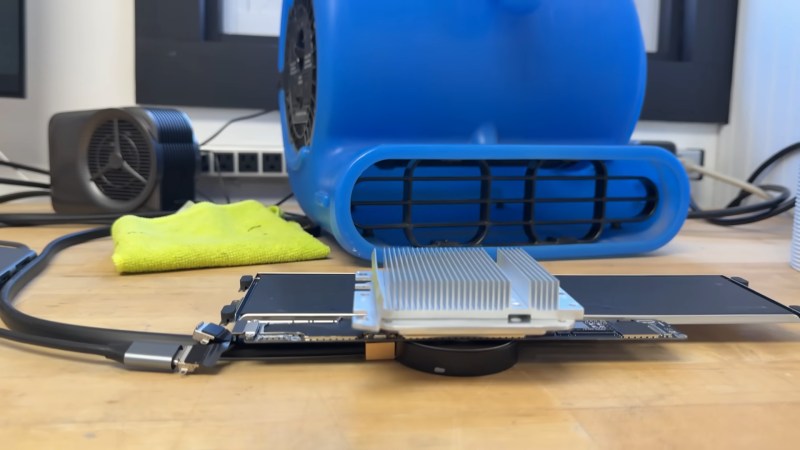
It’s hardly rocket science: you cool the chip. Outdoing Apple’s cost-cutting design in that regard is not difficult; you can evidently get notable performance increases just with decent thermal paste. [Techsperts] goes further than that, combining PTM7950 phase-change thermal paste with a peltier cooler to actively suck watts of heat out of the SOC, heatsinks that likely weigh more than the laptop itself, and an industrial air blower to serve as the highest CFM air cooler we’ve probably ever seen.
By this point it’s hardly a laptop anymore, with the logic board removed to sit inside a cooling sandwhich– water cooled with the peltier on one side, and air-cooled by the blower on the other–but the point wasn’t to have a light, practical daily-driver here. Apple already covered that. The point was to go fast. With 41.47% higher Cinebench scores than the stock laptop, and a power draw of 11W compared to the stock 4W, we can say he’s succeeded in that. Interestingly enough, [Techsperts] could not best the top 3DMark score, in spite of his Cinebench success. It’s possible he just lost the silicon lottery when it comes to the GPU section of this particular A18 chip, but if you have another theory, be sure to let us know in the comments.
Of course you could go colder. For all the absurd impracticality of this setup, it’s not liquid nitrogen cooling, which means there are still gains to be made-– we saw a Pi 5 clocked at 3.6GHz that way last year— and that just means the crown is laying in the gutter, waiting for anyone to pick it up. Unless they already have by the time this prints. In which case, all hail the cryogenic king, and please send us a tip so we can hail their glory.












If you look at the curve, this doesn’t make any sense. If it gains 40% of performance for 2.75x more power sucked in, it’s completely stupid to do that. Buy a second one, you’ll get 100% more performance for 2x the power budget. There’s a reason the manufacturer decide a regime to use its chip, and it’s selected for a the best performance/power ratio. Making monstrosity just to reach a 1.4x gain is pointless, it just prove the choice the manufacturer did was correct.
A hack doesn’t have to be practical, only interesting to the person doing it.
Must be nice living in a world where performance scale linearly.
TL;DR this is delusional.
I’m honestly disturbed by the amount of ‘macbook neo beats “windows laptops” (??) out of the water!’ comments i have seen on the internet. They always, always compare 300$ acer PoS laptops with celeron or i3 with 4GB of RAM. Always. Never a ThinkPad, never a Dell latitude.
And what they compare is almost always synthetic benchmarks and other random browser benchmarks. At most maybe the single core integer peak performance. Never multi core floating point sustained performance. Because they get mostly crushed there by modern x86_64 CPUs. Its kinda unfair to compare x86_64 with it’s variable length instructions to ARM with it’s nice and compact fixed length instructions. And thumb to double that even. Branch prediction is much more inefficient on x86_64 by is nature than ARM.
I must also complain, people say stuff like “wow Apple M* beats Intel and AMD! in performance and power efficiency!”. I mean if they ship 400mm² to 700mm² large pieces of silicon, they BETTER do. AMD and Intel must stop making CPUs with tiny 100mm² silicon pieces if they want to beat apple
I’m sorry but i can’t stop mentally considering ARM based PCs real machines until they can decide upon a standard boot process. And i suggest they do it quickly. I don’t want my PC to be an “appliance” but a tool. I want things to be swappable, software and hardware. I don’t want to depend on one manufacturer or vendor.
Rant over, i am at peace once again
I mean, that fits the long history of apple advertising. When they were still on PowerPC the ads would focus on some arcane stat comparing the # of CPU cycles for specific operations, completely ignoring any real world performance.
It’s why Apple products appeal to the idiots of the world.
Lack of common sense started in the 60’s and accelerated in the 90’s.
They made a good business out of crappy products.
My M4 based Mini is plenty fast enough for all my desktop work and consumes 6 watts of power.
ou’re absolutely right. An M4 can take an astonishing 30 seconds to launch Word, while my 2nd‑generation i5 system performs that task noticeably faster than that so‑called “premium” Apple hardware.
While its inconvenient for a tiny minority of hardcore IT-people who kill app process instead of just minimizing it, it makes absolutely no change for regular users. You also have to keep in mind that Apple manages to emulate entire x86 instruction set with a CPU that needs like 2-4 watts of power. Try emulating ARM code on an i9 and see if it’s doable at all without melting the IHS.
I was a bit curious, so I just tried – on an base M2 Air, I can launch Word in less than 4 seconds.
Note that MS Office on Mac supports Apple Silicon, so there is no emulation.
https://learn.microsoft.com/en-us/microsoft-365-apps/mac/overview
That’s the software’s fault. Why would a text processor need more than 1 second to launch on any halfway decent hardware?
Actually two: battery life.
I’ve got a Thinkpad X1 Carbon from 2018, with magnesia alloy case; A fingerprint magnet, but with a few heatpads, it runs full throttle at maybe 50°C on a desk. And it’s passive, silent, most of the time, the original having a reputation of being loud. Best mod i’ve made.
I remember when I first hit a thermal throttling issue – I had a circa 2002 Toshiba consumer grade laptop, with a 1 Ghz Celeron.
I can’t remember what I was doing – maybe playing a video, something I regularly did, but on a summer day in a not air-conditioned apartment, it started stuttering, I did some searching around, and determined it was throttling.
At the time, I was disappointing – to me, I felt like it should be able to perform at its top speed in the same temperature “envelope” that a human could.
For me now though, this makes sense – for most of what I do, these machines are fast enough – I’d rather have lighter, cooler, and longer running vs capable of peak performance at 30C ambient temperature.
Nice. Now we can see the leftover compute unutilised. 40% performance buffer is a good amount above thermal solution. Better than putting in a chip that could only each 5% gains with better cooling. Nice to see they didn’t over min max with the chip choice
Throughout history, there have always been adventurers who have wanted to be the “first” to do that which has never been done before: highest parachuter, deepest free dive, fastest motorcyclist/speed racer/pilot … Stuff to be written into the Guinness World Records Book. Money spent and numerous risks (even life) are second to the quest.
I applaud anyone whose mindset and pur$e allows for such adventures; It makes great reading. Stripping a Neo down and putting it through warranty-voiding punishment just for the fun of it DOES NOT need to be a reasonable pursuit for anyone else.
youtube 101 to create content attracting views. Do something not intended for an apple product, probably useless or stupid.
the plague of content creation
That headline image with the full size floor blower cooling the neo made me laugh.
The mor*n wasn’t even aware that the PTM7950 would lose its ability to do what it’s supposed to do if it re-solidified while being blasted with lower temperatures from all sides.
I hate tech “content” for the sake of content.
So the amazing performance the Apple M1-M4 chips has only lasts a short time before thermal throttling kicks in, and the performance bottoms out. It wouldn’t be the firs time Apple used misleading specs to sell hardware.