
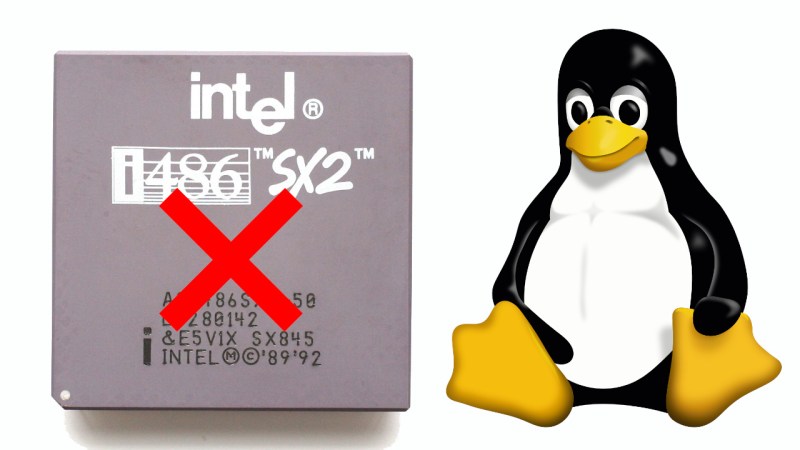
Although everyone’s favorite Linux overlord [Linus Torvalds] has been musing on dropping Intel 486 support for a while now, it would seem that this time now has finally come. In a Linux patch submitted by [Ingo Molnar] the first concrete step is taken by removing support for i486 in the build system. With this patch now accepted into the ‘tip’ branch, this means that no i486-compatible image can be built any more as it works its way into the release branches, starting with kernel 7.1.
No mainstream Linux distribution currently supports the 486 CPU, so the impact should be minimal, and there has been plenty of warning. We covered the topic back in 2022 when [Linus] first floated the idea, as well as in 2025 when more mutterings from the side of [Linus] were heard, but no exact date was offered until now.
It remains to be seen whether 2026 is really the year when Linux says farewell to the Intel 486 after doing so for the Intel 386 back in 2012. We cannot really imagine that there’s a lot of interest in running modern Linux kernels on CPUs that are probably older than the average Hackaday reader, but we could be mistaken.
Meanwhile, we got people modding Windows XP to be able to run on the Intel 486, opening the prospect that modern Windows might make it onto these systems instead of Linux in the ultimate twist of irony.












Really?
It’s linux, so someone will keep it running, even just for fun.
As for XP, I wouldn’t call it a “modern” OS any more and that it doesn’t natively run on the 486 while newer releases of linux do, there is nothing ironic there.
Hi, XP does run on a i486. Support for it had been added recently.
https://hackaday.com/2024/06/23/kernel-hack-brings-windows-xp-to-the-486/
Anyway, it’s not that surprising, since Windows 2000 still ran on 80486.
To be fair, performance isn’t exactly great unless it’s a late 486.
486DX4 or Cyrix/IBM 5x86C etc. Maybe NexGen 586, too?
It depends.. Latest XP updates are from 2019 (POS ready).
And there are Kernel extensions, such as OneCore API.
They allow running Windows Vista/7 era applications to run on XP, including DX10 applications.
With a different, PAE enabled kernel, XP Pro 32-Bit can use 64 GB of RAM (about 16 GB being safe maximum in terms of application compatibility).
Windows 98SE also has something like that, btw.
KernelEx with gdiplus.dll and unicows.dll allows running Windows 7 applications on Windows 98SE/Me.
The 32-Bit versions only, of course. It really works.
Useful for using more recent web browsers and media players, for example.
So a Pentium MMX laptop from the mid-90s can run a modern application, still, provided it doesn’t require certain CPU instructions.
Linux doesn’t have that kind of long lasting backwards compatibility, still.
I think i486 is being removed, rather ironically, because the 32bit x86 architecture is still somewhat alive and actively maintained: people do actually care about the code quality and the performance. There are many other fairly obscure or old architectures under the kernel’s /arch/ directory (qualcomm hexagon, hp pa-risc, etc).
That said, yes, the impact is probably going to be minimal, and you can try NetBSD instead if you absolutely want a Unix-style OS for your 486.
If the CPU has been the same for decades, why update the kernel? Just use an earlier version. Not sure why people think “no more updates” means “dead”. It could just mean “done”.
I think it’s because of dependencies.
One problem with Linux ecosystem is that everything depends on everything.
It’s like a star topology, basically.
So if you want to compile some little utility, you need about 20 packages of various software.
Stuff like a PNG library, Perl, Python, zlib, curl, etc.
But since they aren’t always backwards compatible, they have to be available in a specific version.
Too bad if that versions is outdated and nolonger in the reprository.
Then the utility must be modified or the old version must be built from scratch.
Which in turn again requires old, unavailable packages that are nolonger available.
Same thing might be the case with the Linux kernal, I guess.
That modern Linux software can’t be run on a 10 years old kernel out of box.
I’m not getting upset about this anymore.
Linux is the new Windows, except that it’s an even bigger resource hog now.
But I’m hardly surprised. The philosophy of *nix always has been that free resources equal wasted resources.
Makes me miss the times of Windows 98SE, though, which ran fully functional on a 486DX2-66 and 16 MB of RAM.
https://www.neowin.net/news/a-popular-linux-distro-now-has-higher-system-hardware-requirements-than-windows-11/
To be fair, maybe I should point out that 486 support never was really good in Linux land.
Some Linux distributions such as Mandrake skipped the 486 in favor of Pentium optimizations.
Considering how few 486 systems got the RAM they deserved,
starting with Pentium systems that had high-capacity PS/2 SIMMs and SDRAM made sense.
Also, there were Pentium level CPUs that could be used on 486 motherboards, such as Pentium Overdrive (POD).
So the 586 optimization was a reasonable decision, at least.