
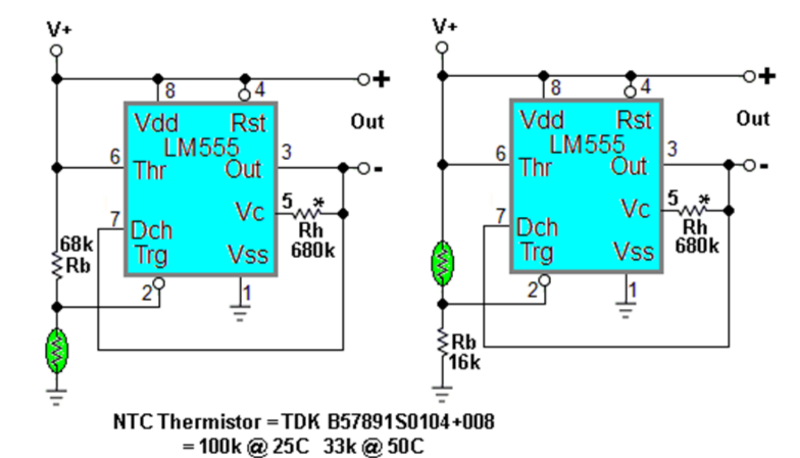
It is a running gag around here that whenever a project posts, someone will inevitably point out that it could have been done with a 555 timer IC. [Stephen Woodward] went the opposite way and built a simple thermostat using the ubiquitous chip.
To be fair, this isn’t some sophisticated PID controller — it’s basically a bang-bang controller. Since the device has a comparator and the circuits use a thermistor, it seems like a clever but simple idea on the surface. However, there are some neat tricks. For example, if you tie the 555 threshold pin to Vdd, then the trigger pin acts as an inverting analog comparator. Another nice feature: the setpoint depends on a resistance ratio, so there is no need for a precise input voltage reference.
A simple circuit change can switch the circuit to power a heater or a cooler. The chip can handle a surprising amount of power, but for some applications, you may need some output drive circuitry. The simple circuit even has hysteresis, which you can set with a different resistor. Pretty impressive for a cheap chip, two resistors, a thermistor, and a battery.
We’ve seen a lot of strange 555 circuits in our contests. We even had a 555 Timer Contest.












Meh, could have done it with two transistors. 555 is overkill.
Meh, could have done it with a bimetallic strip. Transistors are an overkill.
Don’t touch the damn thermostat
-every dad ever
“Touch that thermostat to make it warmer in this house and I’ll kill you where you stand.”
Every menopausal woman ever!
“please do! it would be a mercy”
Every henpecked partner ever!
Meh, could have done it by throwing more or fewer logs on the fire. Electricity is overkill.
Meh, coulda put on a sweater and drank hot rum.
Heating is overkill.
Don’t laugh. For some applications a bimetallic strip is the superior option.
For example… I have a tiny solar array. I don’t want to waste any energy because it is not very large nor very well placed, it only gets direct sun in the morning. It runs through a boost converter before the charge controller because otherwise it isn’t quite high enough voltage to charge my battery except during absolute peak sun.
Well, during peak sun that boost converter gets a little warm. I would like to put a fan on it. But I don’t want the fan using up what little electricity I get during non-peek times. So it has to have a controler of some sort to only come on when needed. And I don’t want that wasting my power either.
A bi-metalic strip uses no power when off. It’s just an open switch!
You gotta ask “who is the reference?”.
Using the 555 comparator section, the rail voltage is critical here – but not when it’s used as an oscillator.
Personally, a TL431 beats this circuit and is 1/10 the cost of a 555.
My kid wants to make everything with a 555. I keep telling him that a cheap arduino clone is actually cheaper than a 555, and you dont have to add passive components to set trigger points, or make a PCB…
I am actually an old school engineer that used to program microcontrollers using only datasheets and assembly. And I like understanding everything I am working with, unlike the blackbox crowd.
But if you are not making art, or have no other part around, then you get the most practical tool for the job, using the triangle of quality..
https://blog.hptbydts.com/project-management-triangle-time-cost-quality
(First link about it)
Let him explore, he is building a valuable skill, making what you can with what you have even if its not supposed to do that. The number of times ive saved the day or bodged a ‘good enough till replacement parts get here’ or my favorite cracking open this dig around my boxes for that and a sprinkling of desk clutter (scattered components from various projects or sacrificial/dead products) put to together and what do you get …. bibbidy bobbidy saved from the junkyard boo! Anyone can buy a microcontroller and plop some vibe code down, but the real skill is knowing where to find a certain kind of IC, and how yo hook it up exactly the wrong way to make it do what needs to be done ;-)
I second that.
As a second thought, I wish there would be more budget integrated chips, eh, pun intended, chips that would be integrating the best known/invented/tried chips innards on one die. I’d love to see something like quad op amp with FETs together with say Attiny85 and some kind of arduino on the same die. While I get it that those are completely different things, and I can assemble these myself on a soldering protoboard for not a lot in total cost, it just plain would be nice to have one universal chip that would potentially rival venerable 555.
Oh, and have some low-count LUTs to make looking up things directly easier without trashing static RAM, again, I can add these, too, older memory static RAM chips are dime a dozen, but still, would be nice to have around. A kind of universal hammer/drill/dremel swiss knife of tools on one die.
Many microcontrollers have fully analog op-amps available on some of the pins, and some even have a few FPGA-like logic cells on the same die, for when you need fast logic, or low-power logic that works even when your CPU sleeps. Not quite the all-stars package you had in mind, but pretty flexible.
Yep, rp2040/2350 kind of sort of came close to what I was looking for, state machines that are really registers that can run independently of the main CPUs, reconfigurable, etc. rp2350 is a neat hack, too, two reconfigurable processors, which is interesting take on flexibility.
One of the neatest chips I’ve played with was Cypress PSoC that had configurable opamps within, and those would link up directly to CPLDs and little LUTs, so that step in that direction was what I thinking of.
You might want to check out Silego/Dialog/Renesas GrenPAKs. No MCU, but essentially a few interesting analog chips + PLD + oscillators + sometimes other cool features (LDOs/half bridge/…). All I²C programmable
The Arduino clones are still quite a bit more expensive than a 555, but there are some microcontrollers like the CH32V003 and PY32F002 that are pretty close. Anything cheaper is probably going to be one time programmable.
I like it, it would drive a solid state relay with 300milliamp. the 555 is a weird chip in that it doesn’t really do anything cheaper or easier than you could do it with discrete components.
Worth noting that replacing the NTC with a photoresistor / LDR would make it “dusk” light controller.
I’m glad they didn’t get all boughey and replace the setting resistor with a pot. Of course, dad doesn’t need a reason to yell at the kids.