
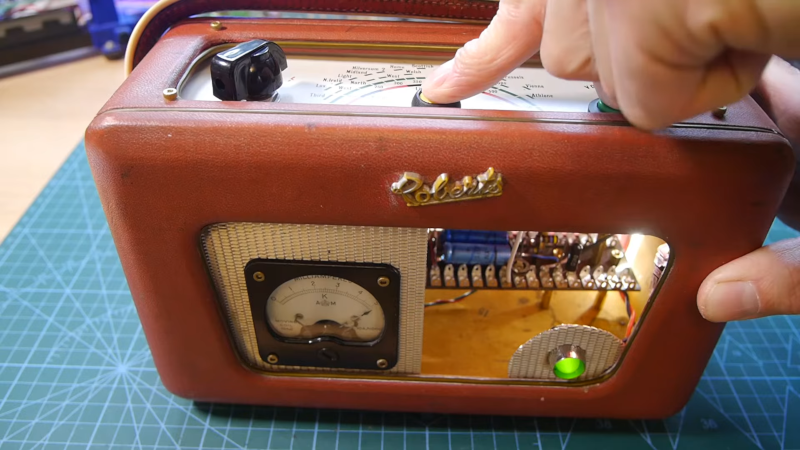
We’ve noticed a recent surge in people recreating old projects from vintage electronics magazines, and we approve. After all, parts and PCBs are easier to get than ever, so other than replacing obsolete parts, it is usually much easier to build these projects now compared to when they first appeared. The latest one we’ve noticed was [Anthony Francis-Jones’] build of the “Reactalyser” from a 1968 edition of Practical Electronics. Check it out in the video below.
You may ask yourself what a reactalyser could be. We did too. Our guess was extremely far off, since we thought it might have to do with reactance.
We liked the retro-look radio that [Anthony] used as a case. He changed the circuit to use an OC71 PNP transistor and replaced a mechanical part of the device with more electronics. So this isn’t a totally faithful reproduction, but it does keep the spirit of the device.
This might seem like an odd circuit for something that would be totally trivial to make with a microcontroller. However, these kinds of circuits were very common prior to simple-to-use computers.
If you like these old retro builds, check out some of the ones we’ve featured from [Bettina Neumryr]. We need a name for this activity. We’ll suggest retromagging. Give us your entry in the comments.












Al Williams thought “Reactalyzer” had something to do with reactance. However I initially misread the word as “Rectalyzer”…
Me as well at first glance. Helped explain the case color choice, I thought.
The chosen word is inevitable inviting to such misread / misspell :)
It’s a clickbait title. I clicked because I thought it had something to do with ReactJS.
Why would you think it would be anything to do with ReactJS? The cover picture is obviously related to an electronics project!
Reactal-laser? not interested lol
Would you prefer a rectal laser? I hear they’re popular with sharks.
Are they Ill-tempered?
Recta-lasik.
Why must I watch most of the video to find out what a “Reactalyzer” does? Had to wait until he showed the cover of the magazine and read the sub-heading to believe it might time a person’s reaction speed.
You are tough guy too. You did not leave even smallest hint what can be this damned thing. Here is mine: retemnoitcaeR
Right there on the screenshot: “Personal impulse reaction monitor”
So if you have an impulse to react to … wait. What?
+1 on how much of a bummer it is to need to stream video in order to find out whether the video even potentially holds any interest =:-/
Back in the 60s and 70s my dad used to collect that English ‘Practical Electronics’ magazine and ‘Electronics Australia’. Both had cool projects like the Reactalyser but the things I drooled over most was the PE ads for the super-cool Sinclair Micro-6 and Micromatic miniature radios, and later the Sinclair calculator kits. I still have some OC71s from back in the day (one I did the obligatory scrape off the paint), I really like his F-J channel for using these.
“it is usually much easier to build these projects now compared to when they first appeared”
I did run into a minor challenge finding the germanium power transistor to repair an elderly Heathkit power supply a couple of years ago. I believe I found it at an online electronics surplus shop.
I briefly looked into converting to silicon, but it seemed like a fair amount of modification would be required. It was easier to just keep typing… :-)
I’ve been playing around with electronics since the mid ’70s. Was digging around in my bin of Arduino stuff the other day, and most of these sensors are less than a buck. Back in the ’70s and ’80s if you could even get some of this stuff, they would have been like $1,000 a piece and the size of a desk. If you could even get them. And I just think that’s crazy cool!
The same year as the magazine (1968), my father was in grad school and needed a project for a physiology class. He and a classmate made an audio reactalyzer. That is, it measured the reaction time from a sound. It turned out that no one had done an experiment to test audio reaction times before. They even got published in a peer-reviewed journal.
I can remember testing my reaction time, just like the kid in the video. I was 6 or 7, so I have no idea how it worked.