
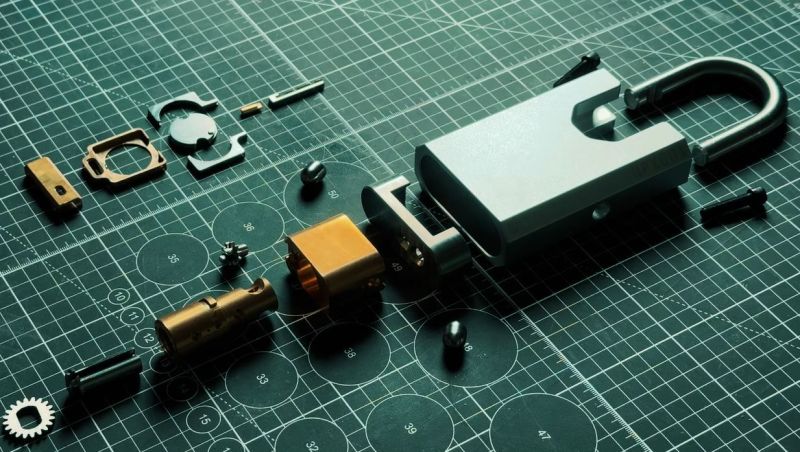

Throughout the centuries the art of lock-making and lock-picking have been trapped in a constant struggle, with basic lock designs being replaced by ever more complex ones that seek to thwart any lockpicking attempts, as well as less gentle approaches. When it comes to the very common pin-and-tumbler lock design, the main issue here is that the keyway also provides direct access to the lock’s mechanism. This led [Works By Design] to brainstorm a lock design in which the keyway is hidden.
The ingenious part here is that because the actual key is rotated away after insertion, there is no clear path to the pins. This did require some creative thinking to have a somewhat traditional style key as well as a way to turn the internal mechanism so that the key would be pressed against the pins. Here inspiration was drawn from the switchable magnet mechanism as seen with e.g. magnetic bases. This ensures the key and key handle can be detached and attached quite firmly.
After many 3D printed prototypes, a metal version was CNCed and subjected to some early testing by a locksmith, who even with having seen the CAD model of the lock was stumped. With this initial result and some user feedback in the bag, it was time for large-scale testing with more lockpick enthusiasts, as there are many more ways to open a lock beyond pushing pins. That said, a mechanism was also added to the lock to prevent bumping attacks.
The next testers were found in the Lock Pickers United community, one of whom raised the issue of an impressioning attack. With a couple of test locks on their way to said lockpicking enthusiasts it’ll be exciting to see whether this new lock design will set the standard for future locks or not.










I love this channel, and this lock is very cool as a concept, BUT…More than anything else, a lock in the real world has to be robust. I think this key is not (the magnetic haft is going to get separated and lost), the lock is trivial to destroy by over torquing or putting gun in the slot and rotating it. Again, nothing against this lock. I think it is very cool, but I don’t think it will ever replace more traditional locks.
i think locks are primarily useful for the psychological effect it has on would be criminals. it’s a surprisingly effective way to communicate phrases like “this isnt yours” or “stay out” and placing an inconvenient hunk of steel in your way. of course these are impotent in the presence of a diamond cutoff wheel or a shotgun and a breaching slug, or for the commando types, thermite. still you cannot argue their efficacy as a crime prevention device.
i want to see a lock that maximizes the psychological effects (not absent in a lock such as this mind you). not necessarily the one that would be the hardest to pick, but which makes the picker question reality itself to the point where you come to your shed the next day and find a criminal on the ground in the fetal position crying with lockpicking tools strewn around.
“diamond cutoff wheel or a shotgun and a breaching slug, or for the commando types, thermite. ”
or you know the more practical, swift hard kick, crowbar, or boltcutter solution.
Bolt cutters won’t cut a high quality lock, but a cordless angle grinder will.
“a high quality lock”
which 90%+ of locks people use ARE NOT.
Masterlock Contractors series boron alloy shackle vs 42 inch bolt cutters https://youtu.be/HYJLcA32mv0?si=LIplE96THEyPMwA8&t=129
Shrouded Masterlock with boron alloy shackle
https://youtu.be/TXQOO3RMXNM?si=hvRIhyekEMwvnJWS&t=177
Stanley 24/7 shrouded lock https://youtu.be/qKQYbNNQtBQ?si=hxP1ok-cQJoNdXJS&t=281 hardened molybdenum steel shackle.
You can defeat angle grinder with ceramic spheres encased in a cellular aluminium structure.
https://www.imeche.org/news/news-article/non-cuttable-material-shatters-bullets-and-turns-angle-grinders-back-on-themselves
Swift, hard kick you say?
https://youtu.be/ET9SNXpeORY
Yes, of course there are exceptions. But MOST doors arent a drug kingpins fortified reinforced steel framed monster. Most doors swing open with a well placed kick https://youtu.be/zwij_VG09Ws?si=YCelVmx8x4ZMQEop
Most front doors in Finland swing to the outside when opening. Kicking the door means you are not causing any (or very little) force on the lock or hinges. Most of the force is transmitted to the door frame.
Wow so in Finlind you just count on people being honest, since they can just pull your hinge pins if they want inside?
Residential front doors in most parts of the world typically open inward (swing into the house). This design keeps hinges secure from intruders, prevents the door from being blocked by snow or debris, and offers better weather protection.
simplest idea: smack the lock with any sort of sh.t. Make it smelly. Done.
Caution: If you try to pick this lock, it might pick your sanity instead.
Physical destruction is way different than picking. If you pick a lock, it’s extremely hard to tell the security was breached. If it’s destroyed, you know it has been.
It’s a prototype.
You can readily increase its robustness with replacement materials.
A pick proof lock isn’t impossible to break through: it’s just that breaking into it leaves a physical trace, which is important.
the sad thing is even the most well engineered lock can be defeated in seconds with a bit of thermite.
with the way the internet acts you would think this would happen every 15 minutes. With 2 brother, a father and a grandfather on the force, combiled they have heard exactly ZERO reports of thermite being used in a break in and have never heard another officer who had taken a call involving thermite.
As a welder, I can imagine far more ways applying thermite to a lock would turn it into a chunk of nearly permanent obstruction than being lucky enough to have it OPEN anything.
combiled=combined. Not sure what happened there
i think the bigger issue is the potential of accidentally setting the thing you are trying to steal on fire.
If the lock is stronger than what it locks, then you can also just melt or blast a hole in the thing that it locks. There is no point in using a tungsten lock on a plastic door for example.
This needs to be sent to LockPickingLawyer for analysis.
..what I came here to say. If you haven’t sent one to the LockPickingLawyer you are simply playing games, not trying to make an actual product…
The other thing with mechanical key locks is that it is sort of a solved problem with electronics instead. However, many of those are done really badly too – in reality.
I’m quite sure electronics make it harder to make a secure lock, not easier. It add a few whole extra attack surfaces. Software, electrical and electro-mechanical.
You need to translate the electrical signal into a mechanical one, which is likely the easiest to attack, for example: A solenoid can be bumped and activated with a strong enough external electromagnetic field.
Assa Cliq and Kaba Evolo are completely pickproof. You need the right key bitting and the correct digital code at the same time otherwise thr lock does not open.
Yes! Yes! I was wondering if I was going to have to be the one to post that! Yeah he’s got lock picking skills, ninja skills, MacGyver skills…..
Thank you old masterful one.
Oh masterful one. Not “old” sorry
unless you are old…. the, not sorry : )
A part of me was waiting for the lock smith to cut a section of drinks can and shim the shackle.
LPL would be who I’d send it to after sending it to some of the best pickers in the world. LPL is a good picker, but he isn’t at the level of some of the better pickers on even the lockpicking subreddit.
LPL is for gaining more normal people interest after ironing out the kinks in the design. Especially if he fails to open it.
Whenever I see a project with a magnet (big or small) I can’t help thinking about the iron particles that are around us everywhere and will cling on to it and never go away…
In a workshop where steel wool cleaning and metal drilling go on I have to remind people not to lay their cellphone or earbuds-headphones on the tables. Back in the 80’s one worker ruined their new walkman phones when shards worked to the diaphragm pulling it down to the magnet. I removed them with a sharp steel needle thru the grille. Magnetic flux concentrates at the steel point they stick to the point and can be pulled out. They left the phones on the dashboard though in the sun and the driver wouldn’t spring back up still buzzing. Heat from a hair dryer chocked down to hot fixed it. Nowadays it’s your phone and the steel needle trick still works. I’ve pulled slivers out of the tiny holes over the back speaker which seems impossible, ring volume goes up.
Very cool, but I suspect in the real world it would be removed just as fast as a far cheaper lock because thieves don’t pick locks, they just smash them, cut them, or lever them apart… or they attack the door/chain the lock is attached to if that’s the softer target… or they just go through a window or knock a hole in the wall…
It would be really interesting to ask the police how many crimes involve locks being picked vs some other method of attack/entry.
This type of lock exists, but I’ve only seen it in very rare safes. The operation is to insert the key completely into a hole, close the cover and open the lock. The key will be returned after the door is locked. The Forever Lock attempted something similar, where their latest iteration is overcomplicated. This is a great prototype demonstrating the concept, and it may stand the scrutiny of the lockpicking community. Mostly as the plastic pin will mash up, and likely result in the lock being inoperable after an impressioning attempt. I would like these locks to be more widely than just influencers. Where several lockpickers, me included, will certainly give it a run for its money. We have decoding strategies which work on very much any lock in a lab setting.
In case you are wondering if it is something new, I have a quote for you:
“Few self-respecting professional “inventors” have felt their mission to be fulfilled until they have “invented” a lock of some kind. Apparently there is a fascination in the subject which they cannot resist, however complete their ignorance of the past achievements and present development of the art, and so each incontinently proceeds to “invent” things which, while new to his untutored mind, are usually already well-known, occasionally in successful use, but more frequently long since consigned to the limbo of useless and discarded schemes.”
—Henry Robinson Towne, Locks and Builders Hardware: A Hand Book for Architects, 1904
Love the date on that quote. =)
You’re right that very little is truly new in the world of locks. That said, even after years of following the lockpicking community it’s always fascinating to see what ideas get rehashed or evolved. LPL looked at a pretty crazy Australian lock too that seemed fairly pick-proof, but as with all locks it’s all just a matter of finding that one (or multiple) weakness.
Not having seen this particular lock type before, I’m most interested in seeing it venture out into the wider lockpicking community :)
Two simple ideas for improvements:
The magnets in the tube are weak. If it is combined with a long tube, so the “shaft” part of the key is fully encapsulated by the tube when retracted, then there is no chance of accidental separation. It also obscures the bits from being photographed.
Add some extra gears, the place where you rotate the key is the same as where you insert it. This makes it easier to operate (Just insert and rotate). It also solves the On/off magnet part, because the “bits” are sheared off when the key starts rotating.
It’s a novel idea, but of course, a lock is only a deterrent to casual theft. It certainly wouldn’t survive a destructive attack. But can we talk about the quality of his video and animations? Those are really exceptional.
Great lock teaching lesson. Unfortunately nothing I own is more robust than the lock, but my intent is to slow the process down enough to be possibly interrupted or be interest causing
In a standard lock picking scenario you’re probing and picking the lock at the same time. In this case I think you could make a probe key for each pin (reducing the complexity to log2 of the number of combinations), insert them one by one, calculate the correct “combination” and fabricate the correct key. Maybe you could have a blank key as reference and then see how the lock responds to different “bits” set.
Picking insert/blank with pressure sensors? It exists? For this lock we need detachable one.
2^9 = 251 ?!?…. just double it while counting down 9 fingers, binary is not that difficult.
Lets say you have two keys — you bought a few of these locks — if you insert the wrong key into the lock and one of the pins drops below the sheer line, your lock is now permanently blocked, no way to remove that key, no way to push that pin back up to get the key out.
—
This design should allow for more combinations. Normally keys are limited, they can not go from one extreme position to the other. Since this key does not slide in, but rotates in from the side, more combinations should be possible, maybe.