
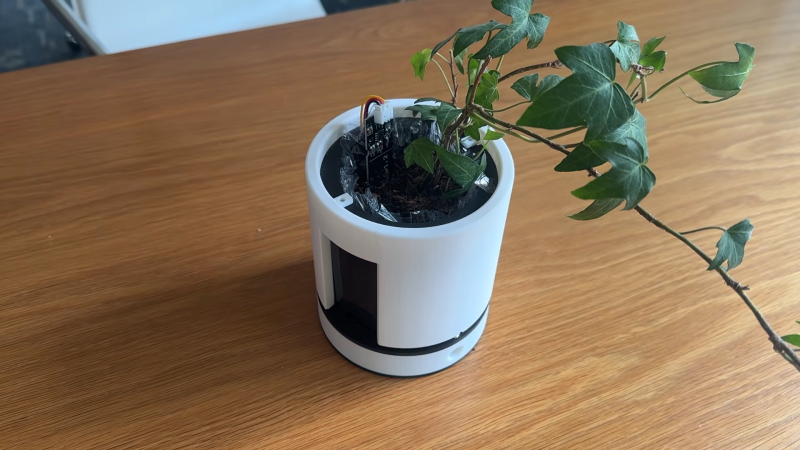
Keeping plants alive is easy if you’re diligent and never forget to check on your green friends. However, a little electronic help never hurts. To that end, [Narrow Studios] built a simple solar powered monitor to assist in plant maintenance, and it mostly does the job.
An ESP32-C3 development board serves as the brains of the operation. It’s set up with a capacitive soil moisture sensor, a great choice because they tend to last longer than other types. Power is courtesy of a small lithium-polymer battery and a solar panel, which keeps everything running off the juice from interior lighting alone. SK6812 addressable LEDs are used to show current soil moisture status. To avoid excessively draining the batteries with the limited power available, a HCSR505 PIR motion sensor is used to only light the status LEDs if the device detects someone in the vicinity.
There were some issues in the build. The voltage regulator doesn’t supply enough current to enable the ESP32 to jump on WiFi, so soil dryness indication is via LED only. The solar setup is a little weak, too. Still, the project was a great learning experience and with a few mods, would be even more capable.
We’ve featured some great plant monitors over the years, like this Hackaday Prize entry from 2023.












Baking paper almost works as toilet paper, so what?
When cat’s organism develops cancer cells, they have to be removed, not helped because they’re “so young” and “so creative”.
When doing solar powered devices, the rule of thumb is Average power = max panel power / 10.
In the perfect location near the equator you can theoretically get about 0.7 / 2 of the nominal power, so for a 1 Watt panel that’s about 350 mW as the sun tracks across the sky and goes down for the night. But because of cloud coverage you can expect around half of that again, and then not having the panel facing directly at the noon sun would drop that by half again, so around 90 – 100 mW is a realistic average.
That may be pessimistic, but it means you don’t need to put your panel in the perfect spot facing south without obstructions from trees and buildings.
It’s easy to forget that interior lighting is much less powerful than sunlight. Our eyes are evolved to work perfectly well on a heavy overcast cloudy day, so we don’t waste energy making artificial lights much brighter than that.
A solar panel outside in direct sunlight can easily get 100x more power than one inside under artificial lights.
So with this kind of project you’re probably better off forgetting about solar and investing your effort into carefully coding the ESP to make use of deep sleep. Or just using a power cord.
The difference is pretty big. A bright LED bulb is around 1000 lumens and that’s spread across all the surface area of the room. The sun puts out around 100,000 lumens _per square meter. The difference between full sunlight and fully overcast day is about 100:1, and between full sunlight and interior lights is around 1000:1.
In terms of solar panels, interior lighting is basically equivalent to near total darkness.
sigh
One of these days I will learn how the formatting on Hackaday works.
Power cords are a pain.
I made something similar based off one I purchased that has a button to light up an RGB status LED. It runs off a couple of coin cells.
For mine I just shoved a lithium cell in there. No solar, no micro, just comparators running a standard RGB LED. Initially the LED was always on, then I added a light sensor, then a PIR as per the OP. Also added a blinking red LED for low battery.
Works fine, needs a charge a few times a year. Could be longer if I used a lower power PIR.
There’s quite a range in current consumption amongst them. Panasonic have some that use about 1uA, while the typical hobby stuff (like what OP used) is 50-150uA.