
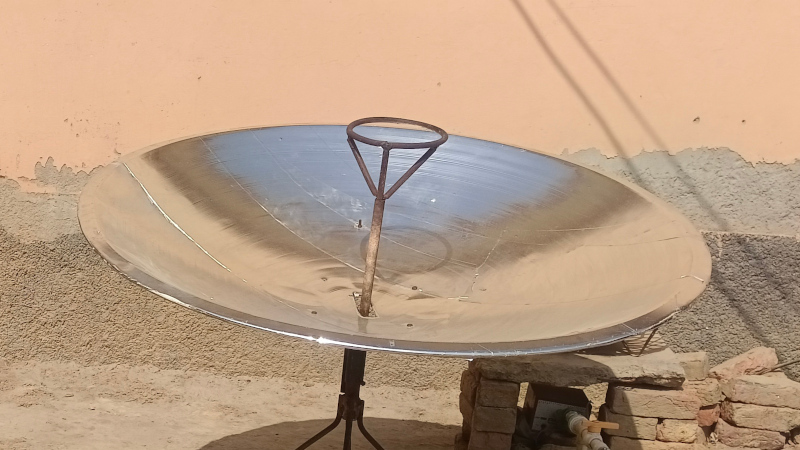
One of the problems facing any solar power installation comes in storing enough power for high-intensity operations such as cooking. The high-tech and expensive way involves battery banks and inverters, but [Solar Genius] is taking a more direct route by skipping the energy storage entirely.
A pair of parabolic antennas are pressed into service as mirrors, catching and focusing the sun’s energy onto a cooking pot. Of course, solar cookers like this are nothing new, so what makes this one different is the in-depth analysis of its performance. This thing can cook!
One antenna is covered in square mirrors while the other is covered in sticky chrome-effect mirror sheeting. They’re described as sun tracking, but since we don’t see any mechanism we’re guessing the tracking is done by hand. The experiment takes place in Pakistan, so there’s a plentiful supply of sunlight that those of us in more northern climes can only dream of.
This hack is part of our 2026 Green Powered Challenge. You’ve just got time to get your own entry in, so get a move on!













parabolic trough reflector with a black steel pipe running along its foci. Very cheap and easy to fabricate. Use High temperature heat transfer fluid pumped through and dumped into an insulated storage tank. Sun up or sun down, if you want to cook you direct the stored HTF either into pipes lining your oven box or stovetop “burners” with the HTF then being directed into a second insulated tank for storage or further heat scavenging. Solar troughs with HTF storage are good for cooking, refrigeration, home heating/cooling, and on demand power generation.
How many foci has your parabolic trough reflector? Is the length of the pipe limited by the length of the foci?
A parabolic dish has a single focal point as every parabola along its surface radiates from the same center point.
A parabolic trough has a focal line, comprised of the focal points of every parabola along the troughs length, as such it is common to refer to the focal line of a parabolic trough as the foci of the system.
The system is limited by the heat transfer fluids maximum temperature, the receptor pipe diameter, the flow rate, and the rate of thermal absorption. Scaling these factors to an ideal balance is where you see higher yields and efficiencies.
A 1 meter by 2 meter long parabolic trough will capture 1300-2000BTU/hr during peak solar. You can run them in series or in parallel according to your space and energy needs.
A 1 meter by 10 meter long trough will capture 15,000 to 30,000 BTU per hour (roughly 4.4 to 8.8 kW thermal) under peak, clear-sky conditions
Its a very scalable and simple technology.
What are those dimensions in real units?
Yeah BTU!
Boo meter!
FREEDOM!
Ah! Thank you, I read right past the word “trough”.
i agree with the description but the insulation / tank / pipe / valve / pump situation to actually make this practical can be a bit of a challenge
If you dont want/need 24/7 availability, for on demand use, you can use a closed loop valveless pumpless system, relying on temperature/pressure differentials to drive things, though a check valve and thermostatic valve add little complexity and a significant upgrade in temperature control.
Even a fully kitted out system is not that complicated compared to PV, BMS, batteries, Inverters, and wiring.
In Africa in the 70s they would use these systems to produce ice blocks for refrigeration in rural villages, Some of them used a second trough to heat a brick oven used for baking bread. These systems operated a much lower temperatures since they werent trying to maximize the thermal efficiency/capture.
In any case, fabricating a parabolic trough is simpler than making a dish.
Like this? https://x.com/DanielSMatthews/status/2047145622801965332/photo/1
I haven’t uploaded my work to github yet, it is a FreeCAD macro in python so fully parametric.
You want a much more shallow parabolic curve.
What you have posted results in a significant amount of material being mostly wasted.
I cant give you a graphic, Im not near my computer and just napkin sketching this out, but sticking to common materials
Polished sheet aluminum is easy to find in 48×96 inch sheets.
Please excuse my mixed units but Im American and bounce back and forth between metric and imperial fairly easily.
If you build a frame that has internal dimensions of 1m X 2.4384m (8ft),
and lightly crease your aluminum sheet 1 inch on both of the long sides the resulting parabolic arc would have a depth of 0.2049 meters and a focal length of ~0,305m or 1 foot in ametrican.
Cutting a matching parabola into bracing struts along the trough and using an appropriate adhesive to affix the aluminum sheet will solidify the trough, prolong its useful life, and make repositioning/tracking to extend useful hours easier.
A reflector of this size can capture 3,800 to 5,200 BTU/hr under peak solar conditions. That should be sufficient to heat a 25cubic foot oven from 75-350F (24-177C) in roughly 30 minutes to an hour (possibly faster with good insulation and a well designed heat exchanger). That would give you enough capacity to bake 45-60 loaves of bread over the remaining 3 hours of peak solar (assuming 4 hour total with no tracking adjustments).
A similar system designed with refrigeration in mind could produce up to 125 pounds of ice during the same 4 hour period.
It is a parametric macro, you can dial in any sky-view angle you like. i.e. The geometry is fully controlled numerically.
Being on my phone I was only able to view the screenshot. My comment was based on the example shown being a poor design choice. I dont need an AI generated freecad macro to design a trough reflector. Its incredibly simple. But thanks for vibing for those who do.
You don’t understand what you are looking at, the geometry is determined by the sky angle that you want to cover. These designs are placed with the long axis running east-west and the aperture determines the output over the entire year if they are in a fixed installation, they are aimed at the noon sun altitude at the equinox. You can’t tell me otherwise, I have a version of the code that does full ray tracing.
Years ago I made a solar water heater for a large paddling pool, a few lengths of microbore copper pipe in parallel, for flow rate, stuck to an old car bonnet, all painted with magnetic blackboard paint, it’s what I had to hand, and the metal particles probably helped too, a wooden frame held a sheet of glass over it to trap the heat. I added a water pump, it worked pretty well.
Ah! Thank you, I read right past the word “trough”.
http://www.dusoleildansnosassiettes.com/content/22-tubes-solaires
Ironically, at the same time hams are buying cheap parabolic solar cooking reflectors to make aerial dishes!
This was one of my middle-school science projects. It’s more difficult than it appears. Geometry is everything.