
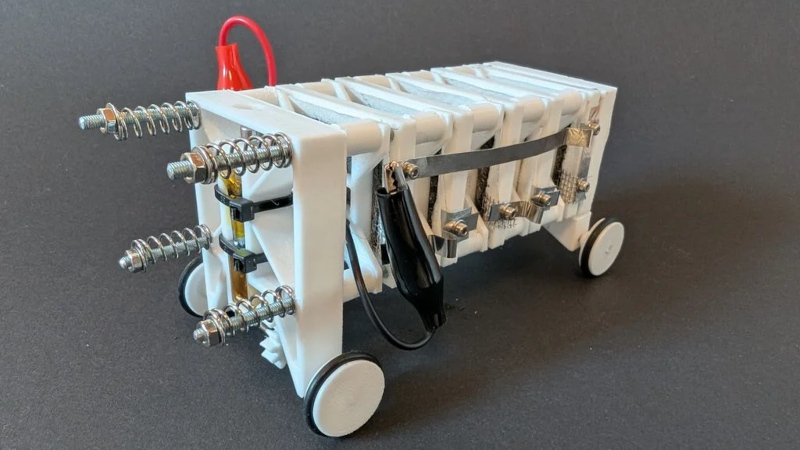
Zinc air batteries have been a familiar sight for decades in the world of photography, where they provided an environmentally less dangerous alternative to mercury cells. They operate by the oxidation of metallic zinc using air, and the zinc comes in the form of a paste spread between two electrodes. Can their astounding energy density be harnessed for something useful? [ZollerLab] has designed a zinc air battery to find out, and is using it to power a rudimentary model car.
The video below is in German so you’ll have to enable translated subtitles if you’re an Anglophone, and it’s very long. But it goes into extreme detail on the chemistry, construction, and constraints of a zinc-air battery, and describes the system in this design. It’s a stack arrangement, in which the cells are held together on threaded rods, and pushed into each other with springs.
We think the car model is intended to demonstrate that this battery chemistry might one day be used in automotive applications. It’s not such a far-fetched idea given the low cost, relatively low environmental footprint, and high energy density, indeed we’ve heard of similar experiments with aluminium primary cells. But in this case we can see it provides the hacker with another route for their experiments, and that’s no bad thing.












It’s worth mentioning the reason mercury batteries were used is that they maintain a stable 1.35v for most of their life. That way light meters didn’t need a reference circuit. Zinc air is about the same voltage and flat-ish. The other solution has been silver-oxide cells which also run flat and a way to adapt the higher voltage.
Are there zinc replacements for all the common mercury cells at this point? I have an old match-needle camera (Canon FTbn; rugged like cannon, loud like cannon) which was retired due to trouble getting batteries; it’d be nice to revive it.
As I understood it, the downside of zinc/air was that once unwrapped they had limited life; the reaction ran whether they were in use or not, or something like that…
They have a limited shelf life because of drying out, or trapping CO2 as a side reaction. The electrolyte reacts to produce potassium carbonate which would eventually deactivate the cell, if it doesn’t dry out before that. I’m not sure if the commercial cells employ a CO2 scrubber or some sort of selective membrane in the battery casing. The potassium hydroxide is also hygroscopic, so in humid conditions it can also flood the cells with excess water and the water balance can go either way.
Zinc air cells that are dried have an unlimited shelf life, but have to be activated with water before use.
Perhaps removing the CO² and water by pulling a vacuum?
The CO2 reaction is not reversible, and you want the water to be there.
These cells may be manufactured dry and then you add water to start it. Pumping the water out again would probably do something bad to the mechanical structure of the cell.
Note that zinc-air batteries are readily available in large formats for things like railway signal lights, roadway construction beacons, agricultural electric fences etc. etc. You can buy one for not much money if you need a very large capacity single use battery. A 6 Volt 50 Ah cell costs about $18.
They were once proposed for vehicles by pumping zinc slurry in and out of the battery at charging stations, then recycling the slurry in a chemical reactor at some central location. The idea was deemed as possible in theory but practically infeasible because pumping the caustic slurry is difficult and dangerous, and the cost of hauling it around for recycling would have been prohibitive.
https://www.nature.com/articles/s43246-024-00662-6
Review article: “Mechanically rechargeable zinc-air batteries for two- and three-wheeler electric vehicles in emerging markets”
… and there I was hoping for a battery with a crank, wondering how the mechanical to chemical energy conversion could be done (using intermediate energy forms — heat, electricity — would be cheating)
My solution to the (PX35?) mercury battery issue was the MR-9 adapter from criscam. Lets you use an SR44 silver oxide cell, like all your other cameras do. Well worth the cost.