
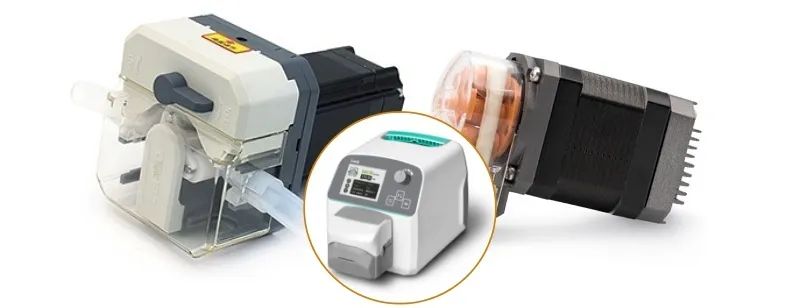
Peristaltic pumps are a very simple and effect device for transferring fluids without said fluid ever coming into contact with any part of the pump mechanism. At their core they involve a mechanism squeezing fluids through compressible tubing, but there are various implementations of such a mechanism that all have their pros and cons. In a recent article by [T. K. Hareendran] over at EDN these types are discussed and when you’d want to pick one over the other.
Also known as a roller pump, these positive displacement pumps have been known since the 19th century, finding uses in industrial, medical, research, agriculture and many other fields. Each of these fields have different requirements with the use of a peristaltic pump as a dosing pump being a specific application whereby e.g. a stepper motor can be used to provide exact dosing.
For industrial settings the typical rollers that compress the tube are replaced with shoes that provide higher pressures and endurance, with overall a bewildering number of motor types and tubing materials available. Depending on what your project needs, you may opt for continuous flow, fine control over dosing, the ability to reverse the flow, etc.
Unless your project is particularly rugged, a roller-based mechanism should be fine, while silicone tubing is great for biocompatibility and PVC is a cheaper tube material option. If you intend to transfer certain kinds of chemicals that will react with each of these there are some more exotic tubing options available as well.
We have previously covered projects that use a peristaltic pump for rather interesting things, such as DIY pharmaceutics, in a home-grown flow battery, not to mention creating DIY peristaltic pumps from first principles.












I learned the hard way that pump tube is important for high viscosity materials. When the roller moves the material, stiff tube can suck the viscous material, whereas flexible tube struggles, resulting in low volume delivery.
Here is a view of pump at 4mins, https://vimeo.com/258691871
You can also try pumping from slightly pressurized container.
The type of tubing is also very important if you are hoping to minimize contamination or algal growth. I work with autosamplers to take environmental samples for chemical analysis and the pump tubing is $300+ per meter as it is platinum sputtered silicone on the inside to minimise trace metal contamination by sample water.
“platinum sputtered silicone”
Never heard of that one. You sure you arent talking about Platinum catalyst cured silicone? Pretty common to medical, food, and lab applications.
Google doesnt seem to have ANY reference to Platinum Sputtered Silicone.
First time I saw one of these pumps was in Key West when the marina put in a new one for black water (sewage) pump outs in 2006. The tube looked like 3″ radiator hose but it would break seals and warp tanks if you didn’t have them vented.
On the other end of the GI tract… There were folks in the micro brewing community making their own a while back in an effort to avoid “yeast chop”. The vanes in a pump can break up the clusters of flocculated yeast after fermentation, which of course throws off the flavor. This is more of an issue with “yeast haze” beers where the done yeast stays suspended instead of completely falling out during cold crash.
The easy way to avoid this is to use CO2 or gravity to move the beer around, but some folks are constrained by space. Which led to interesting designs using spring loaded cams and bearings inside PVC pipes, or simpler ones with heavy casters running around the inside of metal trashcan.
We just dealt with the chop and said it part of the flavor profile of our beers. If we had preference though, we’d have gone with gravity for the simplicity.