
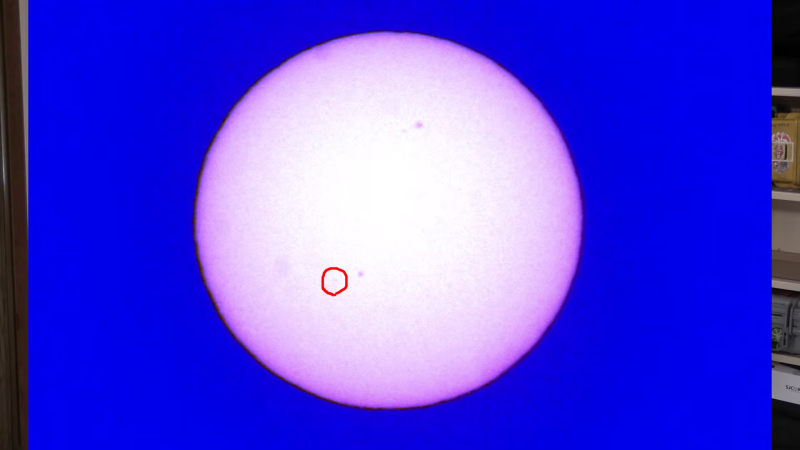
There are plenty of photos of the International Space Station out there on the Internet, but taking your own from ground level is a special challenge. [saveitforparts] recently decided to attempt this feat using a $15 thrift store lens.
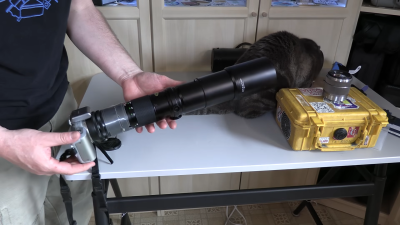
The cool thing about the digital photography revolution is that there is a lot of old film gear that can be had for cheap. In this case, [saveitforparts] found a 400 mm Sigma XQ lens with a 2x teleconverter for just $14.99. Paired with an adapter, it sat nicely on a Sony NEX-3 digital camera, ready to try and capture the ISS as it passed overhead.
But as you might imagine, aiming at the space station is not a point-and-shoot job. N2YO.com was used to figure out the best time to try and capture it. [saveitforparts] was able to capture the ISS as a white dot as it passed over, but couldn’t quite get enough zoom to really see the Station in detail. He was able to repeat the feat with a Canon camcorder, but the image was still pretty blobby and didn’t show much. Later attempts involved capturing transits as the ISS passed by the Sun, though the orbiting complex mostly appeared as a small speck.
[saveitforparts] did technically capture the ISS, just not closely enough to see much beyond a dot. It’s not the first time we’ve seen this attempted, though! If you try and capture the ISS with something truly ridiculous, like a Game Boy Camera or Kodak Charmera, you are honor-bound to tell us on the tipsline.












This is good work, but to me this isn’t so much a story about a guy imaging the ISS with a bad lens. More like, “guy gets very good deal on a nice old lens, and photographs the ISS with it.” The fundamentals of optics haven’t changed much in the past 50 years, and glass that was good in the 70s is still good today.
I think that the invention of nanocoating is within the last 50 years, which has made possible much better lenses.
There is also the material science of the lenses themselves and the computerized grinding, and the computer modeling that has improved I think.
And a lens consists of many elements that have to work together, so it’a a bit of a balancing act, one that is so much easier to do with the right software I imagine.
It’s actually amazing that they could make such good lenses in the old days when you think about it. And rather.. let’s say.. odd, that the prices did not go down a few factors.
There’s been advancements, but it’s a bit like how 3d printed titanium makes possible much more advanced mechanical designs than earlier materials and fabrication. It doesn’t mean all old designs have been superceded, especially when many designs aren’t aiming to be the best, they’re aiming to balance a bunch of different needs.
Example: I understand the k-mount version of the Pentax M* 300mm f/4 was first released about 45 years ago / 1981 using extra-low-dispersion glass which I think had been used in camera lenses for maybe 10 years at that time. This nearly 50 year old lens is still highly desirable because as far as I know, no-one has yet released a competitor which manages to beat it in both image quality and compactness at the same time, only one or the other.
Photographing is is challenging with any lens. I have been trying for nearly 3 years.. If you don’t drive you will find there is about a 0.75s window every two months or so. My dslr can only get 3 or four shots out in that time and everything has to go perfect, no upper atmosphere ice, no clouds, your watch or phone time is correct, the site you used to find the transits is correct, etc.
Any tips from those that have succeeded would be appreciated – eg setup/setings/routine
TIA
Those are some astounding details that I did not even think about, yeah that does all seem quite challenging.
Thanks for your post, interesting stuff.
“The lens is so big it has its own tripod mount.” yeaaaaah, that’s basically all large zoom or long prime lenses
It looks rather like something use to “relocate” the ISS.