
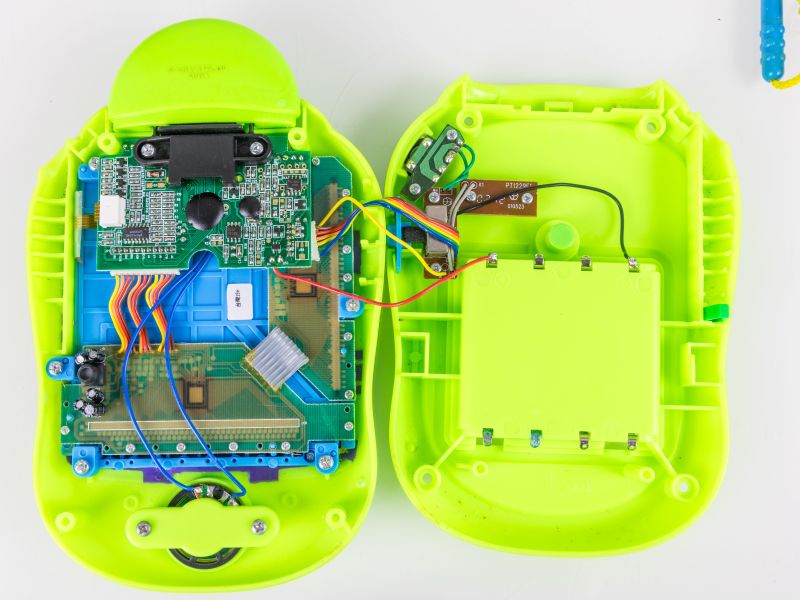
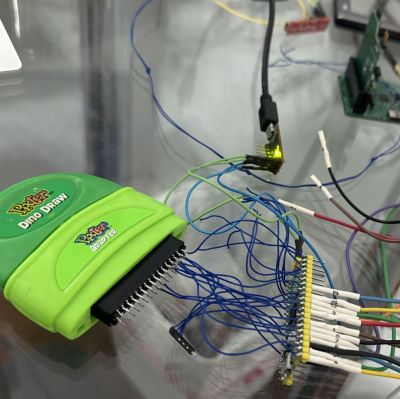
 Between 2000 and 2002 the Fisher Price Pixter was sold to children as an educational handheld toy with a touch screen that enabled drawing and listening to music in addition to cartridge-based games and more. It was followed up by multiple new iterations of the system, but as an ecosystem didn’t last beyond 2007. This has left much of the system in obscurity, with people like [Dmitry] doing their best to reverse-engineer, dump and document what they can, such as recently for the entire range of Pixter devices and most of the games.
One of the reasons why [Dmitri] got interested in the second-generation Pixter Color originally was as a potential PalmOS porting target, which gives somewhat of an idea of how these devices were meant to be used.
With absolutely no remaining known official documentation on how to develop software for the hardware reverse-engineering posed somewhat of a challenge. Fortunately this was made somewhat easier by the Pixter Color using the ARM-based LH7541, but worse by just how much of a minimal ARM7 implementation the SoC is. This was meant to go into a cheap-ish kid’s toy after all.
Where things got wild was that the firmware implements a 16-bit stack-based virtual machine, possibly due to initially having selected a completely different SoC. From here things get even crazier with how audio output is implemented, with [Dmitry] descending into a long-winded rant on this and all the weird things encountered during reverse-engineering.
After the Color Pixter its Multimedia sibling with slightly better SoC was also reverse-engineered, as well as the Classic device that started it all. This particular device uses an 8-bit VM, but a black-blob 6502 processor, which is rather astounding for a 2000-era device, but then again it was meant to be a toy.
In addition to getting a lot of reverse-engineering woes off his chest, [Dmitri] also details how he reverse-engineered and dumped the cartridges, as well as writing emulators to ensure that the Pixter legacy will endure, for better or worse.
Top image: Pixter with opened case. (Credit: Raimond Spekking, Wikimedia)









Children’s do not have buying power … so therefore it wasn’t sold to them
Engrish Amma right?
even worse:”This particular device uses an 8-bit VM, but a black-blob 6502 processor” -I assume this is supposed to read that it DOESN’T use an 8-bit VM(like the other Pixters do, I guess) The real find here for me is dmitry.gr. I can’t wait to read “Linux on a 4004”!!
Great work! Always a pleasure to be linked to dmitry.gr
It seems like all the cool toys were made 2010 and before!
If I were king of the world, wrestling and car toys would be banned, spaceship toys federally funded–and the individuals behind Skibidi Toilet toys executed.
And cool toys with LCDs required to have Flash-based non-“black blob” MCUs.
Regarding the usage of audio PWM0/PWM1, maybe the speaker was initially connected directly to the PWM pins?
Then you would get bipolar waveform to the speaker by using the two PWM pins as described.
I have one of these I was saving for a future R-E adventure (or usage after someone like Dmitry comes along and does it for me). While I was cleaning up, I accidentally dropped some tool (needle-nosed pliers?) and put a big gouge right in the middle of the touch screen! 🤦♂️
I think the LCD is still good, and the ts might even be good, but using it would be pretty distracting. I’ll probably still check out the writeup, though. Thanks, Dmitry!
Sorry to ruin the RE for you. But I do have some extra BEX chips on hand. If you decide to pursue running code on yours, LMK and i can mail you one or two. with that, my docs, and a nor chip, it is easy to run 6502 code on them