
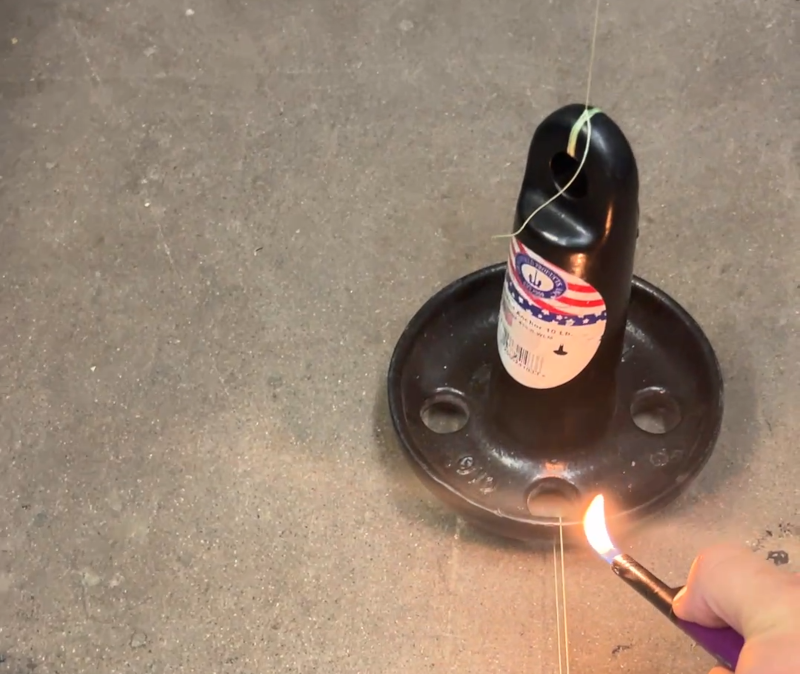
You’ve probably seen a Foucault pendulum in a museum. This Victorian-era science demonstration is named after physicist Léon Foucault and shows how the Earth rotates compared to a pendulum moving in a fixed plane. [RyanCreates] shows you how you can make your own, and it is surprisingly simple.
All you need is a heavy weight like a small mushroom anchor, fishing line, and a swivel — all things you can pick up at any sporting goods store. You’ll need a way to suspend it all, such as an eye hook in the ceiling.
In addition to the mechanical parts, the build calls for a camera to record the results and a lighter or other source of flame. The reason? To release the pendulum, you burn a thread that prevents it from swinging. This allows for a clean release with no sideways force.
The amount of your rotation depends on your latitude. At 33 degrees north, for example, you can expect 360*sin(33)/24 or 8.17 degrees per hour of rotation. [Ryan] measured a somewhat larger number, which was probably due to an error source, especially since he is measuring the angle using captured camera frames in Photoshop. That has to introduce some error, and small pendulums like this are incredibly sensitive to errors.
If you try it and find the source of the error, we’re sure [Ryan] would love to hear from you. Museum pieces are typically much larger, have ultra-low-friction pivots, and use electromagnets to keep the pendulum moving since, after all, even a Foucault pendulum can’t run forever.












it measures a sidereal day, not a solar one, so i would expect the denominator to be 23.93 instead of 24. that gets us to 8.19. i’m not sure but i suspect the oblateness of earth doesn’t matter. But the real problem is just, like the article says, you cannot do an accurate measurement that way. A small number of degrees is relatively hard to measure any way you slice it (in my work shop anyways), but your best bet is going to be to include some sort of marker on the pendulum…a dribble of sand or similar, so that the path is clearly and repeatably (and repeatedly) marked on the ground beneath it. also of course a larger numerator (waiting more than an hour to measure)
if you’re absolutely determined to use a camera, the gold standard is to set your camera up beyond the perimeter of the swing, and center the camera until the pendulum is only getting larger and smaller, not moving sideways at all, and mark the camera position on the ground, then measure the arc of the camera’s motion. might help to mark a circle at a known radius before it starts swinging, to help you position your camera
Why not put the camera in the pendulum itself, pointing down at a marked circle on the ground?
Camera, weight, and laser pointer
you could also measure with a precision thermometer, but you would have to use Planck’s law to convert between radians and degrees
You had me at “sidereal day”
I think it might be due to the string elongating a bit while in motion, due to centripetal force and variable pull of the mass.
That would come down to the kind of line he’s using. The website says it’s Dyneema, which isn’t supposed to stretch much (3-4%) so maybe the braid is shifting?
There was a youtube video I watched a while back about capstan winches/joints and that guy ran into similar issues trying to use bank line or other low or “no” stretch fibers.
“I gonna swing from the chandelier”. We can do physics without much equipment.